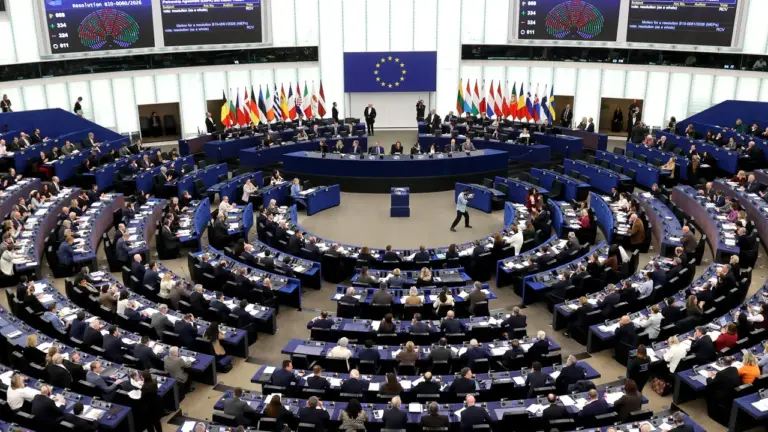
The European Parliament has today asked the European Union to activate the so-called “blocking status”, which protects European citizens and businesses from sanctions from third countries, with the aim of defending the International Criminal Court.
© FREDERICK FLORIN / AFP via Getty Images
25/11/2026
by
Lusa
O Parliament today called on the European Union to activate the so-called ‘blocking status’, which protects citizens and businesses on European soil from sanctions from third countries, to defend the International Criminal Court.
This request is in a report adopted today in plenary session of the European Parliament (EP) in Strasbourg with 438 votes in favour, 168 against and 38 abstentions.
In a statement, the EP stresses that the international justice system is under “unprecedented threats”, referring to the sanctions imposed by the United States on the International Criminal Court (ICC), but also to UN mandate holders and non-governmental organisations.
In this context, MEPs argue that the European Union (EU) should adopt a strategy to protect the international justice system and that includes “updating and activating the blocking status to protect European operators against the extraterritorial effects of coercive measures taken by third countries”.
“ MEPs note that US sanctions have created a climate of apprehension between banks, insurance companies and European digital service providers, leading to an excessive zeal to comply with sanctions that hinder payments and essential services related to international justice,” the institution said.
The EP also calls on the European Council to include the Rome Statute – the founding treaty of the ICC – in the “EU acquis” to highlight the “fundamental role of international justice in the defence of the rule of law, in ensuring the accountability and protection of victims around the world”.
In the report, MEPs consider that international justice is a “pillar of the EU’s strategic autonomy” and call for a “coordinated response” from the bloc to ensure that “impunity is not tolerated for the most serious crimes”.
In this context, they ask the European Commission and the EU’s head of diplomacy to present a strategy that includes “concrete mechanisms for the protection of judges, prosecutors, witnesses and victims” as well as “a predictable and sound financial support for international justice mechanisms”.
As quoted in the statement, MEP Mounir Satouri, who drafted this report, points out that the initiative is the EP’s response to “current attacks on international law and sanctions imposed by the US administration against the ICC”.
“ We defend the sovereignty of the EU and international justice without two weights and two measures. It is now up to the executive authority to act firmly: to urgently activate the blocking status and launch a coordinated strategy to protect the ICC”, he asks.
This report was adopted after, on 22 October, the EP had already decided to deliver the Sakharov Prize to the ICC, recognizing the “important work of the court in the defence of international law and justice”.
The assignment arose at a time when Donald Trump's US administration has multiplied the attacks against the institution, which he accuses of threatening the sovereignty of the United States.
In recent months, the United States has imposed sanctions on several of its judges, including its president, Tomoko Akane, and has called for countries that have acceded to the Rome Statute (the founding treaty of the ICC) to abandon it.
Just last week, the presidents of China, Russia and the United States made a mention of the ICC in their final statement following the trilateral summit held in Shenzhen, in which they argue that the court should not abuse its jurisdiction.