
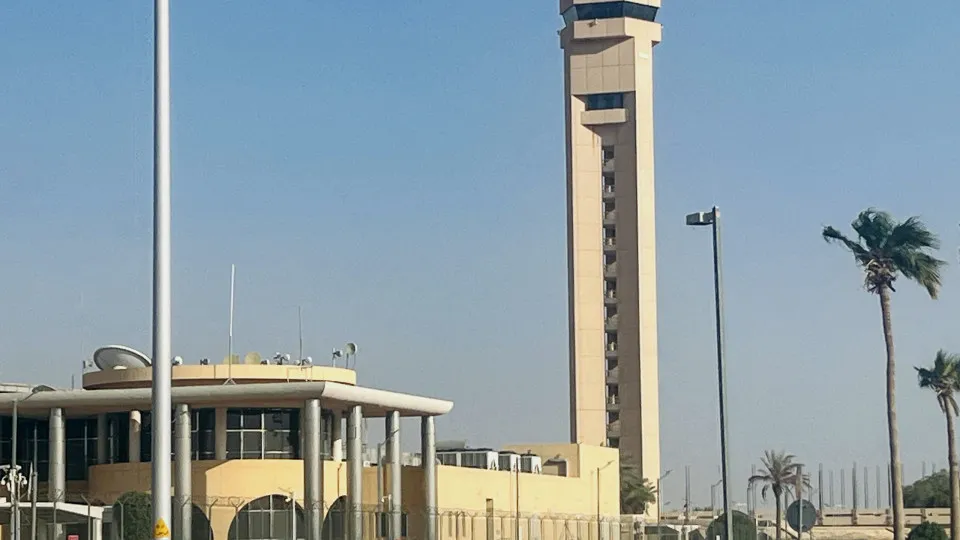
At least 12 people died and 309 were injured today, some in serious condition, according to the Saudi authorities, in the attack on the Riyadh International Airport, the capital of Saudi Arabia, attributed to the Huthis rebels of Yemen.
© AFP via Getty Images
10/10/2026
by
Lusa
Plink 12 people died and 309 were injured today, some in serious condition, according to the Saudi authorities, in the attack against the international airport of Riyadh, capital of Saudi Arabia, attributed to the Huthis rebels of Yemen.
According to the Saudi civil aviation authority, there are four Saudi citizens and eight foreigners, including one American.
The same authority also reported “material damage.”.
Previously, a medical source had advanced to the agency France-Presse (AFP) that two people had died in the attack on King Khalid airport, which was a member of an Egyptian crew serving a Saudi airline and a Palestinian with Egyptian travel documents.
The Saudi aeronautical authority today confirmed the suspension of flights at Riyadh airport after an attack, without specifying the origin, but what diplomatic source cited by AFP attributed to the Huthis rebels in Yemen.
In Riyadh’s first statement on numerous reports of an attack against King Khalid Airport today, the Saudi Civil Aviation Authority had confirmed the existence of “several injured persons”, whose number was still being counted.
The operations were temporarily suspended until the damage was assessed and the safety of the premises was verified, the entity added.
The national company Kuwait Airways had already announced the interruption of links with the Saudi capital.
Diplomatic source told AFP that “Huthis are attacking civilian targets,” specifying that a missile hit the airport facilities around 3:00 p.m. local (13:00 in Lisbon).
A medical source cited by the French news agency indicated, after the attack, that “tens of people were injured, mostly Saudi citizens”, of which five were in serious condition and were taken by helicopter to intensive care units.
The President of the United States, Donald Trump, today admitted to joining the coalition led by Saudi Arabia against the Huthis rebels, stating that he hopes to make a decision “very quickly” following the attack.
Several other Western embassies advised staff to avoid Riyadh airport for a week, and indicated to AFP a diplomat in the Saudi capital.
The French Embassy had already asked its citizens on Friday to take “extreme caution” in Saudi Arabia because of the “Huthis attacks in recent days”.
Several international media outlets reported fires caused at the airport by Huthis projectiles and the evacuation of Terminal 3 after a “direct impact” that injured several people, according to The Wall Street Journal.
The Huthis, an ally group from Iran, have not yet spoken, despite claiming previous attacks on Saudi Arabia, which supports the internationally recognized Government in Yemen, after imposing a naval blockade on the ships of the Arab kingdom, the world's largest exporter of crude since July in the Red Sea.
Riyadh announced today a “large-scale operation” of the coalition he leads against the Huthis, targeting “the rebels’ forces and capabilities,” while supporting the internationally recognized government army in Yemen.
The counteroffensive occurs after significant military advances by the Huthis in western Yemen, allowing control of vast areas of the Red Sea and Bab el-Mandeb Strait.
This strategic gateway to the Suez Canal has served as an alternative to the Strait of Ormuz, which has been blocked by Iran since the start of the US and Israel offensive on 28 February against the Islamic Republic.
After years of relative calm in the civil war in Yemen, the fragile truce agreed in 2022 collapsed in July, when the Huthis challenged Riyadh's control over Yemeni airspace, allowing the landing of a plane with Iranian representatives in Sanaa.
The Huthis are part of the so-called axis of resistance, formed by political and armed groups supported by Iran, alongside Hamas in Palestine, Hezbollah in Lebanon and Shia militias in Iraq.
Between 2023 and 2025, they attacked commercial ships in the Gulf of Aden and Red Sea as a form of support for Hamas in the war with Israel in the Gaza Strip.