
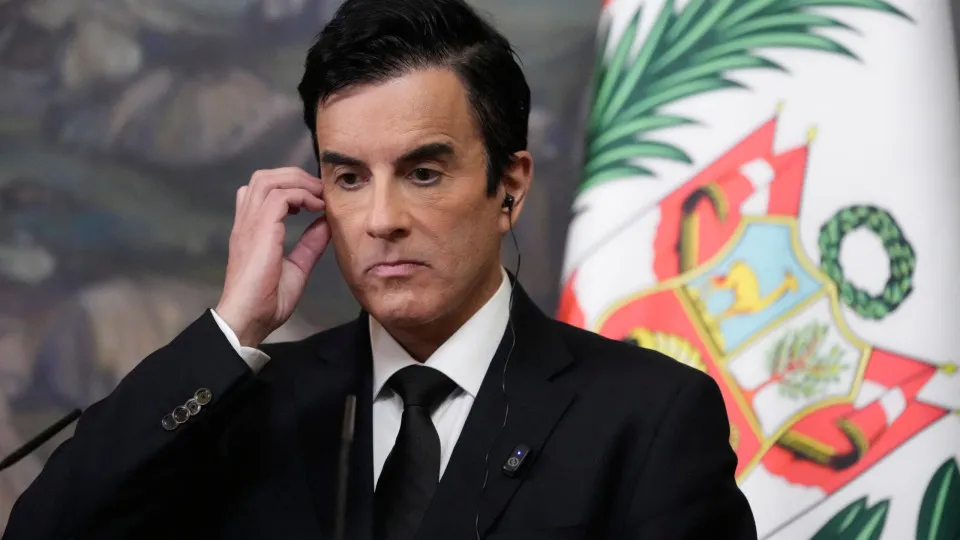
Peruvian Foreign Minister Carlos Espa has expressed concern with Moscow for the more than 459 citizens of the country who will have been recruited by Russian forces to fight in Ukraine.
© Pavel Bednyakov / POOL / AFP via Getty Images
09/11/2026
by
Lusa
O peruvian Foreign Minister Carlos Espa has today expressed concern with Moscow for the more than 459 citizens of the country who will have been recruited by Russian forces to fight in Ukraine.
During a visit to Moscow, Carlos Espa met with the Russian counterpart, Sergei Lavrov, to address the situation of Peruvians sent to the front line.
“ We came to Russia on behalf of the families of these more than 459 Peruvians,” the minister said, defending the right of family members to know if their relatives are alive, died or are prisoners of war.
The visit aims to move forward with political, humanitarian and consular measures to obtain information about Peruvian citizens, facilitate access to the wounded and accelerate the repatriation of those who died, Carlos Espa explained.
He considered that direct dialogue could provide concrete solutions and strengthen coordination between the foreign and defence ministries of both countries.
In early October, a Peruvian court ordered the 14-month pre-trial arrest of a man accused of human trafficking, suspected of offering false jobs to victims who eventually fought in Ukraine alongside Russian forces.
A report by Amnesty International, published in September, states that Russia has misleadingly recruited thousands of people from countries such as Brazil, Colombia, Cuba, Sri Lanka and South Africa.
The judicial authorities of Peru and Bolivia are investigating recruitment networks in their respective countries, while the Colombian Ministry of Foreign Affairs claims to have received more than 800 complaints from citizens in a similar situation.
In April, the Russian embassy in Peru acknowledged, in a statement, that Peruvian citizens had signed contracts to provide military service in the Russian armed forces, arguing that these were voluntary decisions.