
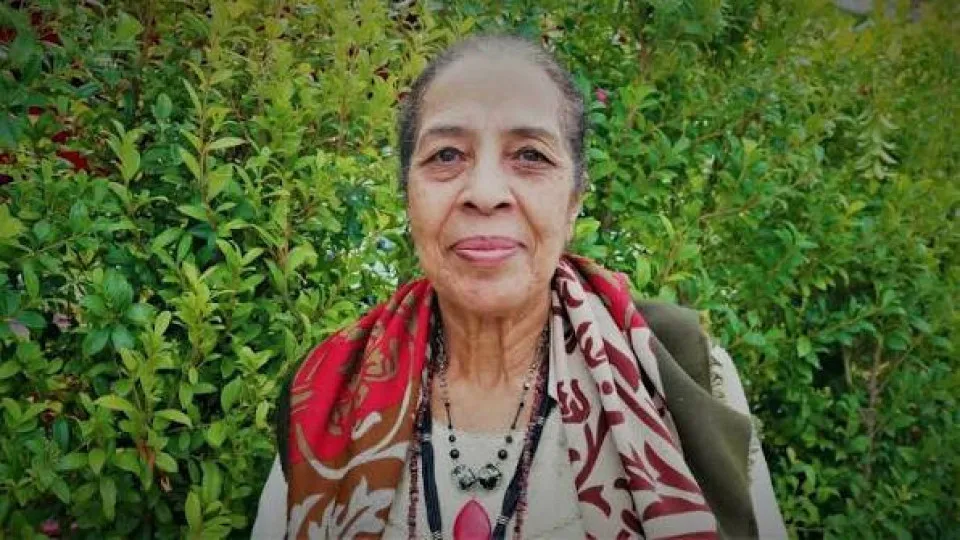
The Santomese poet Olinda Beja ensures that her stories win the screens and social networks in the dispute for the attention of the younger and that the secret is to call them to the narrative, because everyone knows the “Once upon a time...”.
© Delphi Cultural Center
18/10/2026
by
Lusa
Olinda Beja
A som-Tomense poet Olinda Beja ensures that his stories win the screens and social networks in the dispute for the attention of the younger and that the secret is to call them to the narrative, because everyone knows the “Once upon a time...”.
Storyteller, Olinda Beja marks 35 years of literary career next year when she is 79 years old. It has more than 20 published works and no desire to stop writing, counting and singing what it composes.
He writes for children and adults and his poems, tales and novels reveal the country where he was born – São Tomé and Príncipe –, where they took her to Portugal at the age of three and where she returned to her 37, to meet her biological mother.
“ I usually say I walk barefoot between two worlds. For many years it seemed to me not to be from here, nor from there, but one day a teacher who I very dear drew my attention to the treasure that he had – and I have – in my hands, which is to have two civilizations”, he said, in an interview with the agency Lusa.
The first stories he heard were in Portugal, by whom, before sleeping, he talked about the perpetia of the day, in narratives intervalated with riddles.
“In Europe stories were told to spend the evening. In Africa, there is a profession that is the storyteller, which in São Tomé has a fundamental role, especially in funerals ", said.
And he added: “When we are doing the wake in São Tome, there is always someone who goes on purpose to tell stories and then we still make seven days of disgust, during which someone takes care of telling stories.”.
Stories that, between Portugal and São Tomé and Príncipe, Olinda Beja assimilated and were raw material for his books, always with the aim of stopping oblivion.
“ I always try to warn you not to repeat what happened with slavery, the hired ones or 1953”, when the massacre occurred in Batepá, where colonial troops massacred the native population protesting against forced labor in São Tomé and Prince.
On the mother's side, Olinda is the great-granddaughter of an Indian and a Gabonese woman, who was hired to the swiddens of São Tomé and Príncipe. The mother told him many stories of the hired ones, the inhumane way they lived and how they dealt with forced labor and lack of care.
When he returned to São Tomé and Príncipe in 1985, responding to “an appeal from the corner of the bonobo, the caudal rivers, the wind and the forest”, Olinda found the reality of the contractors, especially Cape Verdeans, who went to this country in colonial time and who stayed there, without means to return to their land of morabeza.
“My mother told me about the women hired to work in the gardens, the food that was all controlled and how they ate the fish that came from Moçâmedes (Angola), but that when they arrived in São Tomé, and mainly because of the heat, after two or three days it already smelled bad and it was already half ruined, but it was what they gave them to eat.”.
The people who had to eat that were the same ones who gathered at night to mourn their misfortunes, but who still sang: “Eat, ladies, but have a clean heart, and have no sins, even gives health; eating flesh with a dirty heart, it is not worth it, because the heart is not clean.”.
To these stories joined the “unique and stunning beauty” of São Tomé and Príncipe, with its beaches with coconut trees and palm trees, the various types of bananas, the pine fruit and the yam growing in 15 days, he said.
Professor of the profession, having taught for 40 years, between Portugal and Switzerland, Olinda Beja published her first book ("Bô Tendê?") in 1992 and in the same year began to tell and sing the stories of the two islands.
This book of poems followed many others, including “A Coffee Grain” (2013), the first book for children in the children’s literary panorama of São Tomé and Príncipe, which is translated into several languages, including Japanese.
This work speaks of one of the most important resources of São Tomé and Príncipe that is coffee, along with cocoa.
And even the most difficult audiences end up surrendering to the way Olinda Beja tells her tales, almost always with music, and the secret lies in bringing children and young people into the story.
“ Who doesn't want to be king? And princess of an enchanted kingdom? And even the fool of the court has candidates ", said, saying that seldom leaves a school without another invitation to a new initiative.
In the literary universe of Olinda Beja are present the stories of São Tomé, many narrated by accountants, such as that of the judge who lived many years and his cane gained roots to the land, or that of Father Rocha, who had many children and who said it was better to be a good father than to be a bad father and a good priest.
“ My stories, especially for children, always aim to convey the uses and customs of the island ", said.
Accompanied to the viola by the Sãomense musician Filipe Santo, by the Guinean percussionist Carlos Camará or the Portuguese guitarist Luís d’Almeida, Olinda Beja has made recitals of poetry and singing on various stages of the world.
He has told stories in 15 countries and is proud to have Arabs sing Creole in Dubai during Expo 2021.
His last book was “Mikoló, A Nossa Estrela” (2025), a short story written in Portuguese and forra (Creole Santomense language).
Olinda Beja was recently in the capital of Cape Verde, where she participated in the IV Meeting of Portuguese Language Writers, an event promoted by the Union of Capital Cities of Portuguese Language (UCCLA), together with the Municipality of Praia, in which her interventions were received with strong applause.
He returned to the archipelago, where he is participating in the first edition of the International Festival of Tales – “Old City in Solera Porta Ku Nos Gentis Grandi”, an initiative of RJ ANIMA (Association of Environmental, Social and Cultural Dinamization).
The event that began on Friday and ends today, brings together storytellers, animators, reading mediators, educators, researchers and other participants from different Portuguese-speaking countries.