
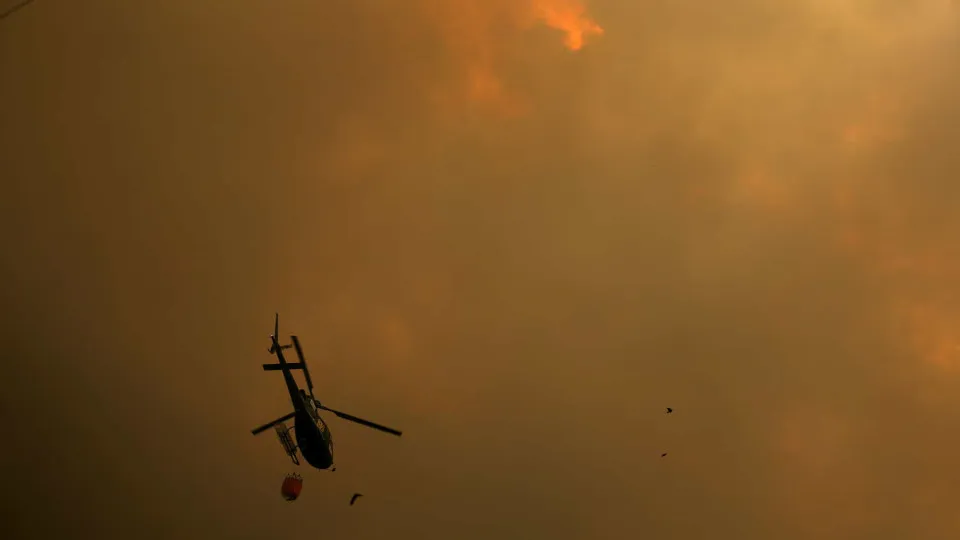
The number of rural fires in the Leiria Region increased this year, attributed to storm Kristin, but the burned area was 89% of the 2025, according to the subregional commander of Emergency and Civil Protection.
© Reuters
21/10/2026
by
Lusa
Region of Leiria
O number of rural fires in the Leiria region increased this year, a situation also attributed to the Kristin depression, but the burned area is much lower compared to 2025, revealed the sub-regional commander of Emergency and Civil Protection.
“The number of occurrences in 2026 [until October 15] increased significantly compared to 2025 [all year], much driven by the occurrences in the municipalities most affected by storm Kristin, particularly Leiria, Pombal, Marinha Grande, Porto de Mós and Batalha,” Lusa Carlos Guerra said.
He said that “although the number of occurrences increased in 2026, the area burned was 89% of the area burned in 2025, which reflects the effectiveness of the initial attack.”.
The municipalities of Alvaiázere, Ansião, Castanheira de Pera, Figueiró dos Vinhos and Pedrógão Grande are also part of the sub-region.
According to data sent to the Lusa agency, 270 rural fires were recorded this year, resulting in 68 hectares of burning area (180 occurrences in 2025, when 616 hectares burned).
“ The increase in occurrences is directly linked to storm Kristin, human behavior and weather conditions,” said Carlos Guerra, explaining that the latter were characterized by “high weather severity, driven by high temperatures, strong winds, lack of precipitation and very low relative humidity, with many night periods without relative humidity.”.
The sub-regional commander said that the influence of the Kristin depression, which seriously hit this territory on 28 January, “has manifested itself in the large amount of fuel material available on the ground resulting from the fall of trees, but mainly in the obstruction of penetrating paths to fires, that is, the difficulty of mobility of personnel and vehicles in some parts of the territory.”.
Recognizing “the much work that was done in the clearance of rural roads before the beginning of the time of greatest risk,” Carlos Guerra admitted, however, that “this obstruction of roads manifested itself in an increase in the time of arrival at the fire sites.”.
For example, he said that “the arrival times of the first vehicle to the theater of operations are, on average, more than two minutes compared to 2025, with a higher incidence in the months from February to June, where the clearance of the roads was still insufficient”, improving in the following months.
“ Despite these increases in arrival at the theater of operations, the effectiveness of the initial attack was 99%, which means that, of the 270 fires, only five were not dominated in the first 90 minutes ", highlighted the Civil Protection officer of the Region of Leiria.
Carlos Guerra stressed that for these results he contributed “decisively the initial dispatch of means for any occurrence.”.
This year, the sub-regional Command “increased the first dispatch from three to six vehicles and, according to the analysis of the location and weather conditions, this dispatch was enhanced with a high number of vehicles and operational, much more significant from June, coincident with the months of higher risk of rural fire”.
Also according to Carlos Guerra, “there is a significant increase in the dispatch of means in the first 10 minutes” compared to 2025, so “a truly muscular attack was possible in the initial attack, with very appreciable results”.
The subregional commander assumed that “the results of 2026 are somewhat contradictory”, given the increase in the number of occurrences and the reduction of burned area.
“ From this contradiction we can conclude that a great deal has contributed to this result the absence of fatalities and serious injuries, the increase in the number of operatives and vehicles in the initial dispatch, constant monitoring of occurrences, which allowed for the immediate and early reinforcement of means, pre-positioning in places of greatest risk, operational training of combat and coordination teams”.