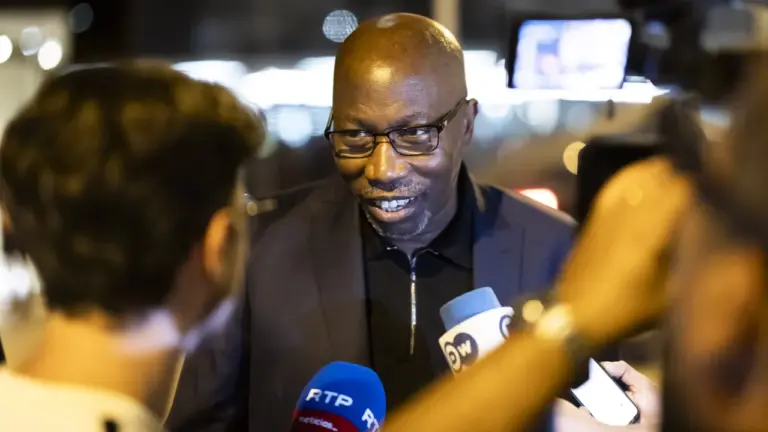
The researcher Sophia Birchinger considered to Lusa that the legal situation of the Guinean opponent Domingos Simões Pereira is “particularly worrying”, because the suspension of preventive detention ended in October and, according to public information, its status is unknown.
© Lusa
23/11/2026
by
Lusa
A researcher Sophia Birchinger considered to Lusa that the legal situation of the Guinean opponent Domingos Simões Pereira is “particularly worrying”, because the suspension of the preventive detention ended in October and, according to public information, its status is unknown.
On November 26, 2025, a self-named High Military Command took power in Guinea-Bissau on the eve of the announcement of the results of the general elections held precisely a year ago, on November 23.
The coup interrupted the electoral process, the President of the Republic and recandidate, Umaro Sissoco Embalo, was deposed, and the military appointed General Horta Inta-a as head of Transitional State, replaced the parliament, closed since December 2023, by a National Transitional Council and arrested the main opposition leader, Domingos Simões Pereira, prevented from running for elections, as well as the historic African Party for the Independence of Guinea and Cape Verde (PAIGC), who leads.
In a telephone interview with Lusa, researcher Sophia Birchinger of the Frankfurt Peace Research Institute (PRIF), one of the main international peace research institutes, said that the freedom of the PAIGC leader “continues marked by considerable legal and political uncertainty”.
Simões Pereira is currently in Portugal – where he was received in July for allegedly needing medical care – and it is “very unclear” what will happen if he wants to return to Bissau, whether he will be arrested again or put back in house arrest, said the analyst.
Sophia Birchinger recalled that since the coup, political rights “have been very limited”, with the prohibition of party activities, mobilization and campaigning, as well as demonstrations and protests. He also referred to repression of civil society, journalists and radio stations.
“ All these are signs that the environment for the political opposition is not very safe,” he said.
After the coup, the Military High Command used military courts to judge civilian figures, including Simões Pereira.
The researcher, who stressed that she was not an expert in law, said that “it is very clear that military courts should not and cannot judge civilians.”.
“This is foreseen in the African Charter on Human and Peoples’ Rights, the Guinean Constitution and the Military Justice Code,” he said.
Asked about whether it is an act of despair or deterrence, he replied that he sees “both”: a strategy of political deterrence, but also an “institutional despair”, in a context of increasing tension between the Supreme Civil Court and the military courts.
The investigator said that, in June, a military education judge initially suspended the case against Simões Pereira and referred unconstitutionality issues to the Supreme Court, but then withdrew and ordered the preventive arrest.
Sophia Birchinger also said that there seems to be an “invisible hand” that directs the military courts to neutralize political rivals.
For the researcher, this may mean that there is a “fight for legal and political authority” that should not “be underestimated”.