
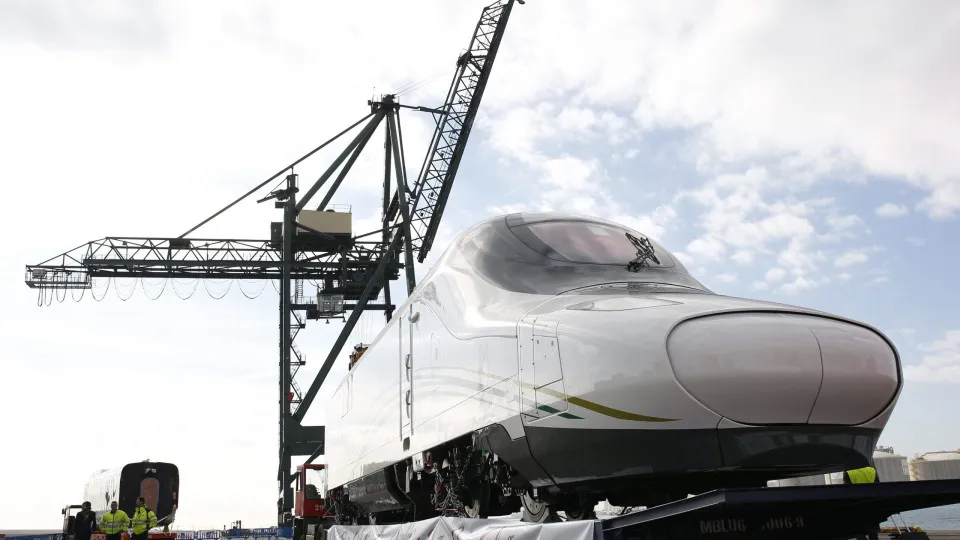
Talgo intends to produce the first high-speed trains in Portugal with circulation capacity in Iberian and international gauge, according to the company's CEO, Ricardo Chocarro.
© Lusa
18/10/2026
by
Lusa
Talgo
A Talgo intends to produce Portugal's first high-speed trains with circulation capacity both in Iberian and international gauges, Spanish company CEO Ricardo Chocarro said.
Talgo and French Alstom were the two companies chosen last month to submit proposals for the supply of high-speed trains to the Portuguese Trains (CP), in a contest with a value of EUR 504 million.
“It’s a high-speed contest to unite Lisbon and Porto in Iberian gauge”, in an “absolute specificity” of the bid, but today Talgo’s high-speed trains “run in Spain in international gauge and Iberian gauge,” Ricardo Chocarro said, in Madrid’s statements to the Portuguese media, including the Lusa agency.
The CEO stressed that Talgo produces trains with “capacity to adapt” to different gauges, which circulate in Spain between routes with different widths without the need to stop the compositions or to bring down passengers, and that is the technology that they consider proposing to Portugal.
“ The competition does not require it, the competition does not value it, but we believe that it is a great advantage for Portugal to have this variable gauge capacity, if it is decided in future to adopt the European gauge or if it is intended to operate in other contexts in other markets. This is what we will put on the table in the contest of Portugal”, said Ricardo Chocarro.
The CEO stressed that Talgo has 25 years of experience with high-speed trains in Spain, a country with a similar context to Portuguese, but that there are specificities that have to be met in the competition for Portugal, such as the need for compositions to be operated in a gauge “which is not usual for high speed” (the Iberian gauge).
“ Secondly, as these [high-speed] roads are under construction at the moment, the train will have to travel by high-speed routes and probably also by routes currently used in more regional transport,” he added, saying that Talgo also has a “multi-way” developed technology.
The tender launched by CP provides, in addition to the manufacture of trains, a maintenance service for two years, with Talgo providing “the development of local capacity, both for supply and maintenance”, namely, with the hiring and training of labour in Portugal, among other things, according to Ricardo Chocarro, who did not reveal figures relating to the cost of the proposal that the company will submit to CP or any investment.
Talgo is a Spanish company founded in 1942 and, according to the company’s own information, “specialized in the design, manufacture and maintenance of high-speed and long-distance trains”.
The company now has an order portfolio of around EUR 6,500 million in contracts for the production of trains and/or maintenance on several continents.
Talgo is a mostly private company with two public shares, the Spanish State (7.9%) and the Basque Country regional executive (7.8%).
The CP competition is for the purchase of 12 high-speed motors, their park parts and special tools, as well as the option to purchase eight more motors.
With a basic price of EUR 504 million, it also includes a full maintenance service to be performed by the successful tenderer in the two years following receipt of the first train.
The next stages of the process are the presentation and analysis of proposals, following the decision. The tender schedule provides for the signing of the contract in the first quarter of 2027 and the first train must be delivered in the first three months of 2031.