
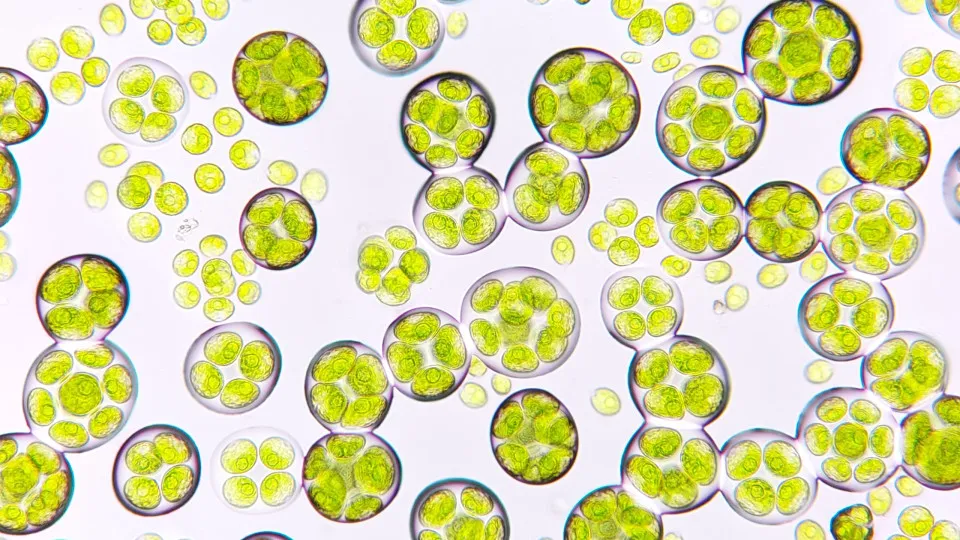
Researchers from the Faculty of Sciences and Technology of the University of Coimbra (FCTUC) have developed a new technology capable of detecting and analyzing electrical signals produced by marine microalgae populations, opening new monitoring possibilities.
© Shutterstock
06/10/2026
by
Lusa
A new technology transforms apparently random electrical fluctuations into information about populations of living microalgae, opening new possibilities for environmental monitoring, aquaculture and bioelectrochemical systems, said FCTUC in a statement sent today to the agency Lusa.
The study, led by researchers from the Bioelectronics & Bioenergy Research Lab, the Center for Functional Ecology and the Associated Laboratory TERRA, integrated into the Department of Life Sciences at FCTUC, focuses on the marine microalgae ‘Phaeodactylum tricornum’, an organism used as a model in scientific research.
According to FCTUC, the team developed a three-dimensional electrode, with a porous structure and a very low electrical impedance, which allows for a more efficient connection between the ionic processes of the cells and the electrical signals measured by the device.
“ This configuration makes it possible to identify electrical fluctuations associated with the activity of microalgae that are difficult to observe through conventional techniques”.
The researchers demonstrated that the presence of live cells significantly alters the electrical fluctuations recorded by the system and also found that as the concentration of microalgae increases, the statistical characteristics of the electrical signals detected change.
The results indicate “that the so-called electrochemical ‘noise’ may contain information about the biological activity of cells”.
“ We're used to thinking of electrical noise as something that should be eliminated. What we show is precisely the opposite: these fluctuations may contain information about the state and dynamics of a living population. It is like winning a new window to observe biological processes that, until now, were practically invisible electrically ", said the project coordinator Paulo Rocha.
According to the FCTUC professor, in the long term this approach may help to “understand how populations of microorganisms respond to environmental changes and how collective dynamics emerge in these communities”.
“ It can also inspire new monitoring technologies for aquatic ecology, aquaculture, water quality and bioelectrochemical systems,” he added.