
The Camp of Porto, which since 10 October protestes in Praça D. João I for the right to housing, has as figures for workers, students and students-workers, from Sociology to Computer Engineering, unfolded in a “extreme effort”.
© Lusa
07/11/2026
by
Lusa
A Camped in Porto, which since October 10th has protested in Praça D. João I for the right to housing, has as fore figures workers, students, and students-workers, from Sociology to Computer Engineering, unfolded in a “ huge effort”.
Henrique Blanc, a 37-year-old Master’s in Management, is a person who is already involved “in various social projects”, being part of Just Life, for example.
“ I'm a Master's in Management, in Financial Management, and I'm also taking a Master's in Management. I'm 37 years old, but I'm not finished either. This has a context behind it, I was retired due to disability following an accident in 2021”, he explains.
The man who became famous at the time of the second police charge that the movement suffered, by sitting cross-legged, in front of the police, placing several carnations on the ground, has been arrested and is one of the most visible faces, one of the most active voices in favor of this fight for the right to housing.
Blanc is in the genesis of this camp, in the model of those that took place in Spain and other countries, and began “initially by a conversation between three friends”, and “three days earlier”, with no great concern or belief that it could grow so much, today watch a “extreme spirit of union, of integration of the whole society”, with daily activities and a struggle for a constitutional right that “has been a fantastic thing”.
As it is in “professional requalification process”, it has been involved in social projects, such as food and pedagogical support work in the neighborhoods of Aldoar and Cerco, besides the Romani Union.
“ Unlike most of the people here, I find myself in a privileged situation. ... I keep having family, friends, acquaintances, and there are still people who need us to fight, everyone ", shoots.
Mariana Guedes, 28 years old, has worked for seven years as a computer engineer, an area in which she has graduated and has worked since she left college, and ever since she has been “very supportive of everything that involves politics and oppression of the people”, or as she simply puts it “always on the right side of history”.
“ This movement meets what I believe is the right to housing. We have seen in our country many cases of precariousness. Even those who work the ‘full time’ have difficulty in paying an income in this economic system”, criticizes.
The young woman is one of the faces that she has spoken to journalists during the demonstrations and ended up celebrating the 28th anniversary last Sunday, on an early morning that ended up being part of the security cordon that was the subject of police charge, the third that the movement has suffered since it started, and that once again destroyed the camp.
The discourse of this protester constantly flows into the importance of mobilization and popular organization to fight for rights, on the one hand, and on the other, what was found in a camp that has already achieved “great achievements”.
“ The work that is done here, the free culture that we offer, the food provided free of charge, the tents that we have already been able to facilitate to homeless people, who have found here a community that they did not once have, because they are completely marginalized from society. I am very happy with what is happening and excited for the next steps”, notes.
Criticing the “police terrorism” that they have faced, the next steps, he says, are first and foremost “the resistance”, with the symbol of the tent present, and succeed in advancing their claims, of which he listed as most important “reverting the new rental law”, which will “again defend and protect landlords and put tenants in precarious situations”.
Despite much mediatization, she does not feel “uncomfortable”, even if she has received negative comments and even threats to physical integrity, surpassed with “extreme strength and solidarity”.
“ I completely believe in what we are doing and I feel like I want to talk, I have a lot of desire to communicate, to express myself, both for me, and for my companions and for other people who have no voice and cannot move, either at the camp of Porto, or at the campsite of Lisbon, which are at the moment the biggest, but not the only ones in the country, so I do not care and like the opportunity to be able to express what I believe and we believe ", shoots.
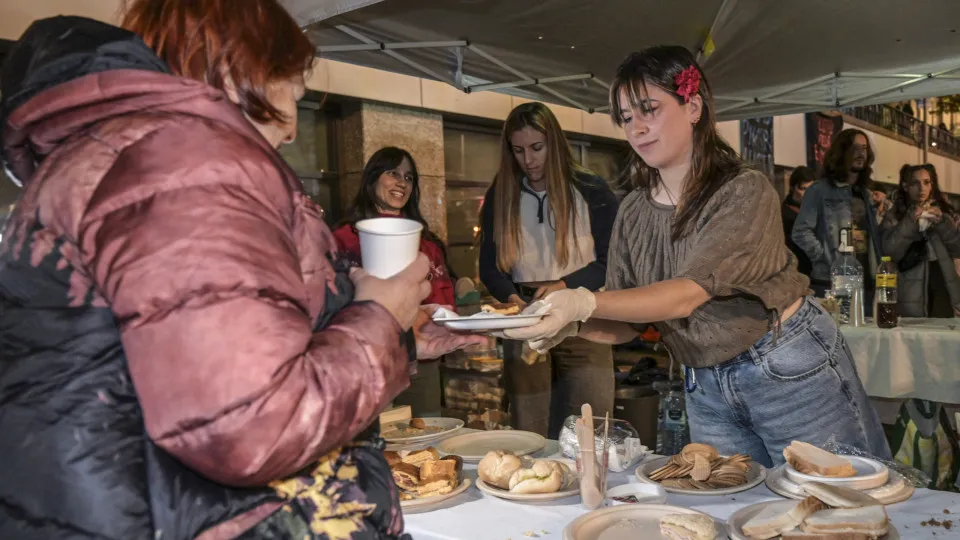
One of the achievements of this first month of Camp Porto was the popular canteen, which every day feeds 200 to 300 people a day, free of charge, at dinner time, according to the organization's estimate, even after the successive police charges have destroyed all the material and inventory they had – donations have allowed them to recover every day.
This is where Diana Lourenço, 22 years old, and Isabel Azevedo, 56 years old, work night after night, whose different paths converge on the same mission of serving those who have the least while fighting a “very serious problem”, the housing crisis.
The most experienced of the two works and joined the group after their daughter was already very attached, and always had “this caring thing”, or she did not show, with pride, a poster that identifies her as a “mother for the Camp”.
“ Food is comfort. People of all kinds come across us, from homeless people who have degrees, others who have made bad choices, doctorates, masters, all kinds of people. This is the charm of this movement, which is already a community ", comments.
Diana Lourenço, on the other hand, gives a smile to everyone who goes through the cafeteria – “I love smiling” – and takes a master’s degree in Sociology while working, and it was the precarious situation that she found, from the Algarve, where she graduated, to Porto, with rooms at very high prices and unfavorable conditions, that led her to the street.
“I changed rooms several times for situations I couldn’t afford, or because the landlord decided to sell the building... now I came to Porto and the room is even more expensive than in the Algarve. (...) Being here gives me great happiness, but it is complicated. ... I'm a bad example. I'm always in the square, because I think it's become a little home for all of us. I continue to make my life, work, study”, says the young woman.
Elizabeth has a “stable situation”, next to her husband, with work and home, but, by renting, they can be “at the mercy of speculation” or unexpected unemployment, and still fight. “We don’t look well if we don’t look around. This is what I have always taught my children and the example I give them ", comments.
There, she has found a canteen that is “resistance,” says Diana Lourenço, and Isabel, who works “from nine to six”, already has the routine “to come to the square” help a little more, in a popular canteen where “you get more than you do”.
“Several young people who work and study come to tell us: ‘I’m glad you’re here, because, otherwise, I wouldn’t eat today because I don’t have any money’. This is something that makes us here every day, and I appeal to everyone's generosity, to keep bringing us what they can. The homeless are of incomparable generosity. We have just had a situation here of a gentleman who brought a bottle of olive oil, who is homeless. He collected cans, went to deliver [in the Volta system] and came to bring us a bottle of olive oil, because every day he comes here to eat and recognizes that he also has to give. This is brutal, it is an example of empathy for our rulers to look at. They should come to the square, see, appreciate, listen to real people, real life, not cabinet life ", says.
Diana Lourenço reminds another homeless man that every day “brings a bag of goods” she bought, to help “mount the canteen, helps build the tent, too”, and there they rehearse “the symbol of greater volunteering that could exist”.
“It’s love, we have a community and a giant family was created. Come to the camp, come and see what the reality of people is like, and come and see that this is also love”, he says.