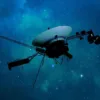
The Voyager 1 spacecraft launched in 1977 exceeded the distance of a “light-day” from Earth after 49 years of travel, becoming the most distant object built by humans.
© Shutterstock
19/11/2026
by
Lusa
A voyager 1 unmanned space probe surpassed, after 49 years of travel through the cosmos, a historical landmark, reaching the distance of a “light-day” from the Earth, the furthest point ever reached by an object built by the human being.
The “traveler” of the U.S. space agency (NASA) has already travelled more than 25 billion kilometers since its launch in 1977 with the aim of exploring the outer planets of the Solar System.
Although it was designed and built for an initial five-year mission, its operation extended far beyond what was foreseen.
NASA has confirmed through several of its official channels that the probe has exceeded the distance of a “light-day” from Earth in its trajectory.
Jared Isaacman, administrator of the U.S. agency, celebrated the achievement on social media, stressing that this is an extraordinary achievement for a spaceship mounted on Earth and launched almost 50 years ago.
When assessing the importance of this milestone, while Voyager continues its journey through interstellar space to almost 61,000 kilometers per hour, Isaacman recalled what those “bright minds” made possible with the technology of 1977, and reflected on “how far one should aspire to arrive with the tools, resources and ambition of the present time.”.
The Voyager mission consists of two twin probes, Voyager 1 and Voyager 2, launched in 1977 with the aim of taking advantage of a rare alignment of outer planets to study Jupiter, Saturn, Uranus and Neptune.
The probe, about 722 kilograms of weight, is equipped with scientific instruments to measure particles, magnetic fields and plasma waves, among other phenomena.
His trajectory began with Jupiter's overflight in 1979, when he identified a system of rings and two moons previously unknown.
He continued with Saturn in 1980, where he discovered five new moons and a ring, and, after the conclusion of these encounters, moved towards the outer limits of the Sun's influence.