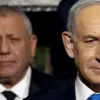
The Yashar! (Integral!), party led by Gadi Eisenkot, today closed a coalition agreement with the Democrats, which provides four ministerial portfolios for this centre-left alliance.
© Gil Cohen-Magen/picture alliance via Getty Images
26/11/2026
by
Lusa
O Yashar! (Integer!), party led by Gadi Eisenkot, who was commissioned to form government in Israel, today closed a coalition agreement with the Democrats, which provides four ministerial portfolios for this centre-left alliance.
“Gadi Eisenkot, president of Yashar!, and Yair Golan, president of the Democrats, agreed to sign a coalition agreement between their two parties,” announced a joint statement of the two political forces, which are part of the so-called bloc of change, in order to ward off the outgoing government, headed by Benjamin Netanyahu, following the laws of October 27.
The agreement arises after the Democrats have broken negotiations with Eisenkot in protest at the holding of Yashar meetings with Netanyahu's Likud about the possibility of forming a government of national unity, although these meetings have so far been inconclusive.
Although the Likud won the vote, Gadi Eisenkot received further party recommendations to form a government in the post-election consultations of the Israeli President, Isaac Herzog, thanks to the support of the two Arab forces, who had a record election of 19 deputies, and one of the Ultro-Orthodox groups, who belonged to the Netanyahu bloc, and did not endorse any candidate.
However, the leader of Yashar! and former head of the armed forces still does not gather the 61 deputies for an absolute majority in parliament (Knesset) that enables a new government, between differences in the Jewish base opposition block.
The bloc of change, which also includes the alliance Together, of former prime ministers Naphtali Bennett and Yair Lapid, and the Yisrael Beiteinu party (Israel is Our House), led by former Minister of Defense Avigdor Lierberman, totals 48 deputies, below the 61 needed for an absolute majority.
Before the coalition agreement announced today, Yashar had already made an understanding with Yisrael Beiteinu, who refuses the support of the 19 Arab Members, contrary to what the Democrats are defending.
Under the agreement reached today with Eisenkot, the centre-left alliance (which results from the merger of the Labour Party and Meretz) will have four ministries if a government is made possible: a broad portfolio of National Security, currently occupied by the ultranationalist and anti-Arab Itamar Ben Gvir, Work and Social Affairs, Communications and Culture and Sport.
The portfolio of social equality will also be the responsibility of the Democrats, as well as the presidency of Parliament's Committee on Constitution, Law and Justice.
According to the Democrats, the agreement, which is still awaiting the finalisation of details before being signed, includes the commitment to “totally repealing judicial reform”, initiated during Benjamin Netanyahu’s last term, and “to ensure important achievements for Israeli society, Israeli democracy and Arab society”.
In this way, the centre-left force continues, the opposition is “opening the way to end the Netanyahu Government and save Israeli democracy”.
The alliance Together, the last force of the bloc of change that has not yet made a coalition agreement with Yashar!, has meanwhile been in parallel meetings with Likud.
These meetings are known to Gadi Eisenkot, according to alliance leader Naphtali Bennett, after meeting last week with Netanyahu in absentia of his opposition partners.
Yashar! for his part has recognized the development of contacts with one of the two ultra-orthodox forces, United Judaism of the Torah, which in the last political cycle supported Netanyahu.
The pro-government bloc represents 53 Members, but it may be reduced if the seven elected members of the Torah Judaism move to Eisenkot, who would still not have an absolute majority.
According to the Israeli press, Eisenkot seeks to increase his base of support in the Knesset if he needs to force approval of a minority government, with the abstention of the Arab groups.
The support of the ultra-Orthodox may, however, collide with the controversial military exemption demanded by this minority and whose end was an election promise from the opposition.
Benjamin Netanyahu proposes for his side the creation of a “government of national unity”, headed by himself, a solution rejected by the opposition bloc.
Gadi Eisenkot has the legal deadline to approve a government until December 6, prorogable for another 14 days.
If he does not, another candidate will be appointed by the Israeli President to form an executive in 28 days, not extended and under threat of further elections.