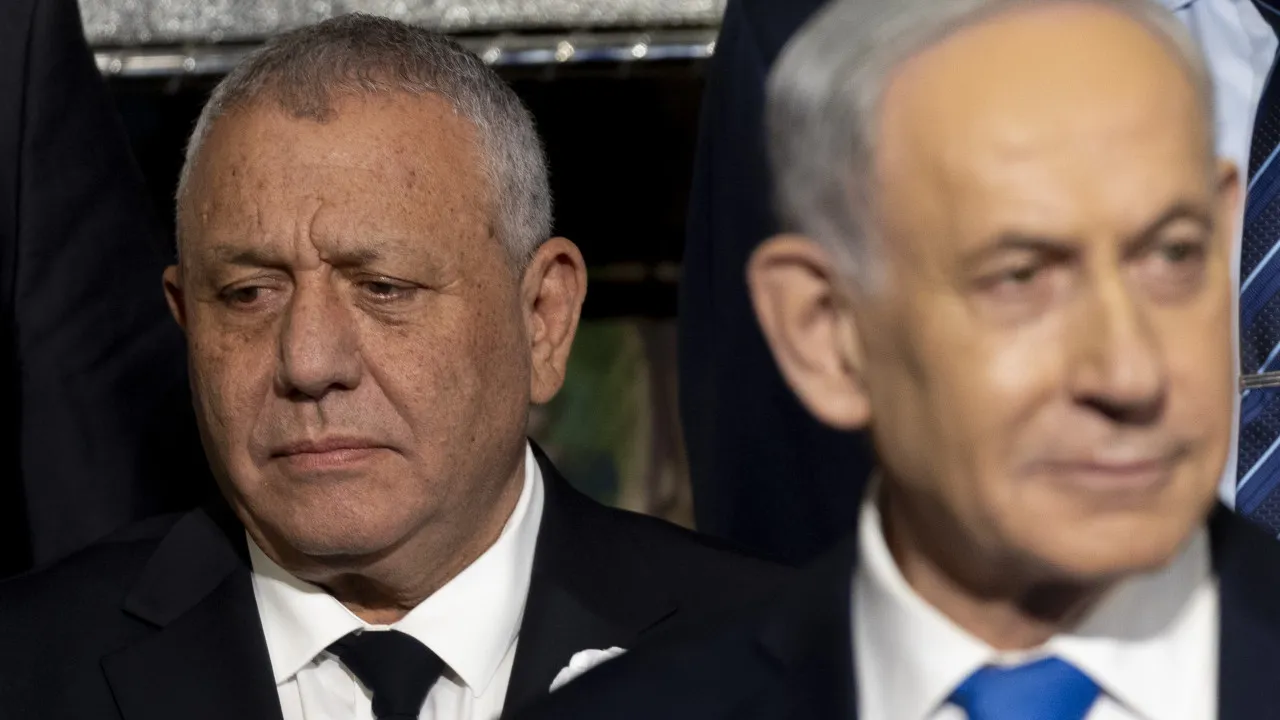
Opposite leader Gadi Eisenkot, in charge of forming the next Israeli government, today invited the right-wing party Likud, of the outgoing Prime Minister Benjamin Netanyahu, to talk about a possible government coalition.
© Amir Levy/Getty Images
21/11/2026
by
Lusa
O opposition leader Gadi Eisenkot, in charge of forming the next Israeli government, today invited the right-wing party Likud, the outgoing Prime Minister Benjamin Netanyahu, to talk about a possible government coalition.
These talks, which are due to begin on Sunday, reflect “a real commitment to the formation of the most comprehensive government possible”, said in a statement the Yashar party! (Integer!), former Chief of Staff, Gadi Eisenkot, who has until next December to form a government.
The talks come following the legislative elections in late October, which revealed no absolute majority, neither to Eisenkot camp nor to Netanyahu.
However, the Eisenkot bloc is divided as to the way forward to secure a governmental majority, between an alliance with the ultra-Orthodox Jews, a pact with the Arab parties or a national union government with Netanyahu.
“In order to consider all options,” Eisenkot “requested the party’s negotiating team to invite their Likud counterparts to a series of intense negotiations,” the Yashar party needed in the same statement.
Gadi Eisenkot “will not deny any possibility” to “achieve the advancement necessary for the formation of a government,” added the information note.
Shortly after the announcement of Yashar!, the Likud imposed various conditions to integrate a union government — an option advocated by the outgoing Prime Minister —, calling in particular for the end of “all personal attacks and incitement to hatred” which, according to political formation, aim Netanyahu and his executive.
The Likud also demanded a joint declaration that would commit both sides to forming a government that would include “all parties supporting the existence of the State of Israel as the nation state of the Jewish people,” excluding Arab parties.
Netanyahu and his bloc vehemently attack the Arab formations, which conquered 19 seats in the Israeli parliament (Knesset) and opposed their re-election, in particular accusing the leaders of these political forces — who condemned the attack carried out by Hamas on 7 October 2023 aimed at southern Israel — of refusing to classify the Palestinian Islamist movement as a terrorist organisation.
The Likud has also proposed a number of guiding principles for a union government, including the rejection of the establishment of a Palestinian state, the maintenance of Israel's areas in Syria, Lebanon and the Gaza Strip, and an agreement on the question of the compulsory military service of ultra-Orthodox Jews.
Representatives of the two parties had already met last Sunday.
Former Prime Minister Naphtali Bennett, a leading figure in Eisenkot's camp, stated today, however, that his party would refuse to form an alliance with “Netanyahu or his bloc, regardless of circumstances”.
Bennett said he was “determined to form (...) a reform government led by Gadi Eisenkot” and “to ensure that Netanyahu is not the next Prime Minister”.
Although he has already claimed to be open to the formation of a government with members of the Likud, Eisenkot has excluded the possibility of joining a coalition led by the outgoing Prime Minister.
On Friday, Eisenkot — whose bloc has 48 members in the Knesset, where the absolute majority is reached with 61 elected — stressed that it does not want to allow negotiations to continue indefinitely, stating itself ready to put a minority government to the vote.