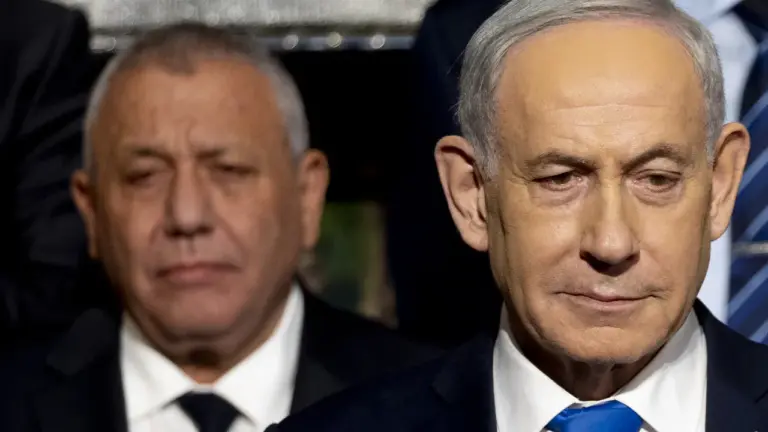
The parties of Benjamin Netanyahu and his rival Gadi Eisenkot, in charge of forming the next government of Israel, have today unsuccessfully attempted an agreement on a possible coalition, which would require significant concessions from both sides.
© Amir Levy/Getty Images
22/11/2026
by
Lusa
Othe parties of Benjamin Netanyahu and his rival Gadi Eisenkot, in charge of forming the next government of Israel, have today unsuccessfully attempted an agreement on a possible coalition, which would require significant concessions from both sides.
After almost four hours of negotiations, which had been announced on Saturday, representatives of the Yashar centrist party, led by Eisenkot, and the Netanyahu Likud, ended the meeting in Herzliya, near Tel Aviv, without showing signs of approach.
“ The positions of the two parties on various fundamental issues were presented and discussed in depth”, indicated the two parties in a secular communiqué, merely announcing the holding of a new meeting without specifying when.
Former Chief of Staff of the Army, Eisenkot has until 6 December – a period that can be extended for 14 days – to form a government, after the legislative end of October that gave no absolute majority to either side.
With 48 seats in the Knesset (Israeli Parliament), where the absolute majority requires 61, the Yashar remains divided over the following strategy: joining the ultra-orthodox parties, approaching the Arab parties or forming a national union government with the Likud.
This latter hypothesis is the one defended by Benjamin Netanyahu, and could be based on a rotation between the two men in the position of Prime Minister, a formula already tested in Israel and which would benefit the outgoing Prime Minister.
With her, Netanyahu, who faces in justice charges of corruption, would maintain the safeguards that the office confers and could continue to oppose the creation of a commission of inquiry into the security flaws that allowed Hamas' attack on October 7, 2023, which led to the invasion of the Gaza Strip by Israeli troops.
Gadi Eisenkot, although open to the formation of a government with members of the Likud, refuses this rotation in office, excludes the possibility of a coalition led by the outgoing Prime Minister and refuses any participation of the far-right party of Itamar Ben Gvir.
On Friday, Eisenkot stressed that he did not intend to allow the negotiations to continue indefinitely, saying he was ready to put a minority government to the vote.