
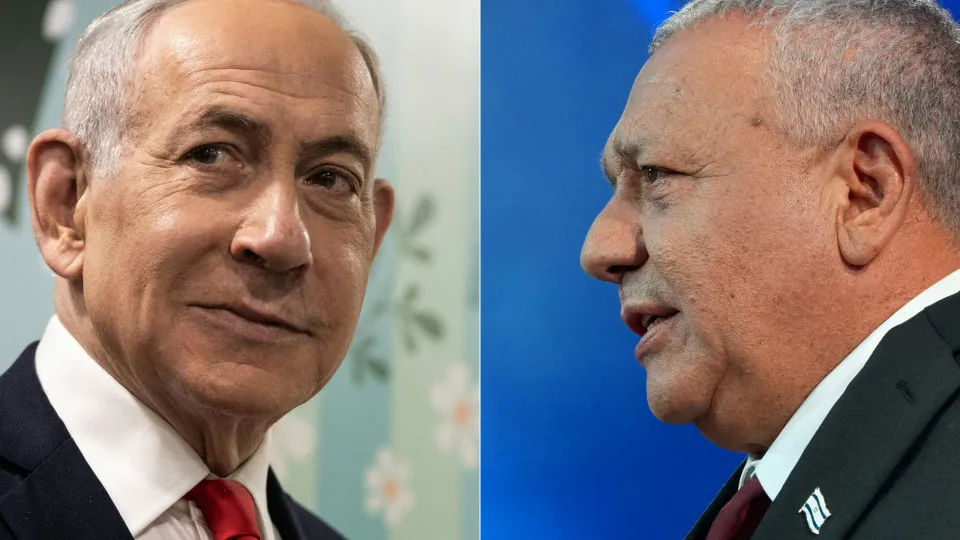
The parliamentary elections in Israel ended without a clear majority, creating a challenge for Prime Minister Benjamin Netanyahu and rival Gadi Eisenkot, who need to extend their blocs to form a new government.
© Jewel SAMAD and Maya LEVIN / various sources / AFP via Getty Images
30/10/2026
by
Lusa
Athe parliamentary elections in Israel ended without a clear majority, creating a puzzle for the field of the Prime Minister, Benjamin Netanyahu, and the rival Gadi Eisenkot, who need to extend their blocks to govern.
Although President Isaac Herzog can nominate another figure to try to form government, the two leaders appear, for now, as the best placed.
Main options for reaching the 61 Members needed to secure the parliamentary majority in the Knesset (parliament), starting from the 53 seats obtained by the Netanyahu camp and the 48 of the Eisenkot block, according to the French agency AFP:
A government led by Netanyahu
The block of the Prime Minister and far-right and ultra-orthodox allies won the elections with 53 seats (27 of which from the party of Netanyhu, the Likud).
If you intend to continue to rule, Netanyahu, who has already gathered all parties on your right, has no alternative but to extend his hand to the opposition.
However, the obstacles to a government of unity are substantial, since the four formations of the “block of change”, led by Eisenkot, presented the elections held on Tuesday as a referendum against Netanyahu.
Among these, the left of Yair Golan (eight places) appears to be the least likely to join the current Prime Minister.
Former minister Avigdor Lieberman (seven seats), former ally of those who distanced themselves, argues that “the only viable coalition is composed exclusively of Zionist parties, including the Likud, but without Bibi”, the Prime Minister’s name.
The position of the center-right party Together (12 places) is more ambiguous: its leader, Naphtali Bennett, came to admit an alliance under certain conditions, later retreating after criticism from supporters.
The possibility of sharing power with Eisenkot (21 Members), predicting rotation in the position of Prime Minister, is sometimes mentioned, but it seems difficult to accept by the opposing leader, who reiterated that he will never serve under Netanyahu's leadership.
This formula has precedents: in 2020, Netanyahu and centrist Benny Gantz signed a similar pact after three elections in one year, but the alliance collapsed after 12 months, forcing new suffrage.
Outside the opposition bloc, there remains the unlikely option of approaching the Arab parties (19 seats in total).
Despite criticising them in the campaign and accusing them of electoral fraud, Netanyahu already sought their support in 2015 and 2021.
A government led by Eisenkot
Eisenkot has two main options: a minority government supported by other forces or a government of unity with Netanyahu.
As for the first option, the two Arab majority lists, which emerged as decisive after the historical result, declared themselves available to collaborate.
However, in addition to the strong opposition of Bennett and Lieberman to this partnership, a minority government would be exposed to the fragility and dependence of these new allies.
As a former Chief of Staff of the Army, Eisenkot could see this support threatened in the event of military operations in the Gaza Strip.
There remains the chance of a government of national unity headed by Eisenkot.
Yair Lapid, one of the leaders of the bloc and architect of a coalition in 2021 who first included an Arab party, today asked the voters for patience while their field tries to build a majority, admitting that “it will be difficult”.
The less likely unit scenario involves Netanyahu's acceptance of the position. Similarly, dissent is unlikely within the Likud, a party strongly aligned with the leader.
Another alternative would be to include in the coalition the moderate Islamist list Ra’am (eight places), although Eisenkot removed this possibility during the campaign.
Still, the profile of Ra’am’s leader, Mansour Abbas, who joined Lapid’s executive in 2021, and the presence of a former Jewish high-ranking police officer as number two on the list could facilitate an understanding.
Even with this support, some mandates would be missing to reach the 61, which Eisenkot could try to obtain from the ultra-Orthodox parties currently allied with Netanyahu, which would require concessions on the issue of exemption from compulsory military service.