
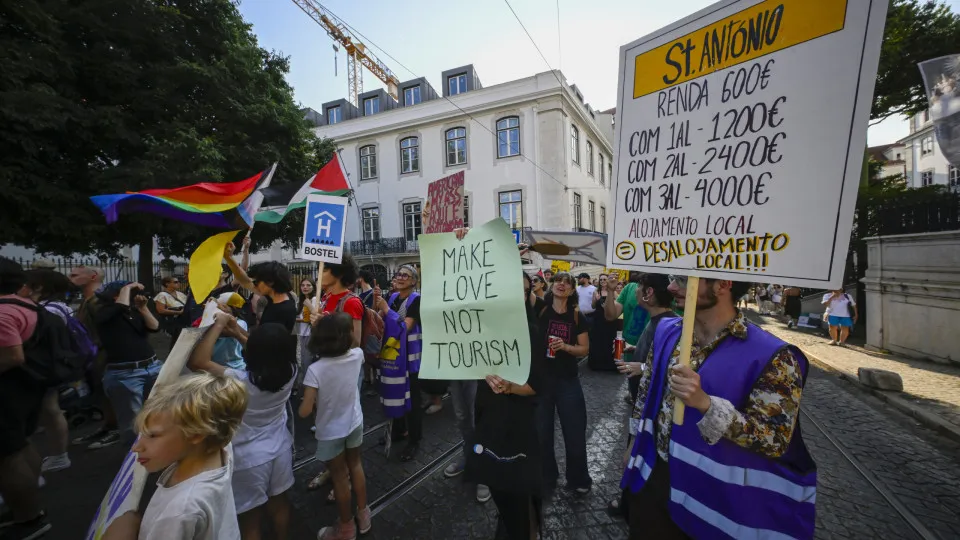
Camps not only serve to convey “the demands” on access to housing, but they are also an occupation of the city, they have highlighted several participants in a debate held today in Lisbon.
© Horacio Villalobos#Corbis/Getty Images
29/10/2026
by
Lusa
Acamped not only serve to convey “the demands” on access to housing, but they are also an occupation of the city, they pointed out several participants in a debate held today in Lisbon.
A hundred people sitting on the ground, in a circle, in Praça D. Pedro IV, today debated the city as a public and collective space.
“ This camp has demands, but what it is doing is conquering territory”, said Luhuna Carvalho, philosopher and activist, recalling that “the city has always been the scene of confrontations” and “space is a reason for constant dispute”.
Social worker António Brito Guterres recalls that the square, known as Rossio, was in the past the point that intermediated the inside and the outside of the city.
“ But the spirit of this camp is to end with rossios and everyone can be everywhere ", stresses, vindicating that, more than demonstrations, it is important to occupy the public space.
Luhuna Carvalho agrees, highlighting “the wealth of discussing in public space”, at a time when the square welcomed several debates at the same time and also outdoor cinema and activities for children.
“ We are creating ties that will be the core of the struggles that come”, anticipates.
Nuno and Carla, who have been in the popular assemblies of Rossio every day, described the life and population of the neighborhoods where they live (Quinta Grande and Curraleira, respectively) and the relocation processes to which they were subjected, to which they point harsh criticism.
The inequality of opportunities and structural weaknesses, such as the lack of transport, are part of the routine of those living in certain neighborhoods, they report.
This and “the fear of the police”, because they deal “since always” with interventions similar to those recently carried out in Lisbon and Porto to disperse the protesters and force them to dismantle the tents placed in squares.
“ We are in the city, but we do not feel we are part of the city ", Nuno recognizes.
Carla, accompanied by two children, tells how the smaller neighborhoods “don’t always have a chance to come and explore the city”, because when you live “very deep” and get home from work at ten o’clock, you no longer have time or energy for anything.
The same energy “is difficult to maintain, when it comes to sleeping on the street and returning every day”, says João, a teacher who, still a student, participated in the 2011 campgrounds against the capitalist system.
“After 15 years, what’s amazing is seeing people so politicized, organized, firm, is incredible”, notes.
Perhaps because the housing crisis does not show signs of retreat, as demonstrated by the testimonies of several residents of the neighborhood of Urmeira, in Odivelas, who shared their accounts with the Lisbon Camp.
“There are at least five or six families at risk of eviction,” estimates Miguel Dores, on behalf of the working group on the conditions in the neighborhoods, who is trying to support the residents of Urmeira.
At the age of ten, Nico accompanies Aunt Carla, and even if he rejects the microphone, he has something to say: he thinks that everyone should be entitled to a house, and a couch.
Today, the daily popular assembly of the Lisbon Camp will take place at 9:00 p.m. and not at the usual 7:00 p.m.
In the popular assembly of Wednesday, it was approved the realization, next Saturday, of a new demonstration between the Marquis of Pombal and Rossio, followed by a concentration in Rossio.
The protesters demand the reversal of the new rental law, the end of demolitions and evictions without alternative housing, a stop to housing purchase by real estate funds, the increase in public housing, the recovery of vacant buildings for housing purposes and ceilings “truely accessible” to income.
The camped by the right to housing began on October 10, in Porto, and then extended to Lisbon.
On Sunday morning, PSP dispersed, with batonada and with the use of dogs, the demonstrations in Lisbon and Porto, after more than two hours of tension and orders for people to leave and remove the tents.
The protesters did not follow orders, invoking the constitutional right to the demonstration, in what has been accompanied by several lawyers, while the PSP has based its interventions on a 1974 decree-law, which states that the protests cannot go beyond 00:30.
The Internal Administration Inspectorate (IAI) opened a process following the police interventions on Sunday, which caused dozens of prisoners and wounded, and the ombudsman also requested information from the PSP, as a matter of urgency.
The leftist parties criticized police intervention and asked for clarification from the Prime Minister and the intervention President of the Republic, António José Seguro.
The head of state appealed on Tuesday to the dialogue on housing “and never to violence”, stating that he did not like the images he saw, but awaits the results of investigations on police action on demonstrators.