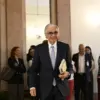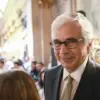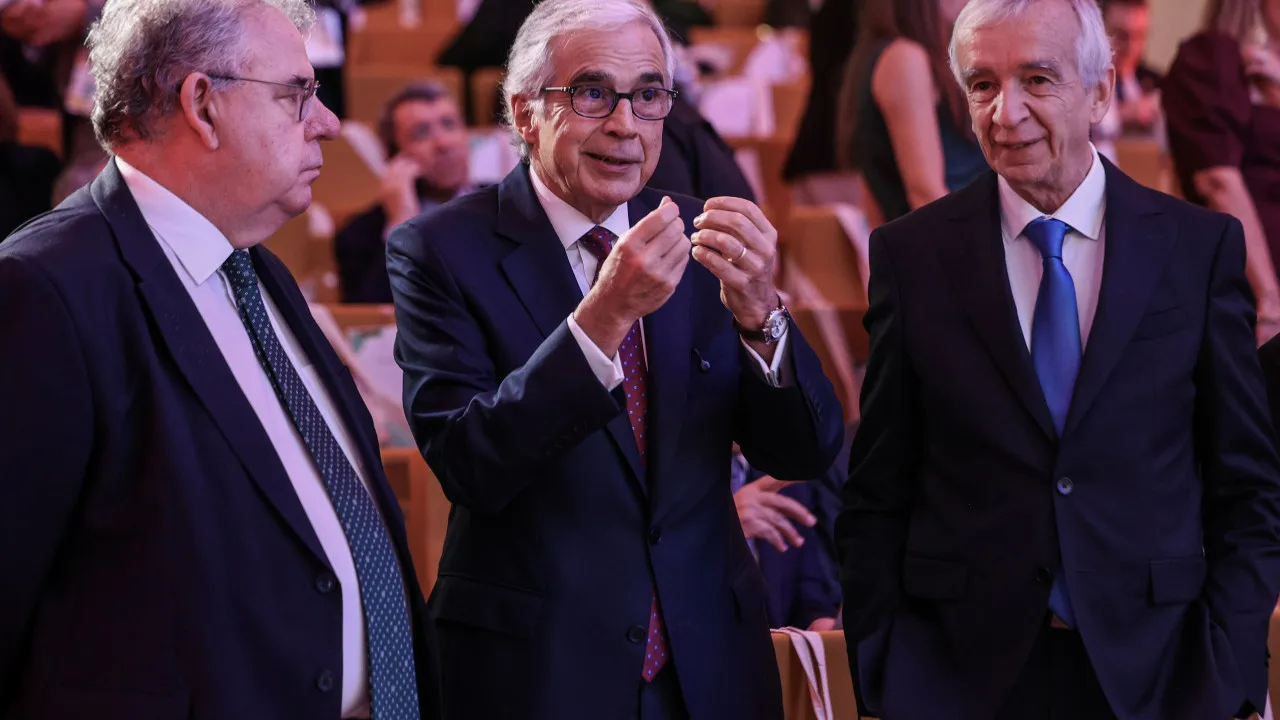
The President of the Assembly of the Republic today considered that politicians should listen to the street, but stressed that the decisions belong to Parliament and there is no “Soviet” of Rossio or of D. João I Square.
© Lusa
19/11/2026
by
Lusa
O president of the Assembly of the Republic today considered that politicians should listen to the street, but stressed that decisions belong to Parliament and there is no “Soviet” of Rossio or of D. João I Square.
This criticism by José Pedro Aguiar-Branco of the alleged legitimacy of the popular assemblies of Lisbon and Porto, held in the context of protests for the right to housing, was made in the speech he gave at the opening of the XX Annual Meeting of the Superior Council of the Magistracy, in the Pavilion of Portugal, in the Park of Nations.
In his speech, the President of the Assembly of the Republic stressed that, in a mature democracy, “the government, Parliament, legislation, courts administer justice and police forces ensure compliance with the law”.
“ Each institution shall exercise the powers conferred upon it by the Constitution and the law. The public square is, of course, a place of freedom, demonstration, contestation and debate. But it is not a place where one decides, in the margins of the institutions, what law is in force or how it should be applied ", said.
Then he accentuated: “There is neither the Soviet of Rossio nor the Soviet of D. João I Square”.
“There is a Constitution, there is the law. And the law is the same for all. The same Constitution protects freedom of expression and the right to property. It protects freedom of expression and the right of political participation. But also freedom of the press and the right of all to circulate in public space. None of these rights can be ignored”, he added.
Next, in statements to journalists, the President of the Assembly of the Republic reiterated his thesis that the right to demonstration is important, even essential, since it is one of the principles that the Constitution consecrates”.
“ But it is not on the street that matters are decided, it is in the Assembly of the Republic. Therefore, politicians must listen to the street, they must debate with the street, but the decision, the legislation that is taken, the solutions that are found is in the space proper to our Constitution consecrates, which is in the Assembly of the Republic ", said.
José Pedro Aguiar-Branco later said that he is sometimes amazed “with those who defend the Constitution, but think that decisions can be taken in a space other than that which the Constitution itself defines: The Assembly of the Republic”.
“ Where the power of the people resides is in the Assembly of the Republic, the result of free, direct and universal elections. There is no representation by calculation, no representation by perception, no representation by probing. There is only representation expressed in free, direct and universal elections by the Portuguese. We must never lose sight of this, because otherwise we will be subverting the democratic regime itself”, he warned.
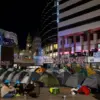
Rather, in his speech, the President of the Assembly of the Republic referred directly to the camps, protests for access to the right to housing.
“ For several days the correct interpretation of the law was discussed. We had commentators to discuss with journalists, protesters to argue with police forces, it was discussed whether the law had constitutional coverage or not, whether the interpretation of the authorities was adequate or excessive, whether its application respected the principle of proportionality,” he observed.
However, the President of Parliament indicated, “it was a judicial decision, even made with unusual speed, which brought clarity to the debate”.
In this context, José Pedro Aguiar-White said he had “difficulty in understanding who celebrates a judicial sentence without reading it to the end, who confuses a decision on a specific case with a general decision, who ignores the rules and mechanisms of appeal provided for in our legal order”.
“Respecting a judicial decision is also respecting its fundamentals, its scope and its limits,” he said.
Next, in statements to journalists, he said he was amazed when he attended some television debates on the interpretation of the law in any square in the country. Debates “with journalists, commentators, people who say they dominate the logic of law and law and that look like a kind of popular trial”.
“ This is not acceptable in a democratic rule of law where the government, the Public Assembly and the courts are the rules. This is the archetype of the democratic rule of law. I swore to defend the Constitution and I will do so until the last day of my term”, he added.