
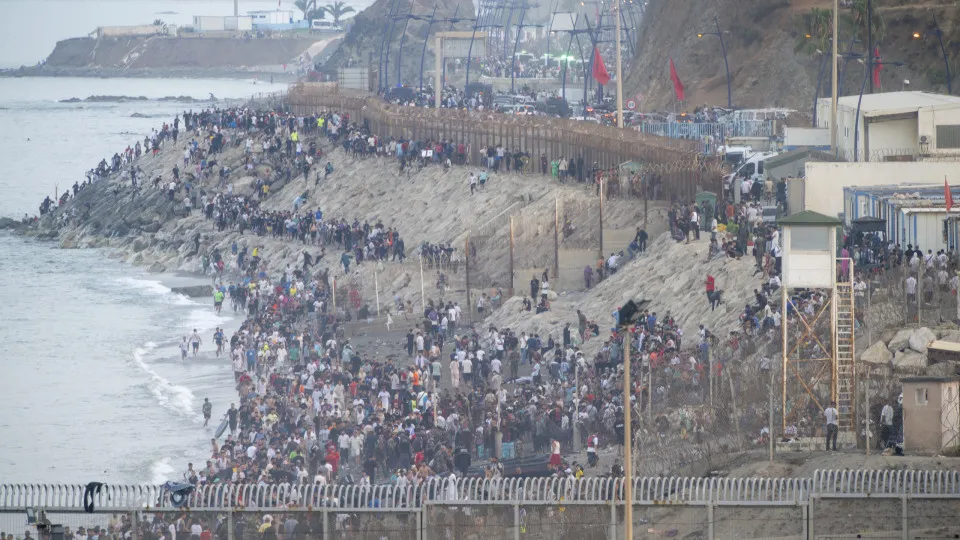
The Spanish National Intelligence Center (CNI) states that Moroccan authorities were aware of a mass entry into Ceuta at the end of July and acted irregularly in the prevention and control of the crisis, according to a report delivered to justice.
© Marcos Moreno/Europe Press via Getty Images
16/10/2026
by
Lusa
Ospanish intelligence services say that Moroccan authorities were “fully aware” that a mass entry was being prepared in Ceuta at the end of July and acted “very irregularly in preventing and controlling the crisis”.
Morocco’s authorities knew “in detail” the summons that circulated on social networks, and that had “a great follow-up”, for a mass entry into Ceuta coinciding with the Feast of the Throne, the Moroccan holiday of July 31 whose official celebrations this year, in a locality about 25 kilometres from the Spanish city, says the Spanish National Intelligence Center (CNI), in a report known today.
The document was drawn up and sent to the judge of the National Audience who is investigating what happened in Ceuta on 30 and 31 July, when more than 70,000 people illegally entered the Spanish enclave in North Africa within 24 hours.
“They were fully aware of what would produce this flow” of people and “absolutely aware that an abnormal situation was being generated in terms of attempts at irregular entry” in Ceuta, wrote the Spanish secretaries in the report delivered to justice and quoted by various media in Spain.
The CNI says that, in addition, the Spanish information services themselves sent warnings on 29 July to the congener services in Morocco, warning the Facebook and WhatsApp groups where they were preparing to enter Ceuta, with the indication that they were pointing to 20:00 on 30 July.
The avalanche of people at the Ceuta border took place from 11:00 on 30 July.
The CNI states that in the previous days and until July 29 there was “certain proactivity in interception” of groups of people who tried to move to Ceuta by Moroccan forces, but then the device proved insufficient, as well as “an attitude of passivity” that led to the uncontrolled situation.
Morocco has only begun to apply more stringent control measures after the peak of entry, according to the report.
“ It is considered that one of the reasons for this insufficient mobilization is due to the fact that the Moroccan authorities decided to prioritise the security of the celebrations of the Feast of the Throne in the nearby Moroccan town of Rincón, since King Mohamed VI was present in the palace of that locality, where the ceremonies took place”, reads in the CNI document.
The Moroccan authorities have thus shown “very irregular action in crisis prevention and control,” Spanish intelligence services say.
The CNI also points out that elements of the Spanish secret services and the chief of staff of the Delegation of the Government of Spain in Ceuta maintained communications on the possibility of a mass entry of people into the city at the end of July.
On September 9, documents disqualified by the Spanish Government had already revealed that the information services alerted, on July 29, Morocco and the delegation of the Spanish executive in Ceuta for “several summons to carry out entrances” in the city on July 30, 20:00, in social media groups with 180,000 people.
On the other hand, on September 2, several Spanish media also released a police report describing what happened in Ceuta in July as a “planned” action that had “total permissiveness” and even support from elements of Morocco’s security forces.
This document, drawn up by a Spanish police intelligence unit, was also sent on Monday to the judge who is investigating the entry of tens of thousands of people in Ceuta on 30 and 31 July illegally.