
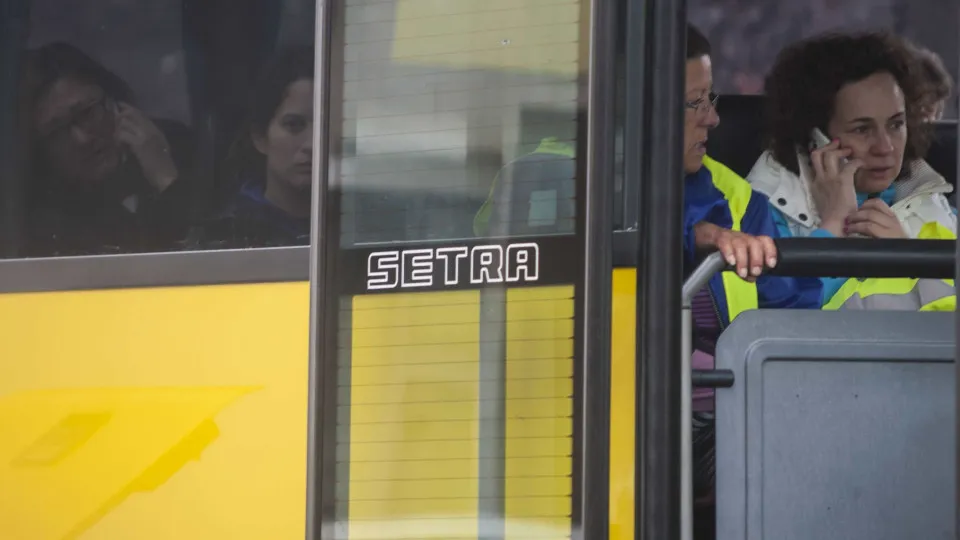
The restructuring of the urban transport network in Coimbra provides for a reduction from 112 to 52 lines, with shorter extensions, greater frequency and greater complementarity with other operators.
© Global Images
16/10/2026
by
Lusa
A proposed restructuring of the urban transport network of Coimbra estimates the creation of 52 lines, rather than the current 112, with shorter extensions, higher frequencies and greater complementarity with other operators.
The base of the restructuring of the network of Municipalized Services of Urban Transport of Coimbra (SMTUC) today had in Eiras the first of three public presentation sessions, after a first initiative addressed to the presidents of the parish councils of the municipality.
The philosophy of the network, which is not yet closed, presupposes fewer lines, shorter average extensions, higher frequency, elimination of redundancy and a simpler reading compared to the current system, which has 112 lines (and more than 200 different routes) and little integrated with new operators on the ground (intermunicipal transport and ‘metrobus’), said Sandra Lameiras, from OPT, a company responsible for the study.
Line reduction does not presuppose the reduction of network connectivity, which is one of the requirements of the specifications.
From an average extension of 19 kilometres per line, the proposal that begins to be discussed with the population proposes an average extension of lines of 12 kilometres and a complementarity between lines and operators, with the creation of transshipment interfaces, informed the responsible, who spoke during the presentation session that took place today at the end of the day in Eiras.
According to the OPT, the proposal provides for seven neighborhood lines (short and high frequency lines to ensure proximity coverage in the central area of Coimbra) and five urban lines, connecting the main centers of attraction of the city, such as hospitals, universities, shopping centers and others.
In addition, two larger circular lines (about 15.8 kilometres) are planned, each one operating in both directions and with one serving the left bank of the county and the other the right margin.
The bulk of the lines of the new proposal focuses on the so-called radials, connecting the periphery to the centre, where an increase in frequencies is proposed, but reducing its size.
The radial lines are divided by sectors (north, south, east and west).
According to the director of the Department of Mobility, Traffic and Transport of the Chamber of Coimbra, Tiago Cardoso, what is now being presented is “a work base developed over several months”, which completely reformulates the current SMTUC network.
“ We no longer have a logic of lines that cross the whole city and we start to have a logic by quadrants: north lines, from center, south, east and west, and then hit specific points with other lines ", said.
Thinking of a logic of complementarity between operators, the goal is for people to reach their final destination with the maximum of a transhipment, clarified.
Although some lines continue to have a similar configuration compared to those currently in existence, their names will also be changed (north lines will be N, neighborhood B, urban U and C circulars).
With the reduction of the average length of the lines, Tiago Cardoso states that it will be possible to increase the number of trips and ensure a higher frequency.
“ We are not limited to what is the ability to execute SMTUC. If in the end it is found that SMTUCs do not have the ability to do, what can be done is eventually the service is granted partially. We may have certain areas to be made by a concession,” he said.
After these three public sessions (beyond today's session, there are two on Saturday), the municipality intends to create a specific site with the proposal and a simulator so that users can simulate their trips and present contributions and criticisms.
The new network will have to be ready when the ‘metrobus’ operation is completed, with the completion of the hospital line effort, which is estimated to take place at the end of the first quarter of 2027.