
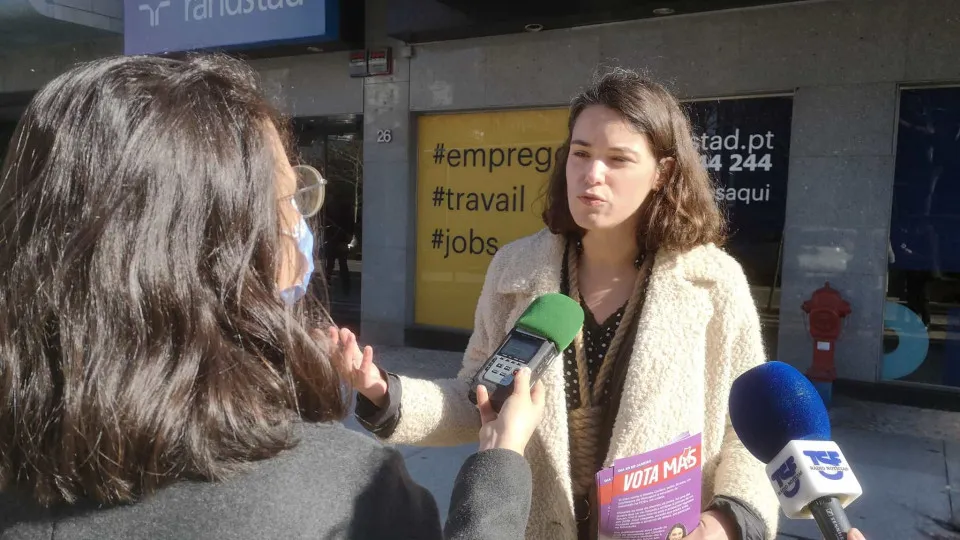
Renata Cambra, author of the subpoena decided favorably on her right to camp in the protest for housing, today argued that “it would be absolutely absurd” for the decision to apply to herself, for the sake of equality before the law.
© Facebook/ Socialist Alternative Movement
02/11/2026
by
Lusa
Renata Cambra, author of the subpoena decided favorably on his right to camp in protest for housing, today defended that "it would be absolutely absurd" that the decision should apply to itself, for the sake of equality before the law.
“ Obviously all this concerns a collective protest. It would be absolutely absurd for the court to say that this is valid for a citizen and that all other citizens of this Republic do not have access to the same rights,” Renata Cambra told Lusa about the decision of the Lisbon Administrative Court, now known.
The sentence allows the petitioner to remain in Rossio Square, the site of protests and camped in Lisbon, beyond 12:30 a.m. – evoked by the police as the time limit of demonstrations based on a 1974 decree-law - allowing her to remain in the place with a tent.
Renata Cambra considered “tragic the attitude of the Ministry of Internal Administration (MAI)” on the court’s decision, stating that it only applies to you.
The author of the action stated that the court gave as evidence several previous camped, “all collective protests”, that the court uses “precisely to substantiate the attitude that has been taken, which is illegitimate and which, of course, puts into question here even the constitutional right to equal treatment”.
Regarding the fact that the sentence does not make the recognition of a general right to set up “tenders in public space by an undetermined number of participants”, Renata Cambra said that the number of tents that protesters have intended to keep in protest has been stable and that the government or police use that point as an argument makes no sense.
He added that it also makes no sense to fear situations comparable to the protests in France, stressing the peaceful nature of the demonstrations in Portugal, or that the camps will continue indefinitely, because the subpoena itself refers to “a very specific calendar, which has to do with the vote on the State Budget on November 24”.
“ Therefore, none of this has any place, this has already been absolutely unfair and discretionary, the government cannot continue to do the same thing and to invent lame excuses”, he said.
“ The truth is, the sentence makes an assessment of illegality. The PSP at the moment, and in the face of all the wounded that we already have, all the prisoners arbitrarily, this unequal treatment in relation to the previous camps that have not been subjected to this repression and this intimidation, the only thing to do by the security forces and in particular by the Government is to respect the right to demonstration and meeting, in the ways in which it has occurred”, he added.
Renata Cambra asked for “a minimum of humility” from the political leaders, as well as “a minimum of common sense”, criticizing situations such as last night in Rossio, where motorists who honked in solidarity with the protest were fined.
The Lisbon Administrative Court considered, on Sunday, that the limit of 00:30 for demonstrations is not “absolute and automatic”, authorizing a protester to remain at dawn in Rossio, in Lisbon, with a tent, until 24 November, when the State Budget is voted, and respecting the Christmas Market foreseen for Rossio Square.
In the decision, the court also ordered the PSP and the Lisbon Municipal Police to refrain from “adopting measures of dispersion, cessation or removal of the right of demonstration” of the citizen concerned “if it is being exercised in the manner prescribed”.
The sentence solves a subpoena for protection of rights, released and warranties brought by a protester, Renata Cambra, against the Ministry of Internal Administration and the Municipality of Lisbon and, in the case, was not appreciated “the legality of a collective occupation” of Rossio or the recognition of a general right to assemble “tenders in public space by an indefinite number of participants”.
Although abstaining from examining the legality of police interventions, the court recalls that the right of demonstration is protected by the 1976 Constitution, arguing that “a general prohibition applicable to any demonstration after 00:30” without meeting the characteristics of this “hardly meets the requirements of the principle of proportionality”.
In reaction, the MAI today stressed that the administrative court’s decision on housing protests does not appreciate the legality of police interventions and does not recognize the right to tents in public space.
In a statement, the ministry led by Luís Neves considered that the decision known today “is limited to an individual and concrete situation, limited to the applicant’s request”, which is, in this case, Renata Cambra.