
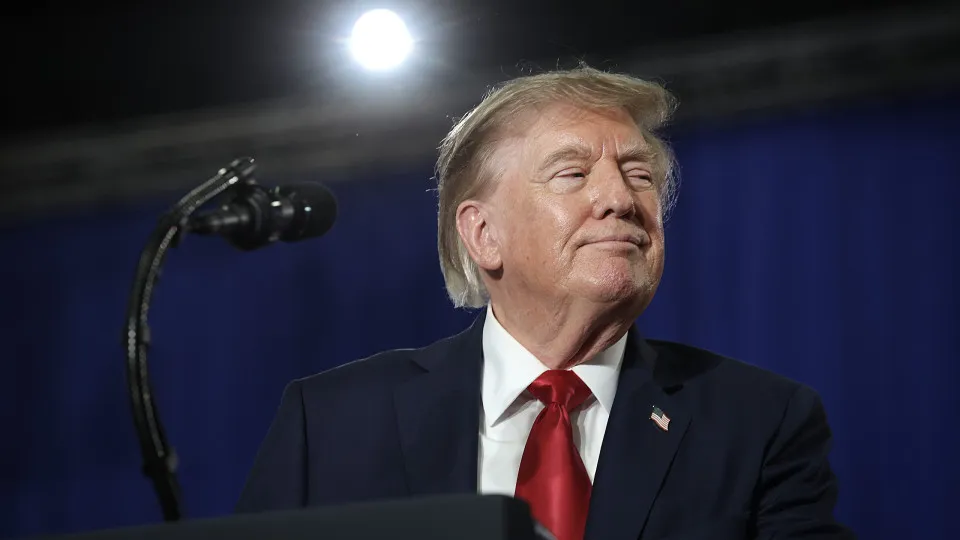
The President of the United States, Donald Trump, asked the Supreme Court to prevent the counting of 20,000 mail votes in California, claiming that they belong to people who may not be American.
© Win McNamee/Getty Images
02/11/2026
by
Lusa
O President of the United States, Donald Trump, asked the Supreme Court to prevent the counting of 20,000 mail votes in California, claiming they belong to people who may not be American.
The appeal was lodged on the eve of Tuesday's mid-term elections and puts the matter before the Supreme Court, where conservative judges hold a majority of six against three.
Trump intends to reverse a decision of the Federal Court of Appeal of the Ninth Circuit, which on Friday rejected the intervention of the federal authorities in the counting of votes in California, considering that this would invade state powers.
The appeal court confirmed a October 29 decision by federal judge David O. Carter, who refused the restraining order requested by the US Government.
Carter considered that the measure would cause serious disturbances in an electoral process already underway, at a time when tens of millions of Americans had voted in advance.
“If the executive power can dismiss votes and threaten ongoing elections on the basis of unproven accusations, then our democracy is in danger,” said the magistrate, appointed by former Democratic President Bill Clinton.
In the decision, the judge highlighted the unprecedented nature of the attempt at federal intervention in the administration of elections, a competence traditionally attributed to the states.
“ Never before in the history of the United States had the federal government, on the eve of an election, tried to coerce a state and local government to abandon its own constitutional electoral procedures and submit to the will of the executive power,” the judge said.
The magistrate added that, by filing the lawsuit, the federal government seemed to want the court to recognize the executive as the sole sovereign power.
The process originated from an initiative by the Department of Justice, which handed over to the authorities of Los Angeles County and the California State Secretariat a storage device containing data from more than 20,000 people identified as presumed non-American citizens.
The government demanded that the electoral authorities check the registers and separate their voting papers within 48 hours, using the crossing of immigration and social security databases.
Judge Carter questioned, however, the reliability of the methods used by the federal government to identify potential voters without voting rights.
As an example, he mentioned a case in Nevada, where the Department of Homeland Security had initially identified almost 16,000 presumed non-citizens registered in the electoral notebooks.
After successive verifications, the number was reduced to 185 people, and it was later confirmed that all legally owned US nationality.
According to Carter, accepting the government’s demands on the basis of a “full procedure of uncertainties and errors” would imply the risk of “deprive US citizens of the right to vote”.
The appeal to the Supreme Court arises in a context of Trump's growing challenge to electoral procedures, although the state authorities are responsible for organizing and supervising the elections in the United States.
Tuesday's mid-term elections will determine the composition of Congress during the last two years of the current presidential term.