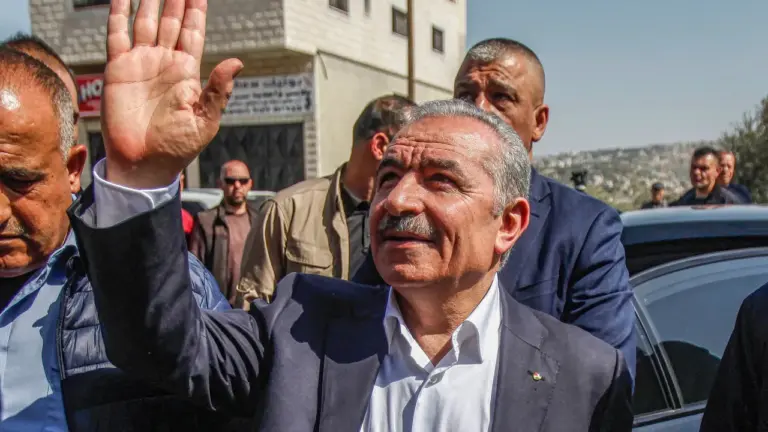
Former Prime Minister of the Palestinian National Authority believes that Gadi Eisenkot, in charge of forming the new Israeli government, can take small steps towards peace in the region.
© Getty Images
24/11/2026
by
Lusa
O former Prime Minister of the Palestinian National Authority today said he believed that the opponent Gadi Eisenkot, tasked with forming the future Israeli government, would not be a continuation of Benjamin Netanyahu's record, and could even take "small steps" towards Palestine.
“No, it will not be ‘Netanyahu Part 2’. I think Gadi Eisenkot is very different. Very different,” Mohammad Shtayyeh said in an interview with the Lusa agency in Lisbon, where he participated in the conference “Palestine, Europe and the Future of Peace: What a role for European Policy”.
The former Prime Minister of the Palestinian National Authority (PNA) from April 14, 2019 to February 26, 2024 – was chief executive at the time of Hamas’ attack on Israel (October 7, 2023), but recalled that “Israeli society turned to the right, to the far right, becoming very radical.”.
“ And today we live in what I consider to be a religious Zionism. Zionism has changed from secular Zionism, from national Zionism to religious Zionism, which means that the idea of a Palestine is not in the minds of the Israelites. So if Eisenkot, and this is a great thing if, if a government is formed, then he can take small steps in favour of the Palestinians” and for peace in the region, he said in his statements to Lusa.
“ Perhaps you will remove some of the check points, perhaps put an end to the terrorism of the settlers, perhaps release some money that Israel is blocking, blocking our money. So Eisenkot is not a second Netanyahu, he is different”, defended the former ruler.
Shtayyeh stressed that he hoped that the international community, in particular Europe, would not support any new Israeli government unless it made commitments that would enable the Palestinians to hold elections and have access to money, as well as to end settlements and thus “end the terrorism of the settlers”.
Eisenkot has until 6 December – a deadline that can be extended for another 14 days – to form government, after the legislative elections of late October that did not give absolute majority in the Knesset (Israeli parliament) to either side, nor the so-called bloc of change, led by the Yashar party! of Eisenkot, nor the pro-government bloc led by the outgoing Prime Minister Benjamin Netanyahu.
With only 48 of the 120 seats in parliament, the former Chief of Staff of the Army has the necessary support to reach the 61 necessary seats and form an executive, but his bloc remains divided as to the strategy to be adopted: joining the ultra-Orthodox parties, approaching the Arab groups or forming a government of national unity with the Likud of Netanyahu.
The latter formula, actively advocated by Netanyahu, can be based on a rotation between the two in the position of prime minister, a system already tested in Israel.
Within the Palestinian policy, Mohammad Shtayyeh admitted that there are “difficulties” in the relationship between Fatah (associated with the Palestine Liberation Organisation – PLO) and Hamas, which will have to accept the conditions of the Government of the NPA if it wants to contribute to future elections, the formation of a government of national unity and the creation of a sovereign state.
“ Anything's possible. We're talking to Hamas now. We want Hamas to come to our side. We're not going to Hamas' side. We want them to come to our side, which means that we want Hamas to accept two states with the 1967 borders,” he said.
Last October, the leader of the Palestinian Authority, Mahmoud Abbas, scheduled simultaneous presidential and legislative elections for 11 September 2027, postponing for almost a year the parliamentary scrutiny, which was scheduled for this November.
“ We want Hamas to accept the PLO as the only legitimate representative of the Palestinians. We want Hamas to accept an army, a country, a law, an authority, not a militia. We want Hamas to accept the PLO commitments, all the agreements that the PLO has signed. So far, he is not accepting all these assumptions, but we are negotiating with them,” Mohammad Shtayyeh, a training economist, said.
“ We hope that the elections will bring everyone under the ‘hat’ of the parliament, and that we will have some deliberations, dialogues, negotiations with all the political parties that will be represented in the Palestinian parliament. But before Hamas enters the election, we want you to accept the political principles that have already been put on the negotiating table”, he insisted.