
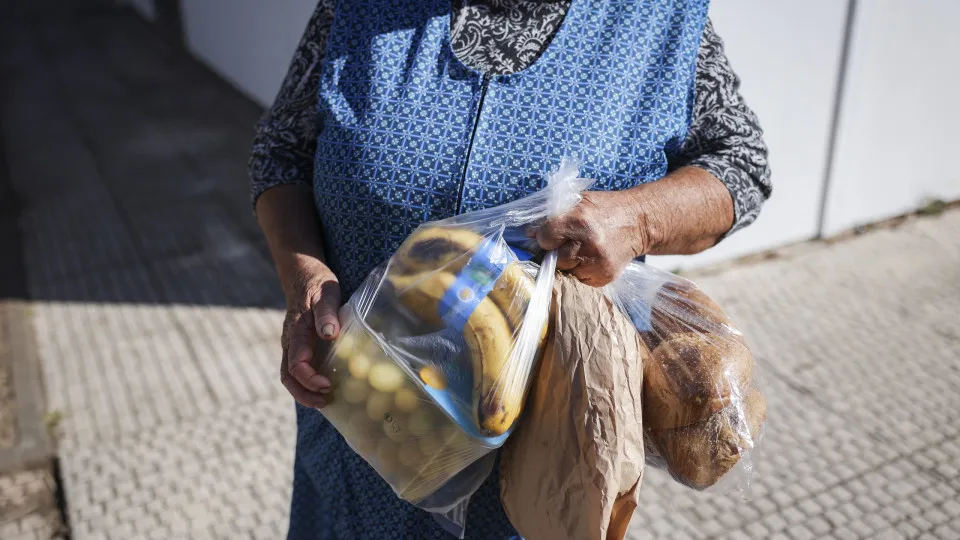
The increase in the cost of living is forcing many immigrant families in Portugal to reduce food expenses and resort to donations to meet monthly charges.
© Lusa
08/11/2026
by
Lusa
immigrant families
A increasing the cost of living is aggravating the difficulties of many immigrant families in Portugal, which, like other Portuguese, reduce food costs and resort to donations to meet monthly charges.
In the Unidinhos de Cabo Verde kindergarten, Casal da Mira, Amadora, there are people who worry about the situation and on Monday, the center delivers food baskets to people in need, for whom wages and pensions no longer cover expenses.
It's 10:00 a.m., and in the kitchen, the smell of the cooking you're picking up on a pannel is already eating up. Soon, the stew will be served for lunch to the children of the center, to the staff and to anyone who needs it.
In the three nursery rooms, children between the ages of 3 and 5 receive a food boost. Many did not have breakfast at home, due to lack of conditions or because their parents, rushed, did not have time.
They are practically all from families in need, in which what they earn “is not enough for basic needs, for food, to wear,” says Cesaltina Gomes, known as Avó Ciza, an education assistant and one of the pillars of the center, where she has worked for almost 40 years.
It is also through his work that support reaches families, with the collection of donations from a known hypermarket made on Sunday.
For those who receive food, help makes a difference in everyday life, marked by the difficulties experienced by the rising cost of living, especially with food and energy expenditure
The pressure on family budgets has particularly difficult consequences for those with low incomes and the increase in prices has led immigrant communities to consider staying in Portugal.
Some go looking for better incomes in France, Switzerland and Luxembourg, especially the younger ones, who seek work in restaurants, cleaning and as educational action assistants, reports Cesaltina who has seen friends leave in search of better conditions.
D. Natalia, D. Maria and D. Lena are already there to collect the food they need. They are of Cape Verdean descent and have lived in Portugal for decades, like many of the residents of that Amadora neighborhood, where many former residents from the Estrela da África and Fontainhas neighborhood were relocated.
Maria Natalina Lopes, 53 years old, worked in cleaning, cared for the elderly and passed by restaurants. Today, however, the parrots slaughter his back and he can no longer stand for many hours, so on Mondays and Tuesdays he goes through the kindergarten to collect food. He gets a pension, but the money doesn't pay the rent, the water, the light, the gas and the food.
“ Sometimes there are things we can't buy even ", regrets.
He says he's also been looking for work, but age makes it difficult.
She has seven children, two of whom still live with her: the youngest, 14 years old, is studying, and the 22 does not work.
“ Food is very expensive, there are things we don’t even buy and the options go to chicken or hake, sometimes”, complains.
The difficulties, he considers, are not limited to immigrant families. “Suffer a lot,” he says, referring also to the Portuguese. “We go to Lisbon, we see many people sleeping on the street (...) It is sad”, he says, pointing out the costs of the gas tank, which is “at the price of gold”, water and light, in the face of wages and pensions that remain low.
Ana Maria was born on the island of Santiago in Cape Verde 70 years ago. Also a widow, she recently started resorting to support from the center after hearing about donations. The income of EUR 300 weighs on the budget, which depends on the pension and widowhood pension to meet the needs of six people, including three children and two grandchildren.
The food basket is therefore a “good” help, he says.
“ We can't eat the food properly, we have to buy what we can. With six people at home can you buy anything? You can buy pasta, chicken, the cheapest things. When we arrive at the end of the month, we pay the water, pay the light, pay the rent, we already have nothing for the house ", notes.
Every once in a while, he visits his family in Cape Verde, and although he feels that everything is better and that everything is cheaper, he does not think of returning. The children also do not want to go back, preferring to go only “to take a vacation”.
“Not staying there, we’re used to it,” he says.
Lena, also a resident of the neighborhood and of Cape Verdean origin, arrived in Portugal in 1973, coming from the island of Santiago. He says that life is becoming increasingly difficult, especially because of the price of food, and calls attention to families “who are lacking in what to eat”.
“A few days ago I went to buy a kilo of onion, it was 1.69 euros. I got scared,” he said.