
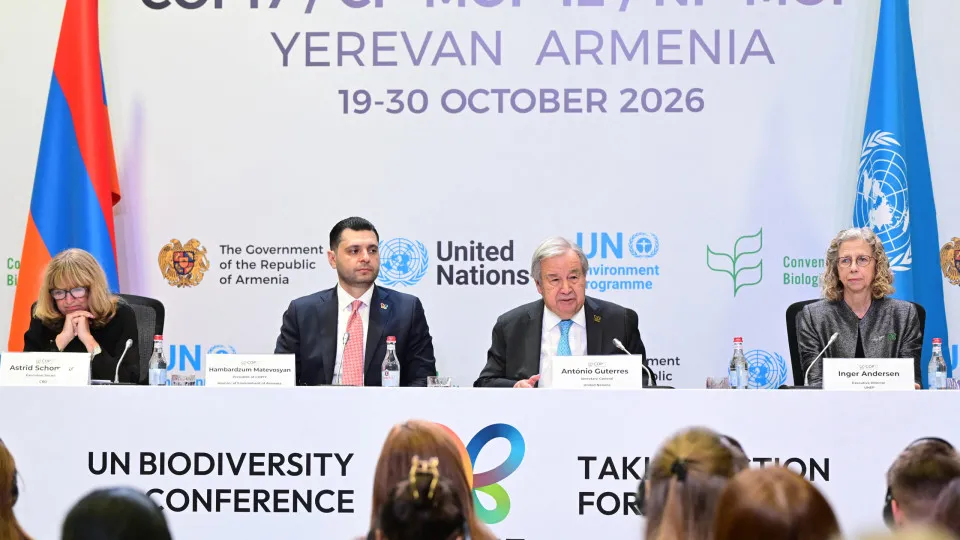
The variety of life on the planet will be the focus of the UN from Monday for two weeks at the 17th meeting (COP17) of biodiversity, with funding and nature protection at the center of the debates.
© KAREN MINASYAN / AFP via Getty Images
17/10/2026
by
Lusa
COP17
A variety of life of the planet will be from Monday the UN focus for two weeks at the 17th meeting (COP17) of biodiversity, with funding and nature protection at the center of the debates.
In Erevan, Armenia, under the theme "Taking action for nature", thousands of participants will meet by day 30 at the 17th Conference of the Parties to the Convention on Biological Diversity (CDB), also taking place the 12th meeting of the Cartagena Protocol on Biosafety, and the 6th meeting of the Nagoya Protocol on access to genetic resources and fair sharing of benefits (both linked to the CBD).
The UN conferences on biodiversity (variety of life forms, their ecosystems and relationships) take place every two years. The conference on climate change and the conference on desertification were set up at the so-called Earth Summit in Rio de Janeiro in 1992.
Conferences, COPs, are intended to assess progress and targets in protecting planet biodiversity and to set new objectives. COP16 took place in Colombia (and then last year it resumed in Rome) and COP15 had been in Montreal, Canada.
This issue is important, because in Canada the Global Framework of Biodiversity Kunming-Montreal (the conference took place first in Kunming, China) was approved and now, in Erevan, the first global review of the progress of countries on the 23 global targets to reverse biodiversity loss will be made and signed by 196 states. One of them was the protection of 30% of land and sea by 2030.
For COP17, the CBD recently presented the Global Progress Report (the implementation of the agreement signed in Canada).
And it is very clear: the Kunming-Montreal document has generated unprecedented global involvement, but if we do not speed up quickly “the goals and mission of 2030 will not be achieved”.
Although it is too early to detect changes in biodiversity results, “the slow pace of current progress poses a long-term risk,” the CBD warns environmental organizations to ensure that almost none of the targets are on the right track.
“None of the targets presents a totally positive picture”, can be read in the document.
UN Secretary-General António Guterres said two days ago in Erevan that “there is still a big gap between promises and actions.”.
The world is living “a gap between ambition and action” when it comes to protecting nature, “less than half of the national biodiversity targets are being met,” said António Guterres in Erevan.
He also said that even if all countries fulfilled what they promised on biodiversity protection only 26% of terrestrial ecosystems and 12% of marine ecosystems would be protected by 2030.
Non-compliance with the commitment to the preservation of marine and land areas, or the case of subsidies for activities detrimental to biodiversity, which are not being reduced as agreed, by USD 500 billion a year, are central themes of COP17.
In Thursday's statements, António Guterres summarized: “This bad news means that the war against nature has not yet ended and we continue to suffer the dramatic convergence of these three global crises: the crisis of climate change, the crisis of loss of biodiversity and the pollution crisis, all closely linked.”.
On Friday, also in Armenia, where he attended a summit of leaders that preceded the opening of COP17, António Guterres went further, saying that “subsidizing fossil fuels is tantamount to subsidizing suicide,” adding that hydrocarbons are warming the planet and are “a scourge for biodiversity”.
“ The hard reality is that we are spending our money on the wrong causes. For each dollar invested in nature protection, $30 is spent on its destruction,” the Secretary-General said.
These issues will be central to COP17, an opportunity to take stock, correct paths and accelerate the process.
In Erevan António Guterres considered priorities changes in land use, climate action, containment of invasive species, combat pollution and control of direct exploitation of natural resources.
In COP17, and in addition to organizational issues, there are on the agenda the mobilization of resources and the financial mechanism, indigenous peoples and local communities, gender, synthetic biology and scientific support, health, invasive alien species, agriculture or climate change, all within the scope of biological diversity.
A week ago, the environmental organization WWF, in the “Planet Vivo Report” (bienal) this year warned that about 73% of the species on the planet are in decline, being more pronounced in freshwater ecosystems (-85%), followed by terrestrial ecosystems (-69%) and marine ecosystems (-59%).
COP17 precedes the UN climate change conference (COP31) in Antalya, Turkey next month.