
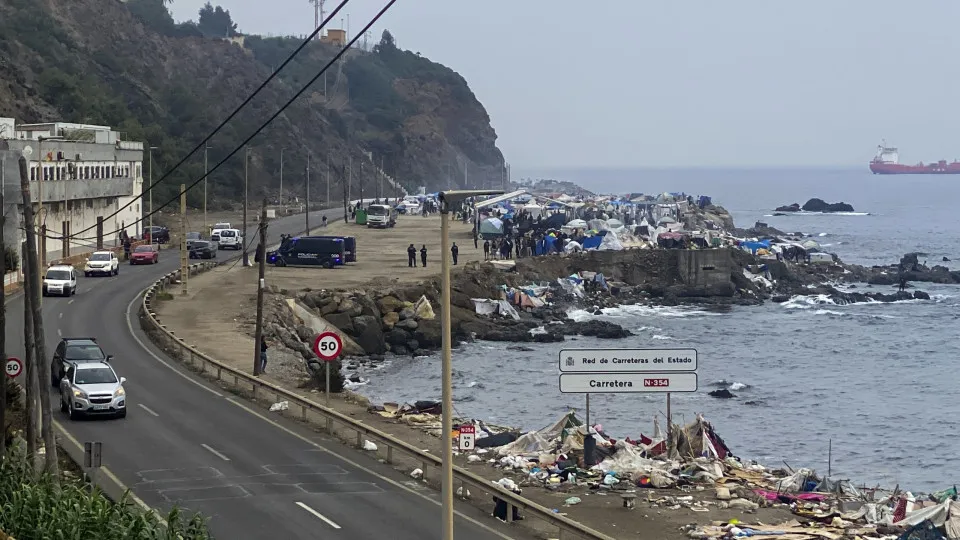
The Spanish Civil Guard estimated that approximately 88,146 migrants returned to Morocco after entering Ceuta at the end of July, according to an EFE report of 27 October.
© Lusa
06/11/2026
by
Lusa
A Spanish Civil Guard estimated that “approximately 88,146” migrants “had returned” to Morocco after entering Ceuta at the end of July, according to a report of 27 October to which the EFE news agency had access today.
The judge of the María Tardón National Audience, who investigates the massive entry of migrants in Ceuta on 30 and 31 July, already has on the table several reports that requested several weeks ago to different bodies such as the Civil Guard, the National Police or the National Intelligence Center (CNI) to try to clarify what happened.
Last Thursday it was known that the police identified two high Moroccan commandos, who appear in videos of the entrances to give instructions around the Bab Sebta border crossing in Fnideq (Morocco), near the border of Tarajal, and today another report came up, this time from the Civil Guard, which raises to more than 80,000 people who returned to the country of Magreb after the illegal entry into Ceuta.
This is a larger number than the government has so far. The Civil Guard report, dated October 27, focused on the deployment of personnel and material resources mobilized since this episode, points out that there were 862 rescues in national waters and 90 deaths.
Asked also about the number of repatriations, the National Police specified to the judge that it was only able to account for migrants who expressed their agents the willingness to return, a number “minimum compared to the one who, overall”, includes all those who voluntarily returned for the entry that the Civil Guard has kept open since the migration crisis in July.
Only the armed institute, explains the police in its report, can know this number because the massive entry, to which it refers as “invasion”, occurred in a zone that is “under the protection of the Civil Guard”.
In another report at the beginning of July, before the massive entry of migrants, the Civil Guard warned that the recent doctrine of the Court Supreme would increase the irregular entry by sea into the autonomous cities of Ceuta and Melilla, and warned for a possible “called effect”, proposing a strengthening of the provincial maritime service of the Spanish autonomous city in charge of preventing the access of swimmers, the officers of the Special Group of Underwater Activities in Melilla, to enhance the technological systems of early detection and coastal surveillance, and to regulate the possibility of applying the rejection regime at the border to any attempt at irregular entry outside the licensed border posts, regardless of the means used.
Among the documentation sent to the judge, there is also a report from the CNI of 30 July in which it analyzes “the situation and perspective” of what intelligence considers the “greatest displacement of migrants in the history of Spain in the Autonomous City of Ceuta”.
However, he considers that “the profound distortion between King Mohammed VI’s vision during his annual speech to the nation was evident” on 29 July and “the reality lived on the ground, at a time when Morocco tries to assert itself as a stability actor and a reliable security partner”.
Meanwhile, the government delegation in Ceuta announced today that on November 17th, the expansion of the Tarajal and Benzú border jetties will begin.
The government delegate, David de la Encina, announced these works and highlighted that on that day the arrival to Ceuta of the vessel that will start drilling to install stakes in the marine subsoil is expected.
David de la Encina indicated that during the months of August, September and October the Ministry of the Interior managed the “important amount of authorizations” necessary to carry out this work.
“ After this complicated process, on 17 November we will have in Ceuta the vessel to start this work of great importance with a budget of about 5 million euros”, said De la Encina.
The work will involve the reinforcement of the jetties about 150 meters inside the sea, from the base line of the current 50 meters jetty, and later will be complemented with the floating barrier, so, according to the delegate, “we may be talking about almost 500 meters of barrier that will avoid swimming entrances”.