
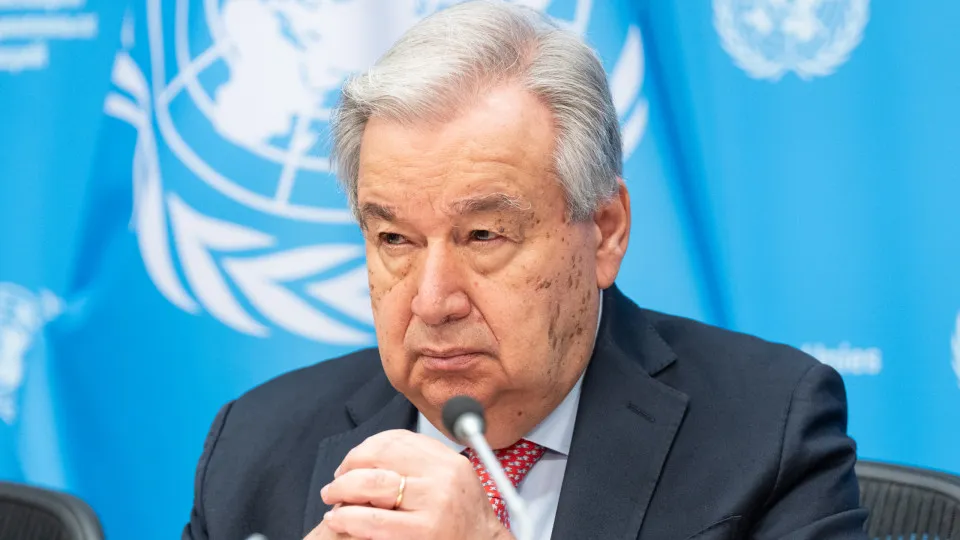
UN Secretary-General António Guterres warned of a worldwide wave of protests caused by rising cost of living and aggravated by international conflicts, calling on governments to combat inequalities.
© Lev Radin/Pacific Press/LightRocket via Getty Images
22/10/2026
by
Lusa
O uN Secretary-General António Guterres today warned of a worldwide wave of protests caused by rising cost of living and aggravated by international conflicts, calling on governments to combat inequalities.
In a statement to journalists, Guterres said that millions of people from Europe to developing countries face a persistent crisis in the cost of living, marked by rising food, fuel and other essential goods.
The Secretary-General of the United Nations also highlighted the increase in interest rates, which affects both families and states, and the deterioration of the economic prospects of younger generations.
According to Guterres, the accumulated frustration is becoming a wave of demonstrations on various continents, with citizens demanding answers from the authorities.
In France, protests over the last few days have caused at least two deaths, more than two thousand arrests, widespread pillage and the imposition of mandatory curfews located in cities such as Paris, Lyon and Marseille.
In Portugal and Spain, tens of thousands of people spoke out against the difficulties of access to housing, while in Italy protests against the cost of living, particularly in Milan and Bologna, gave rise to clashes with the police.
In Albania, demonstrations also degenerated into violent clashes, with security forces resorting to rubber bullets.
According to UN News, the Secretary-General also mentioned protests motivated by the economic crisis in Iran, following the devaluation of the currency, and demonstrations against immigration in South Africa, which caused victims in Durban.
Guterres recognized the depth of social discontent, but condemned the episodes of violence and destruction associated with some demonstrations.
He argued that perpetrators of criminal acts should be held accountable, stressing, however, the need for governments to respond to the economic and social causes of protests.
The Secretary-General considered that economic instability represents only part of the world crisis, alerting to the multiplication of armed conflicts and their effects on the civilian population.
Using a comparison with the climate phenomenon El Niño, Guterres said that the world is currently facing a kind of “El Niño da guerra”, in which localized conflicts have consequences thousands of kilometers away.
From the Middle East to Ukraine and Sudan, Guterres denounced attacks on civilians and essential infrastructure, including housing, hospitals, schools, airports and energy facilities.
He particularly warned of the consequences of military escalation in the Middle East, which threatens global energy and food security.
The Secretary-General also identified economic inequalities as a factor that amplifies the effects of international crises.
While a privileged minority manages to absorb price increases, millions of people are forced to choose between buying food and heating their homes, he stressed.
For Guterres, this reality demonstrates the existence of structural problems that require coordinated responses from governments and international institutions.
Guterres warned that the multiplication of wars is aggravating human suffering, increasing prices and diverting essential resources to development, deepening divisions in a world already marked by strong inequalities.
The Secretary-General concluded that populations requiring security and dignity expect concrete responses from governments and international organizations to overcome the current crisis.