
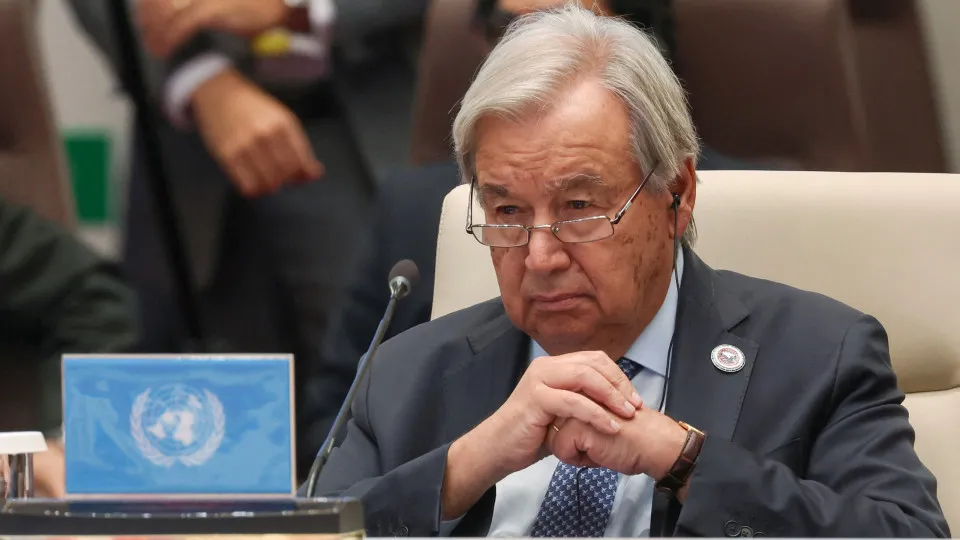
The Secretary-General of the United Nations, António Guterres, today assured that Minurso’s departure from the process in the Western Sahara “does not nullify the inalienable rights” of the Sahrawi people and called for respect for the rights of that population.
© Vyacheslav PROKOFYEV / POOL / AFP via Getty Images
01/11/2026
by
Lusa
O secretary-General of the United Nations, António Guterres, today ensured that Minurso’s departure from the process in the Western Sahara “does not nullify the inalienable rights” of the Sahrawi people and called for respect for the rights of that population.
In a statement read by Stéphane Dujarric, spokesperson for the UN Secretary-General, to whom the Lusa agency had access, Guterres expresses himself “concerned” with the security situation throughout the territory and the risk of an escalation of hostilities, and calls on all actors to exercise maximum restraint and refrain from actions that could exacerbate tensions or compromise regional stability.
“ Although the Minurse peacekeeping operations (United Nations Mission to the Referendum in the Western Sahara) have ended, the UN remains available to support efforts to promote dialogue and achieve a peaceful resolution of the conflict through the personal envoy of the Secretary-General, Staffan de Mistura,” Guterres stressed.
“The Secretary-General reaffirms the UN’s commitment to supporting the parties in the search for a just, lasting and mutually acceptable political solution to ensure the self-determination of the Western Sahara population,” he added.
The end of Minurse's operations is the result of the non-renewal of the mission's mandate by the Security Council, with Guterres recognising the central role played by the peace force since its inception in 1991 in monitoring the ceasefire and in creating favourable conditions for seeking a political solution.
“The Secretary-General expresses deep thanks to all Minurso personnel, including the Special Representative for the Western Sahara, Alexander Ivanko, whose leadership guided the Mission during a particularly difficult period following the resumption of hostilities in 2020,” he said
The former Portuguese Prime Minister also paid tribute to the 20 Minursus members who lost their lives during the 35 years of the mission, created to protect and serve the population of Western Sahara, in particular to enable him to exercise his right to self-determination.
“The 1st November 2026 [today] marks the beginning of the mission’s liquidation period, during which a smaller team, under the responsibility of the United Nations Operational Support Department, will oversee the orderly transportation of equipment belonging to the countries contributing troops to their respective national territories, as well as the fate to be adequately given to UN equipment,” Guterres said.
In this sense, the UN Secretary-General called for “full cooperation of the parties to ensure that this process is completed in an orderly manner and as soon as possible”.
The non-renewal of the mandate of the UN peace force took place on 30 October (the mission expired the following day) following the vetoes of Russia and the United States
Morocco has expressed “satisfaction” with this “advance” and has committed itself to “respecting the ceasefire” and has, however, called on the United Nations to stop “the regular meetings of the Council on the Sahara, its reports and information sessions”.
Shortly thereafter, Moscow presented its own motion for a resolution, which omitted any reference to the extended autonomy plan – presented by Rabat in 2007, supported by Washington and rejected by the Polisario Front – and which provided for a further year to extend the mandate of Minurso.
Following this decision, the United States also decided to exercise its right of veto, so it was not possible to adopt any resolution defining the mandate of the United Nations peace mission.
Polisario advocates the holding of the referendum on self-determination of the former Spanish colony in Africa, as signed by all parties in 1991, at the UN headquarters in New York, a consultation that never took place.
In 2007, Morocco submitted a proposal, rejected by Polisario, which envisages giving the Western Sahara greater autonomy to Rabat, but always under the sovereignty of Morocco, a plan that has been gaining international support from countries such as the United States, Spain or France, among others.
The Western Sahara is officially considered by the UN as a non-autonomous territory since 1973 and is on the list of territories awaiting decolonization and self-determination, often being cited as the “last colony of Africa”.