
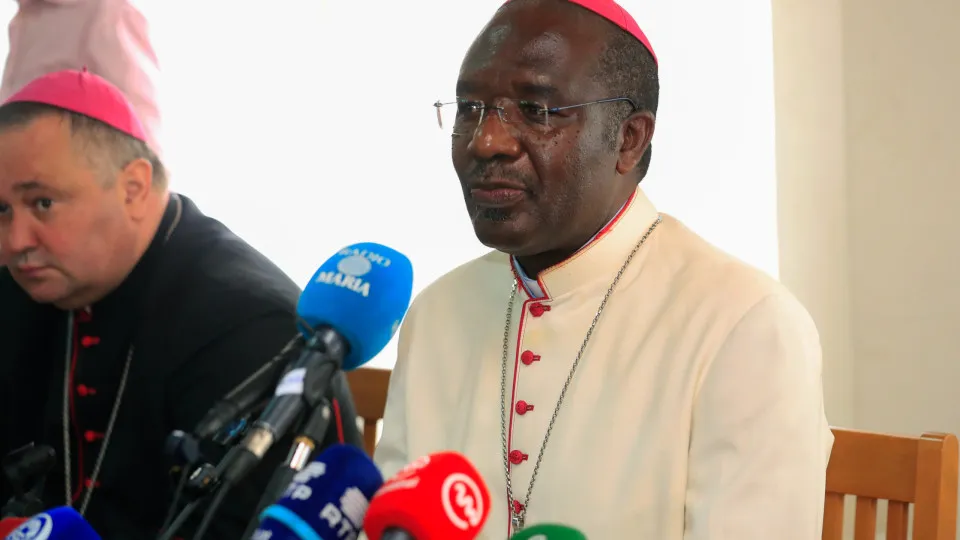
The Catholic Church in Angola urged the rulers to put people at the centre of public policy and considered that the country needs transparent management of resources, without adjudicating corruption, waste and compadence.
© Lusa
09/11/2026
by
Lusa
A The Catholic Church in Angola urged the rulers to put people at the center of public policies and considered that the country needs transparent management of resources, to combat corruption, waste and compadre.
The position was taken at the II Plenary Assembly of the Episcopal Conference of Angola and São Tomé (CEAST), which began on the weekend and takes place until Thursday in Lunda Norte, eastern Angola.
For the president of CEST, José Manuel Imbamba, the hope of the citizens in Angola “continues stifled by the social, political, cultural and religious drugs that still hang in the air”.
“ This environment conditions and drastically compromises our emotional and psychological balance”, said the Angolan archbishop, at the opening of the Second Plenary Assembly of CEST.
According to Catholic bishops, Angola’s most remote communities remain “distancing from the country’s development table” and, “not often, at the mercy of various manipulations and instruments”.
“Social exclusion remains an open wound,” said the president of CEST, adding that to overcome “these and other evils, it is urgent” to put people at the center of all public policies.
José Manuel Imbamba argued that the country needs transparent management of resources, to give real priority to family farming and local production, to value teachers, doctors and to combat corruption, waste, compadrio and militantism without abhorrence.
On the other hand, he praised the Angolan Government for its “continuous effort” and dedication in the process of building peace and national reconciliation, “in a commendable work conducted in close collaboration with civil society”.
The CEST leader also welcomed the inauguration of the Memorial to the Victims of Political Conflict – infrastructure inaugurated by Angolan President João Lourenço on 14 October last in Luanda, in honor of citizens who died in political conflicts between 11 November 1975 and 4 April 2002.
For the responsible, the infrastructure is a “gest of deep dignity and historical healing”, opening up that this milestone serves as a reflection for the whole nation to understand, “for once and for all, that war is undoubtedly the worst choice a people can make”.
“It is now imperative that all of us, citizens and institutions, work with firmness, commitment and unity to shield this supreme good [peace] with feelings of nobility, sincerity, patriotism, openness of spirit and mercy”, he pointed out.
The Archbishop of Saurimo also acknowledged the efforts that have been made by the authorities to solve the problems that afflict populations in the country, especially in the areas of infrastructure, electricity and some essential services.
He noted, however, that the challenges of populations “continue much greater” than the solutions achieved.
“ We remain very anxious about the high rate of unemployed or busy young people in precarious jobs and with no prospect of improving their living conditions (...), remaining potential breeders of misery, thus mortgage the quality of life of future generations ", criticized.
José Manuel Imbamba also recalled that Angola holds the next general elections in August 2027, urging, therefore, that they should not be a reason for division, fear or violence, but rather a celebration of citizenship and maturity of a people.
He even asked the political, social and religious leaders of the country to cultivate civilism, tolerance and permanent dialogue.
He also argued that the language of confrontation in an electoral environment should give way to the language of joint construction and called on citizens of electoral age to prove their lives and update the data.
The challenges of artificial intelligence, the preparation of the Pastoral Message for Elections of 2027, the reports of the episcopal committees and the Framework Agreement between the Holy See and the Angolan Government are some of the themes that dominate the work of the II Plenary Assembly of the CEAST.