
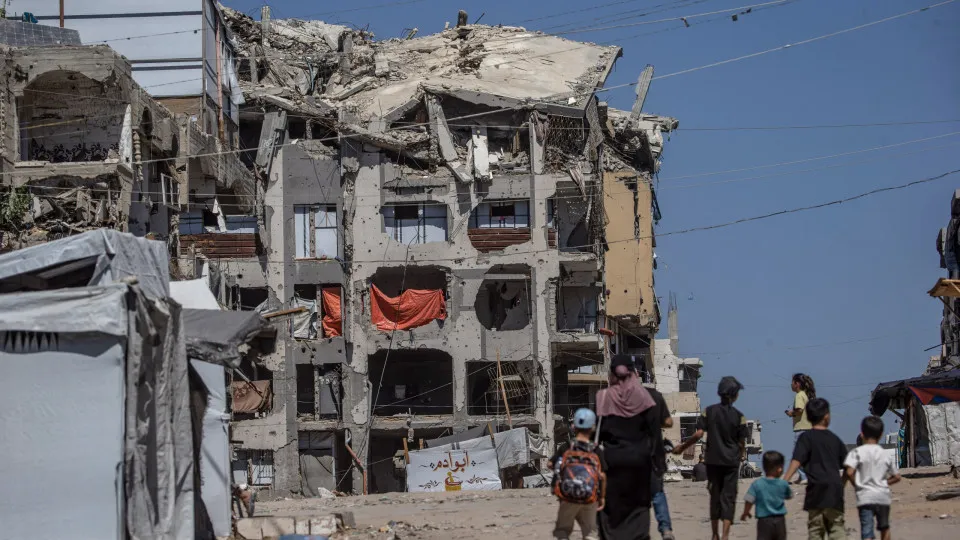
The Israeli Government announced the gradual resumption of goods entering the Gaza Strip after four days of suspension, accusing Hamas of extorting traders.
© Lusa
19/10/2026
by
Lusa
O The Israeli Government today announced the gradual resumption of goods entering the Gaza Strip after four days of suspension after accusing the Palestinian Islamist Hamas movement of extorting traders.
The Coordination of Governmental Activities in the Territories (COGAT), an Israeli agency responsible for activities in the occupied Palestinian territories, stated that Hamas “suspended its tax mechanisms and threats” in a reference to the 10,000 shekels rate, about EUR 2,800, required by the Palestinian Islamist movement for each truck entering the territory.
Last Thursday, when the COGAT first accused Hamas of ‘extortion’, the Palestinian movement replied that the amount corresponded to a ‘voluntary Community initiative’, in which ‘enterprises participate in a national fund whose resources are intended in full to support the most vulnerable groups as well as housing, sanitation and humanitarian aid projects’.
In the meantime, after confirming that Hamas had stopped demanding this fee, “traders have again submitted their requests to resume coordination with Israel for the entry of goods into Gaza”.
“ Resumption of coordination is taking place in line with Israel’s commitment to the humanitarian provisions of the cease-fire agreement,” confirmed COGAT, as Palestinian media, such as the Sanad agency, indicate that trucks will start entering Gaza from Tuesday.
The COGAT, however, maintains reservations, considering that “traders’ statements alone do not constitute a verification”, which is why the body, dependent on the Israeli Ministry of Defense, stressed the “gradual” nature of the reopening.
Israel warned, however, that any trader who made payments to Hamas will have revoked the authorisation to operate under the goods entry mechanism in the Gaza Strip.
The decision arises on the same day that the World Food Programme (WFP) announced that it will need to reduce its humanitarian operations in the Gaza Strip due to lack of resources, leaving 500,000 Palestinians without help on a monthly basis.
The organization also made an appeal, through a communiqué, that the world should not "send away the gaze" of the enclave devastated by war.
“Families [...] live in extremely difficult humanitarian conditions,” despite the entry into force of a ceasefire a year ago, told the news agency France-Presse (AFP) Shaun Hughes, director of WFP in the Palestinian territories.
The Israeli offensive in the Palestinian enclave began following the attack by the Palestinian Islamist group Hamas against Israel on 7 October 2023.
About 1.4 million people, of a total of 2.1 million people, “are still in acute food insecurity and need humanitarian aid to survive,” Hughes said, speaking from the offices of the UN agency in Beit Hanina, a neighborhood in East Jerusalem.