
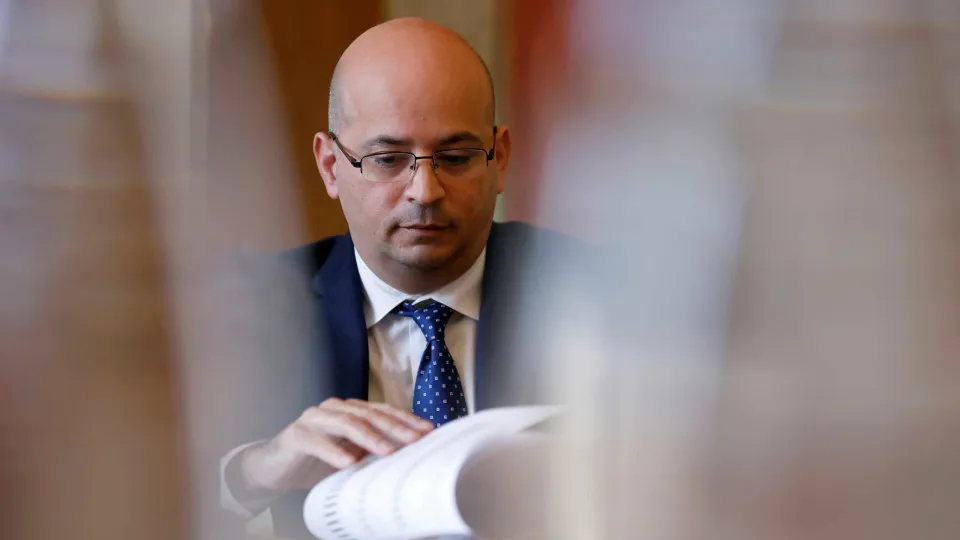
The Portuguese member of the European Court of Auditors (ECA), João Leão, today warned of a sharp reduction in European funds for Portugal between 2027 and 2029, which is expected to worsen from 2030. The reduction is linked to the end of the Recovery and Resilience Plan (RRP) and to the reduction of national funds in the next EU budget.
© Reuters
13/10/2026
by
Lusa
John Lion
O portuguese member of the European Court of Auditors (ECA), João Leão, today warned of a sharp reduction in European funds for Portugal between 2027 and 2029, which is expected to worsen from 2030.
“ We will have an even more significant reduction,” said the former Finance Minister, during a hearing in the Committee on Budget, Finance and Public Administration, in conjunction with the European Affairs Committee, in the Assembly of the Republic, to present the ECA annual report for 2025.
This is the end of the Recovery and Resilience Plan (PRR) and the reduction of national funds in the next EU budget.
João Leão explained that, after a historic peak in the implementation of European funds in 2026, associated with the conclusion of the Recovery and Resilience Mechanism (MRR), Portugal will face a reduction in the funds received in the following three years.
This breakdown should be partially offset by the acceleration of the implementation of the funds of the current Multiannual Financial Framework (MFF) for the period 2021-2027.
However, from 2030 onwards, the decrease will be more significant, as the effect of reducing national envelopes in the next European budget to 2028-2034 will be added to the conclusion of the RRP.
According to João Leão, on the basis of the latest proposal of the Irish Presidency of the EU Council, the financial envelope allocated to Portugal is expected to fall from “about EUR 32 billion to EUR 31 billion at constant prices”.
Although the reduction in absolute values is relatively limited, the Portuguese member of the ECA pointed out that, when measured as a percentage of gross national income (GNI), it represents a drop of more than 10%.
The former ruler explained that this development is the result of two changes in the European budget: the need to start paying the debt contracted to finance the MRR and the emphasis on new strategic priorities, namely competitiveness, innovation, security and defence.
According to João Leão, the proposal under negotiation provides that the weight of the European budget for expenditure, excluding debt payments, will rise from 1.13% to 1.05% of the Union's GNI.
At the same time, a growing share of European funds will no longer be allocated to the Member States in advance and will be distributed in a competitive manner through programmes centrally managed by the European Commission.
In this context, it warned that the most technologically advanced regions and companies will have greater capacity to capture new funding, particularly in the areas of digital, clean energy and defence.
“ The most technologically advanced regions and companies in these areas will be able to obtain these funds,” he said, arguing that countries should start preparing strategies to compete for the new programmes now.
The Portuguese member of the ECA acknowledged that this change could pose increased difficulties for the least developed Member States, although the European Commission provided for measures to strengthen their access to finance.
During the parliamentary hearing, João Leon also warned of the absence of a medium- and long-term European strategy to ensure payment and amortisation of the debt contracted by the Union.
“ At the moment there is no such plan,” he said, stressing that maintaining the ability to finance European policies will depend on an increase in EU own revenue or a reduction in expenditure.
The European Union's next long-term budget for 2028-2034 is still under negotiation between the Member States, and the amounts submitted may still be changed.