
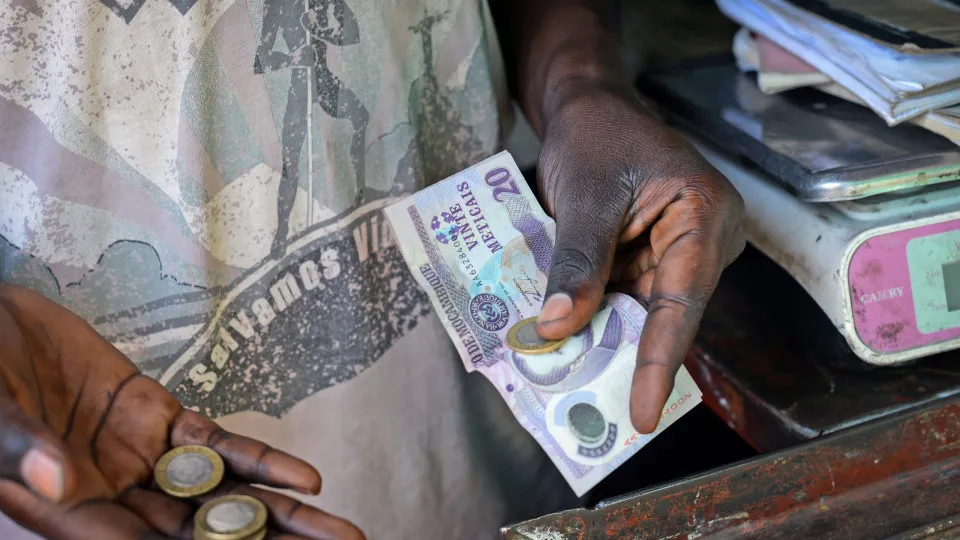
The government expects the Mozambican economy to grow by 1.6% in 2027, with average inflation of 7% and government deficit of 4.6% of GDP.
© Lusa
16/10/2026
by
Lusa
O Government expects the Mozambican economy to grow by 1.6% in 2027, with an average inflation of 7%, a fiscal deficit of 4.6% of GDP and the entry into operation of the Mozambican Development Bank.
The targets are set out in the proposal for the 2027 Economic and Social Plan and State Budget (ESOE), to which Lusa had access today, a document setting out the executive's economic and social priorities for next year, to be submitted to the Assembly of the Republic.
The proposal takes the sustainability of public accounts as a priority: “In tax management, fiscal policy for 2027 will be guided by a prudent, credible and macro fiscal discipline approach.”.
The government plans to mobilise global resources equivalent to EUR 511.162 million (EUR 7,099 million), while it intends to reduce the budget deficit to 4.6% of gross domestic product (GDP) and limit the State's use of internal credit to 1.9% of GDP.
“ Sustained by this framework, the macroeconomic framework projects real GDP growth to 2027 of 1.6%, in parallel with a slowdown in average annual inflation to 7.0%”, the proposal adds.
For 2026 economic growth is expected to be 0.6% of GDP after the government's downward review, which has admitted an impact equivalent to 2% of GDP due to floods at the beginning of the year.
The proposal provides for state revenues of around EUR 427 billion (EUR 5,9 billion), equivalent to 23.5% of GDP, while financial expenditure and operations are expected to reach approximately EUR 511 billion (EUR 7,1 billion), corresponding to 28,1% of GDP. In this way, the budget deficit is centred on some €83 billion (€1.2 billion), corresponding to 4.6% of GDP.
The government describes PESOE as “the government’s main economic, social and budgetary programming instrument” aimed at “building macroeconomic stability and promoting Mozambique’s sustainable and inclusive development”.
According to the document, economic transformation will be one of the main priorities of next year, based on increased national production, diversification of the economy and development of value chains.
“The executive will prioritize the operationalisation of strategic initiatives with high multiplier impact”, refers to the proposal, pointing out as main instruments the Local Economic Development Fund (FDEL), the Women’s Opportunities Promotion Fund (PRO-WOMEN) and the Mozambique Development Bank (BDM).
The FDEL will have an allocation of EUR 1.5 billion (EUR 20.8 million), while the PRO-WOMEN will have EUR 500 million (EUR 6.9 million) to finance productive business and income generation.
The Mozambican Development Bank, to be launched in 2027, is presented in the document as an instrument for “financing long-term strategic projects”, with the potential to increase production and productivity, especially in the energy, agriculture, industry and tourism sectors.
The executive also maintains that the combination of these mechanisms with the attraction of foreign direct investment and business environment reforms should allow the mitigation of credit restrictions faced by the private sector, in particular by micro, small and medium-sized enterprises.
In agriculture, considered strategic for food security and job creation, the government plans to produce 17,600 tonnes of certified seed, assist 1,482,451 producers and 8,845 fishermen, distribute 155 thousand agricultural kits and make available 100,000 multipurpose silos.
The plan also includes the training of 2,646 fish farmers, the delivery of 170 motorized vessels, the provision of 500 floating cages and the financing of 54 fishing projects.