
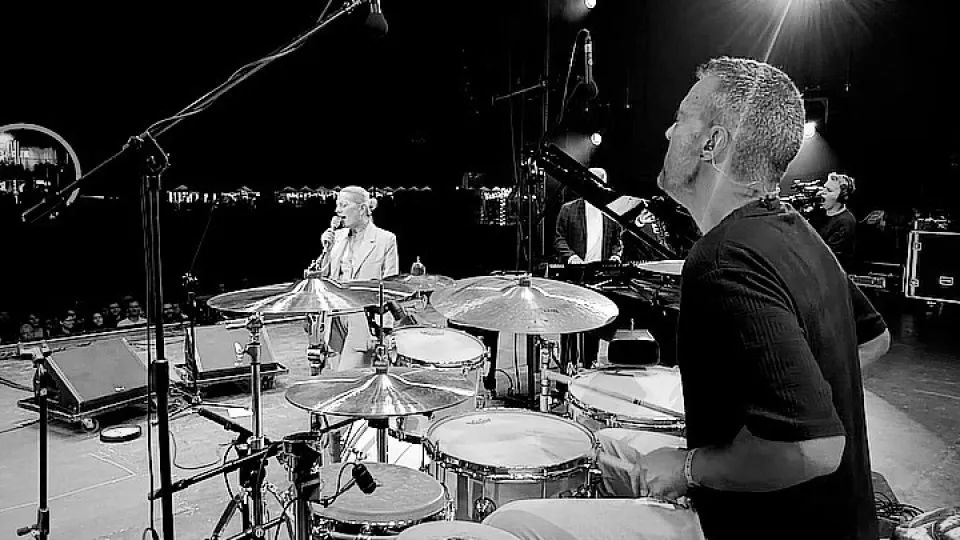
Portuguese drummer Marito Marques gathered musicians from different nationalities at an improvisation concert in Toronto, seeking to bring the Portuguese community closer to new musical languages and promote dialogue between cultures.
© Marito Marques/ Instagram
31/10/2026
by
Lusa
O portuguese drummer Marito Marques gathered musicians of different nationalities at an improvisation concert in Toronto, trying to bring the Portuguese community closer to new musical languages and promote dialogue between cultures.
The show, entitled “Circuito”, took place on Friday night, in the Alentejo House of Toronto, with the participation of Portuguese accordionist João Frade, who accompanies Mariza on international tours, and musicians of different cultural origins, in a project based on spontaneous musical creation.
“ The message is music, simply, in its pure state ", he said to the agency Lusa Marito Marques, explaining that the concert was built without previously defined sheet music or conventional rehearsals.
Born in Arganil, in the district of Coimbra, and settled in Canada 14 years ago, the drummer and composer explained that the project “Circuito” was born about a year ago and seeks to explore creative freedom through interaction between instrumentists.
“ We have never properly performed rehearsals, because the music is completely improvised”, he stressed, adding that the presence of João Frade, his longtime friend and collaborator, constituted “a cherry at the top of the cake”.
The concert also featured the participation of Iranian singer Shahriar Siavash, based in Toronto, and Colombian musician Juan Carlos Medrano Magallanes, residing in Canada, who presented traditional sounds through the Colombian flute known as harmonica.
For Marito Marques, the diversity of nationalities present on stage reflected the multicultural identity of the largest Canadian city.
“ This multiculturality that exists in Toronto is the mirror of our city”, said the musician.
The choice of Casa do Alentejo to host the show also represented an attempt to strengthen the composer's connection to the Portuguese community of Toronto, from which he recognized that he had been relatively distant over the last few years.
“ This concert was also a step forward in this direction, but bringing a different song, not the one to which the Portuguese are completely used”, he explained.
Despite developing much of her career in the North American market, Marito Marques maintains a close professional relationship with Portugal, where she began the artistic career and collaborated with names such as Carlos do Carmo and Sara Tavares.
Currently, he is still involved in the production of Portuguese artists' records, developing projects that include recordings in both Portugal and Canada.
“ I am producing a lot of music coming from Portugal”, he said, expressing the intention to deepen contacts with musicians and institutions of the Portuguese-Canadian community.
The drummer also integrated the album "Immersed", by musician and producer Justin Gray, distinguished in 2026 with Grammy for Best Immersive Audio Album.
“The Grammy is a very important recognition, and I was very happy at the time, of course, but I don’t think it changes anything exactly,” he said.
According to the composer, the distinction is mainly an incentive to continue to develop new projects and deepen musical research.
Also João Frade, who has maintained an artistic collaboration with Marito Marques for about two decades, highlighted the importance of experimentation and the crossing of musical languages.
For the musician, the accordion allows exploring different sound universes, without abandoning the traditional Portuguese references that marked the history of the instrument.
“ I'm kind of a fan of the exploratory side of the accordion and all the instruments. It is just a question of searching languages and crossings of languages”, Lusa explained.
The musician also highlighted the configuration of the show, which allowed the public to accompany artists from different positions, including sitting on the floor, standing or circulating through space.
From their perspective, this proximity between musicians and spectators contributes to creating an artistic experience distinct from conventional concert formats.
Asked about the growing presence of Portuguese instruments in international circuits, João Frade considered that the development of music teaching in Portugal and the increased circulation of information contributed to increase the visibility of national artists.
“ Our country has developed a lot in academic terms, new universities have opened up, huge possibilities for young people to study music in a perhaps more solid way,” he noted.