
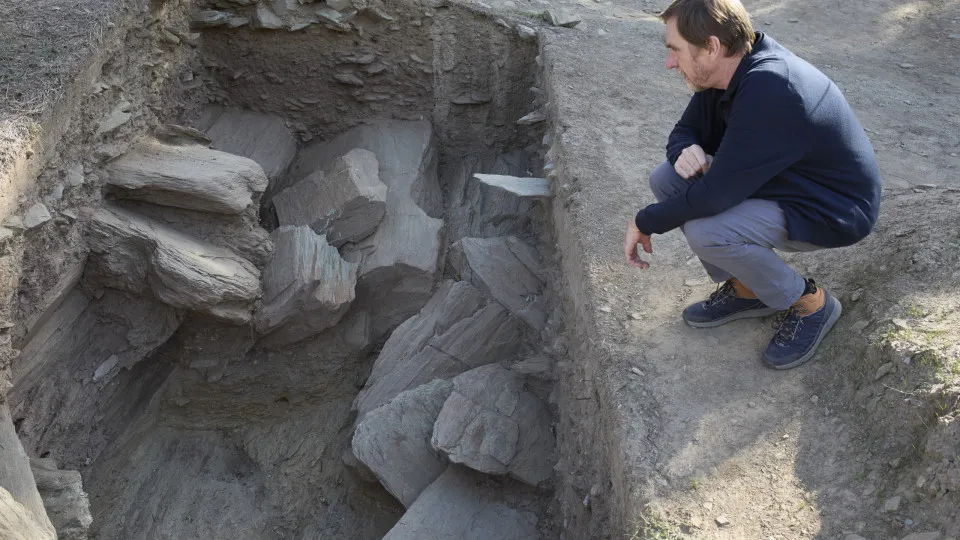
New archaeological discoveries in the Côa Valley have revealed evidence that can change the narrative about the relationship of the populations of the Upper Paleolithic with rock art and confirm the human presence in the region beyond 27,000 years, according to the scientific coordinator.
© Lusa
31/10/2026
by
Lusa
Côa Art
Novas archaeological discoveries, in the Côa Valley, revealed evidence that can change the narrative about the relationship of the populations of the Upper Paleolithic with rock art and confirm the human presence in the region beyond 27,000 years, according to the scientific coordinator.
The new discoveries of pigmentation materials, in hundreds of fragments, were made by archaeologists of the Côa Park Foundation (FC-P), during the survey on Rocha 3 of the Penascosa site, which point to a date older than the one known until now in the Côa Valley Archaeological Park, the world's largest shrine of Paleolithic art, classified as the world heritage of humanity.
In statements to the agency Lusa, the scientific coordinator of FC-P, Thierry Aubry, said that the most recent excavations on the site of Penascosa demonstrate that the traces of human presence on the site can go beyond 27,000 years, surpassing the allowed date so far of 26 thousand, and prove the use of pigments in daily activities.
“ We think these discoveries are from the end of the ‘gravetense’ [ Superior Paleolithic] with the appearance of the chipped stone. There are indications that these occupants have tanned furs, made weapons for hunting and fire. There are elements we found in the oldest layer over 27,000 years old. We have mineral pigments such as iron oxide [ocre], and natural colors such as yellow, red, black and brown, which means that these materials may have been used” for various purposes, including “to paint the rocks,” the archaeologist explained.
The investigation required several months of excavations, in an area of eight square meters, in Penascosa, a work now completed, with the participation of Archaeology students from the University of Lisbon.
According to Thierry Aubry, “these color pigments could have been used to make glues, enjoy skins... But the most surprising thing is that they could have a more artistic use, such as the painting of rocks, when in the Côa Archaeological Park, the visible is the technique of picotage”.
“ This means that the engravings were better preserved, but that possibly these materials were available to paint and draw. These discoveries can change our narrative about paleolithic art in the Côa Valley. We already know that there was a continuous human presence in the Côa, which had several activities”, noted Thierry Aubry.
For the specialist, “this type of painting could be in the rocks or in the skins that served as coats and covers, but that were not preserved”, contrary to what happens in “sites more sheltered like caves”.
“ The two techniques, painting and engraving are often associated, and perhaps in the Côa Valley the men of the Upper Paleolithic used the painting 27,000 years ago. In this particular case, we have material that could allow painting, and now it's not just imagination. This changes the whole narrative”, he said.
According to the investigation, since the rock paintings were not preserved due to the climate, they may have been replaced or reinforced by the pictographic technique to show the daily lives of paleolithic communities.
“ We can assume that the technique of painting was used before the engraving and so [with the picking], conserved longer this art. We know they had paint materials. There are still many answers to this question and [too much to] study. These pigments are common in an area of a radius of 60 kilometers between the two extremes of the park,” he said.
The researcher underlines the “concrete data” obtained from the investigation: “They had the material that allowed them to paint,” they had colors, “they had ochre, yellow.” “Now, we still don’t know what the support was” on which they were used. But from the pigments themselves, through their analysis, it may be possible to know where they come from, if from a rock, if from a skin, because different supports will leave different traces.
The excavations will continue in the spring, on the Penascosa site, given the materials found.
The findings were presented recently at a seminar in Algeria and, according to the researcher, surprised the scientific community.
The president of the Board of Directors of FC-P, João Paulo Sousa, for his part, argues that one must look closely at the Côa Valley and bet on scientific research, declaring that there must be reinforcement of specialized human resources.
“ The Foundation staff map has only three people involved in research and an urgent strengthening of researchers is needed,” Lusa said.
According to João Paulo Sousa, so far there has been the collaboration of several universities such as Coimbra, Lisbon and Minho, which allows to build teams, because “the archaeologists and other researchers are truly passionate about Côa Art”.
“ Our body of archaeologists begins to enter a certain age, requiring its reinforcement ", vincou.
At the time of the creation of the Côa Valley Archaeological Park in August 1996, 190 rocks with rock art were identified with pictulated engravings, now the evidence of the presence of color may give a new direction to the knowledge of Côa Art.
Currently there are 1,600 identified rocks, divided by 104 archaeological sites, for a total of more than 15,650 reasons, with paleolithic engravings predominant, in an artistic cycle of rock art that has never been interrupted.
Côa Art was classified as a National Monument in 1997 and in 1998 as a UNESCO World Heritage Site.