
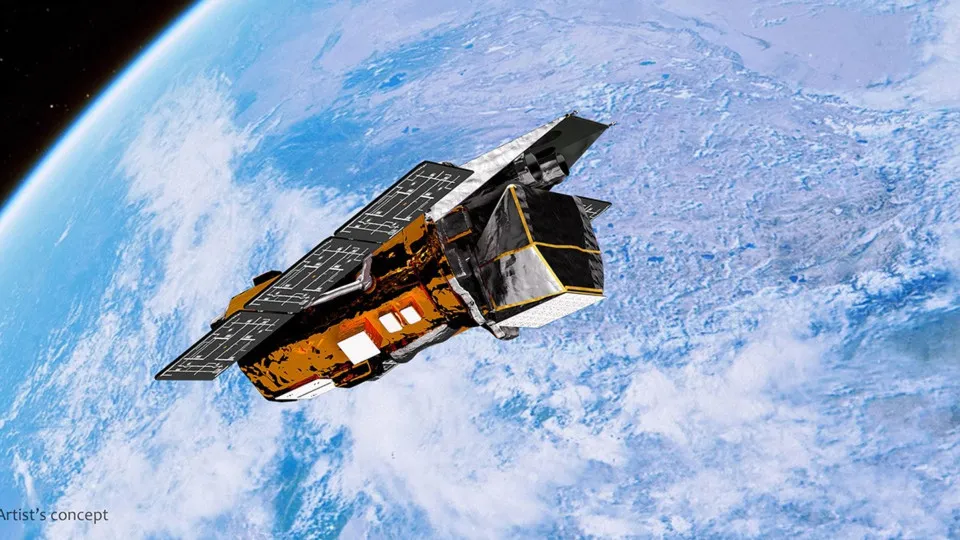
NASA warned that the Swift Space Telescope will fall to Earth unchecked today, predicting that the equipment will almost completely disintegrate as it crosses the atmosphere. The agency estimates that any remaining fragments will fall into an unknown area without causing surface damage after nearly 22 years of mission.
© NASA
04/11/2026
by
Lusa
Lusa 16:59 – 29/10/2026
The exact location of the fall is still unknown. NASA has, however, clarified that the fragments that survive the passage through the atmosphere will fall into an intertropical range between 20.6 degrees north latitude and 20.6 degrees south latitude.
This area covers mainly open ocean waters, the Caribbean, Central America, North South America, as well as regions of Central and Southeast Asia.
The space agency stressed that the risk of someone on Earth suffering damage “is unlikely, being of approximately one hypothesis in 2,100”.
In August, NASA confirmed that the reentry would occur in an uncontrolled manner, after the failure of a robotic mission that intended to capture the telescope and push it into space.
Launched in November 2004 for a two-year mission, Swift observed over 2,000 gamma ray explosions, the most powerful in the cosmos, and over 1,400 supernovas.
Its data served as the basis for some 7,000 scientific articles, according to NASA.
This speed allowed him to capture, in 2005, for the first time, the brightness of a short explosion of just 0.03 seconds, which corroborated the theory that such explosions arise from the fusion of two neutron stars.
Its return to Earth is a natural process after decades of use, since the telescope was not equipped with propulsion devices that allowed it to gain altitude in orbit.
The telescope leaves a public archive of about 12 terabytes, containing over 1.5 million images.
NASA seeks, through other missions, to supply its ability to react quickly to cosmic phenomena.