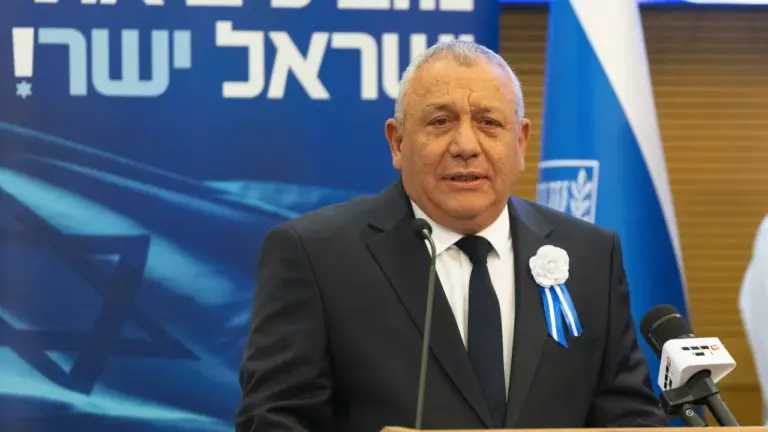
The Yashar party, led by Israel's appointed Prime Minister, Gadi Eisenkot, today announced the resumption of negotiations with the Democratic Party, the former Labour Leader Yair Golan, to form Government.
© Kobi Wolf/Bloomberg via Getty Images
26/11/2026
by
Lusa
O yashar party, led by Israel's appointed prime minister since November 8th Gadi Eisenkot, announced today to have resumed negotiations to form Government with the Democratic Party, former Labour leader Yair Golan.
After the break announced by the Democratic Party on Tuesday night, in protest that Eisenkot was conducting parallel talks with Likud, acting Prime Minister Benjamin Netanyahu, Yashar admitted to reopening the communication channels and said he predicted “trading marathons to reach a coalition agreement”.
Israeli media suggest that Golan's action also seeks to secure a more prominent position in the next government.
Eisenkot's party, within the framework of its mandate to form the next government, has maintained multi-party negotiations and has shown commitment to talks with Netanyahu's Likud.
Negotiations with Likud have been criticized by several parties within the Yashar bloc itself — the potential allies with whom Eisenkot will form government.
The leader of the Yisrael Beitenu party (Israel is Our House), Avigdor Liberman, condemned these contacts, stating that “they confer legitimacy” to the outgoing Prime Minister.
“ I don't think we should negotiate with Bibi. He must be responsible for the disaster of October 7th [the day the Palestinian Islamist group attacked Israel, starting the war in Gaza] and for the diplomatic disaster that made us international pariahs,” he defended in statements to public radio Kan.
The differences within the opposition bloc also focus on the relationship with the Arab parties Lista Conjunto and Raam, which together hold 19 seats in parliament and are fundamental to the formation of a government without Netanyahu.
While Golan defends agreements with the Arab parties, Liberman has assumed this as a ‘red line’, although in recent days he has referred to a government of ‘clear Jewish majority’, which is interpreted as a certain openness to agreements with these parties.
Eisenkot did not dismiss a government of unity with the members of Netanyahu's Likud party, insisting that he is working to achieve a "wide coalition" and indicating that he is exploring several options to form a government.
Benjamin Netanyahu, for his part, advocates the creation of a “government of national unity”, headed by him, without Arab parties and including the Zionist opposition, which has rejected this option.
Gadi Eisenkot has to present a government by 6 December, although the legislation allows this deadline to be extended by 14 more days.
If you cannot do so, another candidate will be appointed by the Israeli President to form an executive in 28 days, not extended and under threat of further elections.