
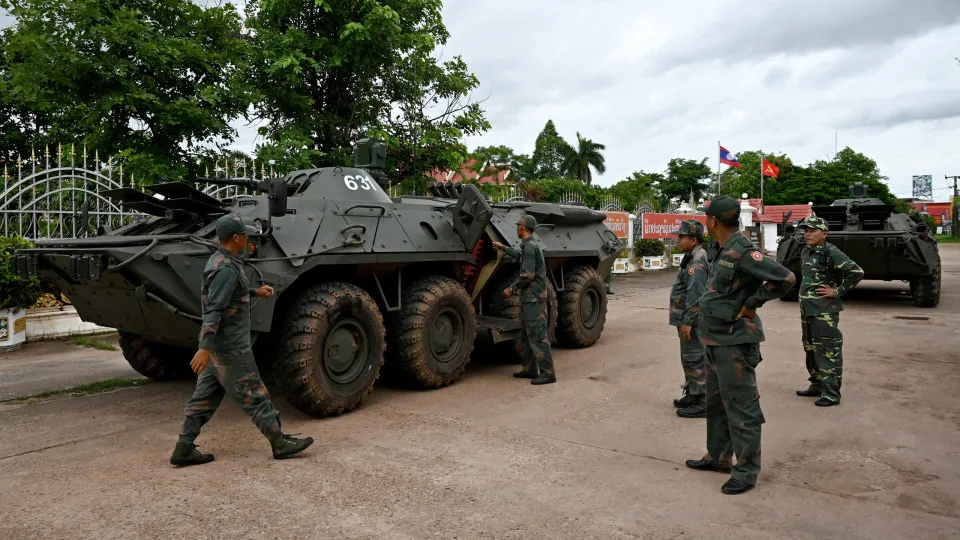
A new Chinese military facility in Laos, inaugurated in September, is raising concerns in Vietnam and among defense analysts due to the potential for infrastructure expansion and the growing military projection of Beijing in Southeast Asia.
© TANG CHHIN SOTHY/AFP via Getty Images
15/10/2026
by
Lusa
Uthe new Chinese military facility in Laos, inaugurated in September, is raising concerns in Vietnam and among defense analysts, due to the potential for infrastructure expansion and the growing military projection of Beijing in Southeast Asia.
According to an analysis by the Associated Press (AP), based on satellite images, Ban Keun aerodrome, located about 50 kilometres north of the capital of Laos, Vientiane, is still partially under construction, despite the official inauguration.
The installation, jointly managed by China and Laos, is the first Chinese military infrastructure abroad focused on air power, joining the Chinese base in Djibouti and the Beijing naval presence at the base of Ream, Cambodia.
The airfield currently has a runway of about 2,000 metres long enough to receive fighters, a parallel track and parking space for about 24 aircraft.
Satellite images indicate that there is room to extend the runway by at least another thousand metres, which would allow the use of larger aircraft, including bombers.
At the inauguration, the Chinese Ministry of Defense stated that the China-Laos Joint Support and Training Center and the China-Laos Friendship Aviation Academy are intended to strengthen the training of Laosian military pilots and “are not directed against third parties”.
Beijing did not, however, clarify whether it intends to permanently park Chinese aircraft and military in the facility.
The director of the Asia Maritime Transparency Initiative, the Center for Strategic and International Studies (CSIS), Greg Poling, considered that the infrastructure does not radically change regional military balance, but may particularly concern Vietnam, which maintains territorial disputes with China in the South China Sea.
A Vietnamese officer, quoted by the AP but who asked not to be identified, said Hanoi officially views the project as a training and humanitarian assistance center, but considers that the initiative is also aimed at strengthening Chinese influence in Laos.
“ The deployment of Chinese military forces in Laos would naturally put additional military pressure on Vietnam,” he said.
The Institute for the Study of War (ISW), an American think tank, warned that, although the facility does not yet allow major military operations, the location may offer Chinese air forces alternative routes to reach disputed areas of the South China Sea and bypass Vietnamese airspace.
Thailand, which shares a border with Laos, said it did not consider infrastructure an immediate threat to its security.
The spokesman for the Thai Defense Ministry, Surasant Kongsiri, stressed that Laos has the sovereign right to conclude military agreements with other countries, but ensured that Bangkok will continue to monitor the evolution of the project.
Evan Laksmana, analyst at the International Institute for Strategic Studies (IISS), considered that the base could also complicate US military planning in a possible conflict around Taiwan by offering an alternative runway for damaged Chinese aircraft and repair facilities.
The infrastructure can be supplied through the railway link between the Chinese province of Yunnan and Vientiane, built under the Chinese initiative Band and Route.
Laos, one of the poorest countries in Southeast Asia and heavily indebted to China, currently has only seven combatable aircraft, according to the IISS annual Military Balance report.
For Laksmana, the main benefit for Beijing may lie less in combat capability and more in the experience gained in the operation of military facilities in foreign territory.