
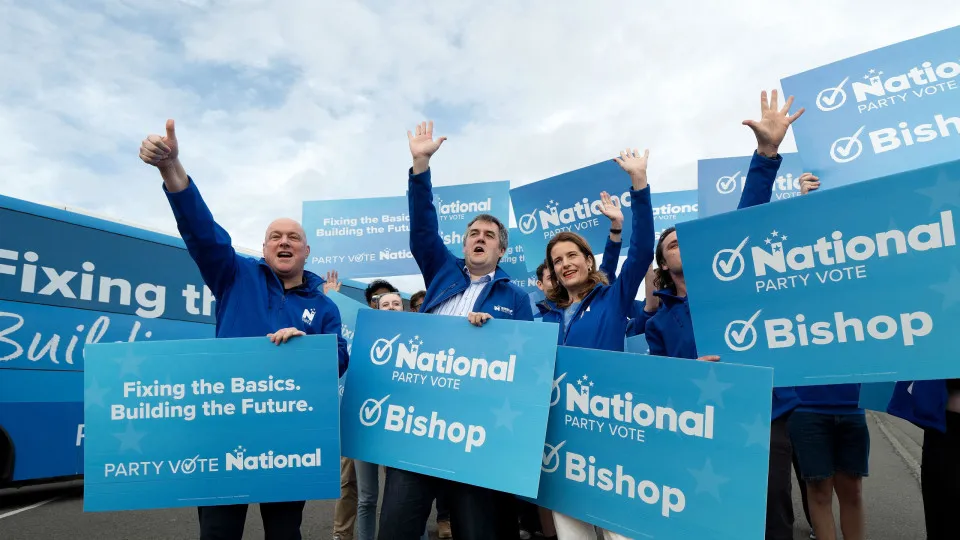
New Zealanders go to the polls on Saturday in legislative elections that promise to be close, with inflation as the main concern of voters.
© Marty MELVILLE / AFP via Getty Images
05/11/2026
by
Lusa
Onew zealanders go to the polls on saturday in legislative elections that promise to be close, in a scenario marked by concerns about rising cost of living and the economic situation.
According to the RNZ-Reid Research survey conducted by New Zealand's public broadcaster, 64% of respondents claim that inflation and rising prices are their main concern, followed by the situation of the New Zealand health system and then the price of gasoline, with other factors being the state of the country's economy and rising unemployment.
According to the polls, neither the National Party, which is in power under the leadership of the Prime Minister, Christopher Luxon, nor the Labour Party, in the opposition, seem capable of obtaining an absolute majority, so an alliance will be required to appoint a head of government, giving the smaller parties a key role.
The outgoing Prime Minister expects his right-wing coalition to remain in power by promising that “there will be no new taxes” and describing opponents as an unpredictable left-wing alliance.
Former executive director of Air New Zealand, this conservative millionaire has been leading the New Zealand government since 2023, but the internal divisions in his party, added to the increase in the cost of living during the term, have worn out his popularity.
Luxon said he saw himself as a “superseller” at the service of the country and undertook to promote more free trade agreements if re-elected.
His main opponent in these legislatures is Labour Chris Hipkins, who served as Prime Minister for a few months in 2023, succeeding Jacinda Ardern (2017-2023).
Hipkins seeks to present himself as a man of the people, making jokes about his dubious taste clothing, appreciation for sausage puffs and passion for manual labor and household repairs.
If it comes back to power, the Labour Party has promised a set of measures to address the cost of living, from the gratuitousness of medical consultations and prescription drugs to the reduction of public transport prices.
Qiulae Wong’s Party of Opportunities (TOP), a centrist movement, has only about 7% of the voting intentions in the polls, but a result too close in the Saturday elections may give its leader a decisive role in the formation of a future government.
At the age of 38, KPMG’s former consultant undertook to pass a universal basic income of up to 370 New Zealand dollars (just under 186 euros) per week, financed by a property tax.
It also promised to adopt ambitious measures to combat climate change and recover the health system in New Zealand, which faces difficulties.
Populist Winston Peters, current foreign minister and leader of the New Zealand First party (New Zealand First) is currently one of the most controversial figures in New Zealand politics, with his assumed racist position.
In July, the Chinese embassy in Wellington filed a complaint against the octogenarian politician, after suggesting to Green Party deputy Lawrence Xu-Nan, born in China, to “regress to his country” when he questioned him in plenary.
Although the Prime Minister classified the comment as “very offensive”, he did not fire Peters from his government.
If it comes back to power after Saturday's legislation, New Zealand First has promised drastic cuts in immigration and the withdrawal of New Zealand from the Paris climate agreement.
Another protagonist of these legislatures is the current New Zealand Deputy Prime Minister, David Seymour, who has ruled alongside Christopher Luxon since 2023 in a sometimes turbulent coalition.
Seymour gained visibility by campaigning against measures aimed at strengthening the role of the Maori indigenous minority in governance, and in favor of drastic cuts in public spending and taxes, and his party, ACT, which defends libertarian positions, has intensified provocations against the left.
With 10% of voting intentions, it will be a key part in any right-wing coalition.
On the other side of the political spectrum are The Greens, the third most popular party in New Zealand, whose co-directors, Chloe Swarbrick and former minister Marama Davidson, were inspired by a project by New York City Mayor Zohran Mamdani to propose the creation of a supermarket chain run by the government.
They also promised to impose a tax on large fortunes and allocate billions additional to the health sector.
As the country's second most popular centre-left force, the party's support The Greens will be decisive if Chris Hipkins wants to become Prime Minister.