
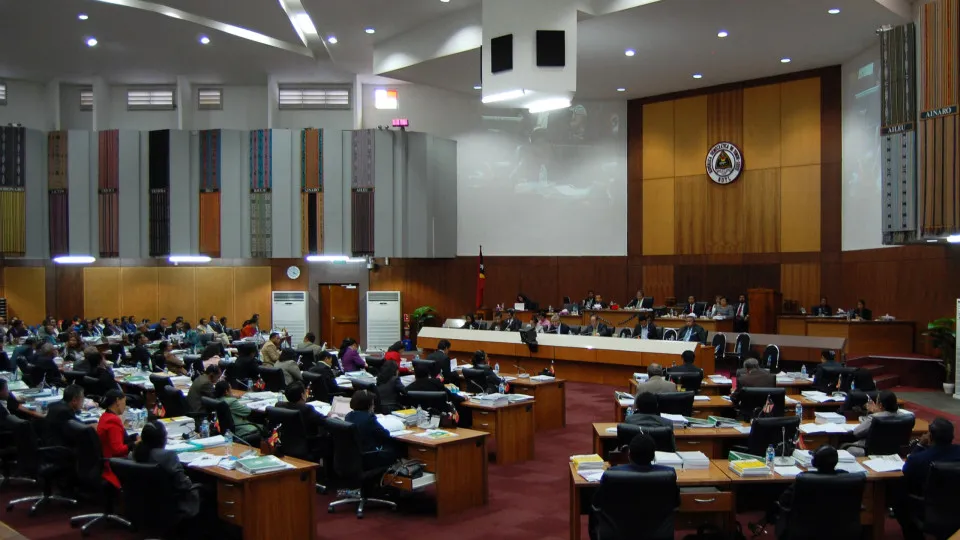
The Government of East Timor today presented the State General Budget (OGE) for 2027, with savings measures and the creation of a new tax to ensure the financial sustainability of the State.
© Lusa
09/11/2026
by
Lusa
O head of Timorese Government said today that the budget for 2027 provides for savings measures and the creation of the tax About Value Added to ensure the financial sustainability of the State and the Oil Fund.
“The government expects the efficiency measures implemented in 62 public entities to generate annual savings of approximately USD 53.6 million [about EUR 48 million],” said Xanana Gusmão.
The Timorese leader spoke in parliament, in the presentation of the proposed law of the state budget (OGE) for 2027, with a consolidated global amount of USD 2.57 billion (EUR 2.26 billion).
Xanana Gusmão also explained that the limit of 250 million dollars (EUR 224.2 million) for the projects of the Infrastructure Fund is a “measure to control the pace of expenditure and give priority to the completion of the projects being implemented”.
In OGE 2027, the Timorese Government also plans to introduce the tax About Value Added, with a proposed 5% rate, from 2028.
“The preparation of this reform should be careful. Companies and the tax administration need time to adapt and the design of the tax should protect low income families and consider the treatment of essential goods,” said the Prime Minister.
The financing needs of the East Timor OGE for 2027 exceed 60% of the non-oil Gross Domestic Product (GDP), according to the report of the proposed law.
That is, the total expenditure will be above the household revenue plus the Estimated Sustainable Income, which is the money that can be withdrawn from the Oil Fund every year.
According to the Government, the OGE for 2027 will be financed with domestic revenues, which in 2027 are expected to increase to USD 298.6 million (EUR 267.3 million) and the oil fund's sustained income.
The estimated sustainable yield of the Oil Fund will be USD 540.5 million (EUR 483.8 million).
The remaining financing need of USD 1.67 billion (EUR 1.49 billion), equivalent to approximately 61% of non-oil GDP, will be financed by the Oil Fund, by the Treasury cash balances, loans and budget support from international partners.
To the Oil Fund, according to the data available in the OGE document for 2027, the government intends to go for USD 1.35 billion (EUR 1.21 billion), a survey three times higher than the Estimated Sustainable Income.
“ The projections indicate that, while maintaining current trends, the Oil Fund may run out around 2039. This is a serious warning signal,” the Prime Minister stressed.
The Government, according to Xanana Gusmão, justifies the use of savings on investments in productive capacity and public services.
But the Prime Minister pointed out, the use “also creates an obligation: to demonstrate results, control costs and create revenue sources”.
Under the motto “Strengthen Resilience through Transformation: Diversifying the Economy to a Sustainable Future”, the 2027 OGE continues essential public services with investments and reforms aimed at strengthening productive capacity, creating jobs, improving the living conditions of the population and reducing the vulnerability of the economy to external shocks.
The Timor-Leste National Parliament will debate the General Budget of the State for 2027, in general, between today and Wednesday, and, in the specialty, between November 24th and December 4th, following the final vote.