
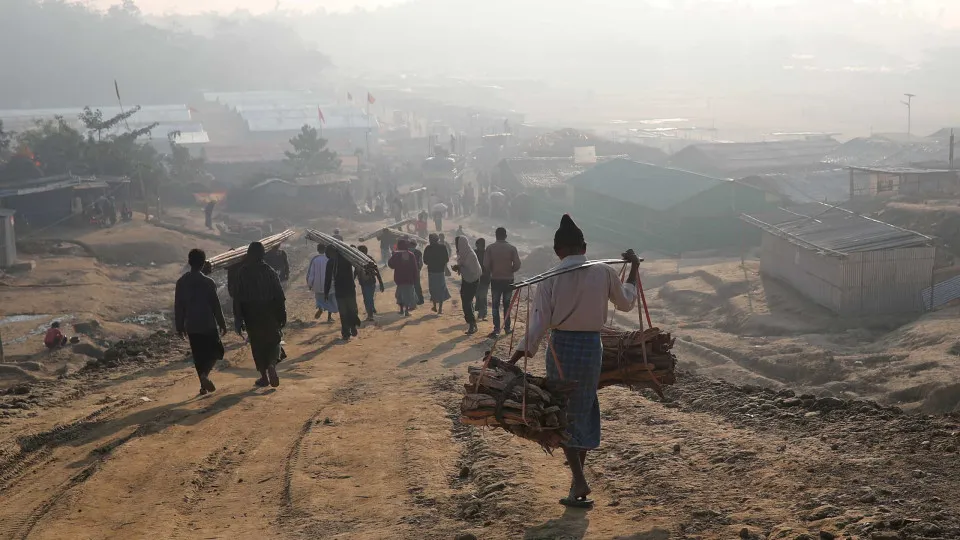
The head of the UN team of investigators for crimes in Myanmar said that attacks against civilians in the west of the country prevent the return of the Rohingya minority who is refugees in Bangladesh. Two weeks ago, at least 50 people died and another 58 were injured during an air raid in Rakhine, where lives the Muslim minority Rohingya.
© Reuters
12/10/2026
by
Lusa
O head of the UN Crime Investigation Team in Myanmar (formerly Burma) today said that attacks against civilians registered in the west of the country prevent the return of the Rohingya minority who is refugees in Bangladesh.
Two weeks ago, at least 50 people died and another 58 were injured, according to UN data, during an air strike against a market in the state of Rakhine, where the Muslim minority Rohingya lives.
The attack was attributed to the Burmese Army by the rebel Araban Army movement, a Buddhist guerrilla that also discriminates against this minority.
“The [UN Independent Research Mechanism for Myanmar] investigates allegations of very serious international crimes currently being committed in the state of Rakhine by authors of different ethnicities, religions and political affiliations,” said Nicholas Koumjian in a statement.
The person responsible for investigating the UN mechanism today concluded an official six-day visit to Bangladesh, a country where more than 154 thousand Rohingya have fled since the beginning of 2024 due to violence against this minority during the conflict between the Arakan Army and the Burmese Army.
“Many Rohingya shared with me their recent and traumatic experiences that led them to seek refuge in Bangladesh and these testimonies are crucial to advance our investigations,” Koumjian said.
This persecution joins the one suffered by Rohingya during the brutal campaign launched by the Army in August 2017, which led more than 720,000 members of this ethnic group to flee also to Bangladesh.
According to UN data, over 1.2 million Rohingyas are in refugee camps located in the territory of Cox’s Bazar, Bangladesh — the world’s largest network of camps.
Koumjian defended the need to “end violence against the civilian population” and for those responsible to respond to justice, pointing out these measures as “ crucial steps to ensure that the Rohingya community can return to their homes safely”.
This UN mechanism, established in 2018, provided material to the International Criminal Court (ICC), the authorities of Argentina, which opened a case in 2024 on the basis of universal jurisdiction, and the International Court of Justice, in the context of cases initiated to investigate the possible genocide against the Rohingya people.
The campaign of repression of the Myanmar army against this minority was described by the UN as an ethnic cleansing.
Myanmar, of the Buddhist majority, does not recognize this minority and imposes multiple restrictions on Rohingyas, namely freedom of movement.