
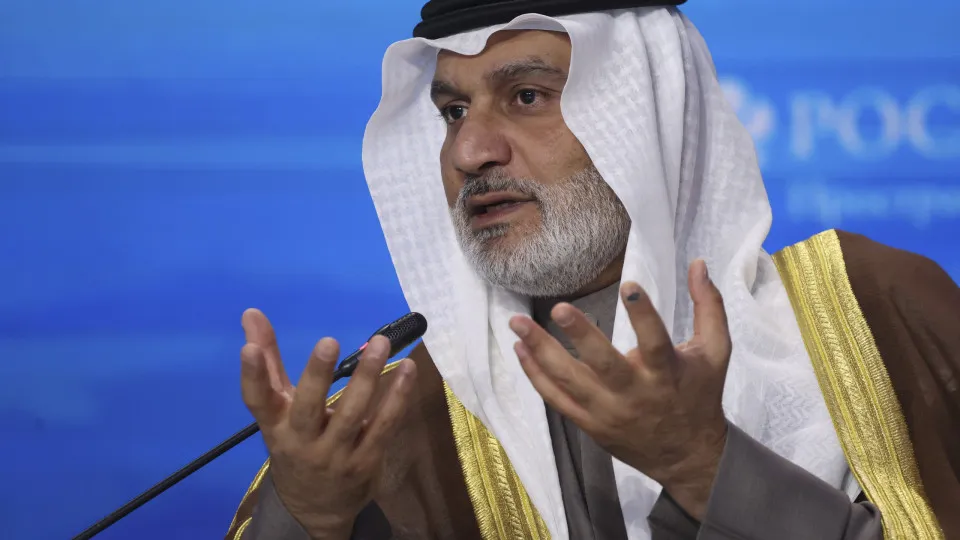
OPEC Secretary-General Haitham al Ghais stated that the world will need 23% more primary energy by 2050, highlighting the need for investments in infrastructure for oil, gas and other energy sources.
© Lusa
12/10/2026
by
Lusa
O secretary-General of OPEC, said today that “the world will need 23% more primary energy by 2050” and defended the need to invest in infrastructure for oil and gas as well as other energy sources.
“ We continue to invest in the OPEC (Organisation of Petroleum Exporting Countries) countries in oil and gas, oil and gas infrastructure and insurance policies that we need to have in force. But we also invest in other energy sources, because we believe that the world will need another 23% of primary energy between now and 2050,” said OPEC Secretary-General Haitham al Ghais in the 25th edition of the World Oil Council Energy Congress (WPC) in the capital of Saudi Arabia.
Primary energy is that collected directly from nature, such as oil, wind or sun, while secondary energy is its transformation into gasoline or electricity.
At a ministerial session, Al Ghais said that one day it cannot be said: “‘Look, I am in short supply and I will build a new refinery to start producing immediately’. It does not work that way, since it is an industry “with long implementation times. It takes a lot of planning.”.
To justify, Al Ghais explained that “people do not realize that it is necessary to invest today to be able to produce within five, six or seven years, both in exploration and production activities and in refining and distribution” of oil.
Because the world’s population “will increase by nearly 2,000 million people from now until 2050 (...) Urbanisation alone will cause more than 1,800 million people to move to new cities around the world between now and 2050. The size of the world economy will double compared to the current one if we consider an annual growth of Gross Domestic Product (GDP) of 3%. In addition, everyone talks about artificial intelligence (AI), as if it were the new religion: AI data centers and everything. All this will require much more energy ", enumerated.
Al Ghais attributed the “cassez” that the world today suffers from “diesel, airplane fuel and gasoline” to the lack of investment, “something that was going to happen. It was only a matter of time. It was predictable. We had been warning this for many, many years.”.
The head recalled how OPEC estimates that up to US$18 billion is needed for annual investment in exploration and production, transportation and storage, and refining and distribution activities, which is equivalent to around US$700,000 million per year.
And all this in a context in which, after downward revisions in recent months due to the war initiated by the United States and Israel against Iran on 28 February, it is now predicted that “demand is expected to grow this year by 400,000 barrels per day, against an estimated 1.4 million barrels per day at the beginning of the year.”.
“However, to be fair, this demand has been postponed to 2027, a year when we believe there will be an accumulated demand pending to materialize. We now place demand growth for 2027 in 1.7 million barrels daily”, he concluded.