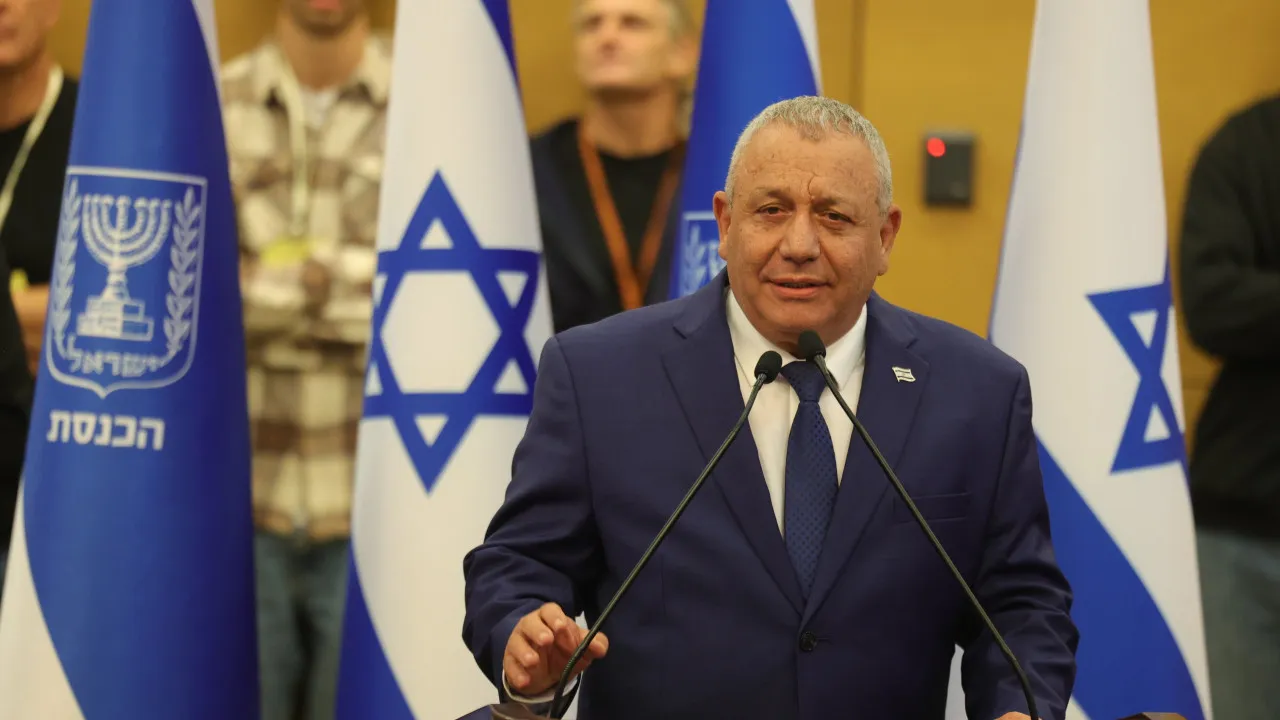
The leaders of the Israeli opposition gathered today to reaffirm the need for a “national emergency government” headed by Gadi Eisenkot, after one of its leaders met with the outgoing Prime Minister, Benjamin Netanyahu, in the absence of the partners.
© Lusa
18/11/2026
by
Lusa
Oleaders of the Israeli opposition gathered today to reaffirm the need for a “national emergency government” headed by Gadi Eisenkot, after one of its leaders met with the outgoing Prime Minister, Benjamin Netanyahu, in the absence of the partners.
In a statement, the Yashar! (Integral!), Eisenkot party, reported that the leaders of the four Jewish parties of the so-called bloc of change were gathered in the parliament (Knesset) in Jerusalem to examine “progress on the various fronts of negotiations for the formation of a government”.
The leader of Yashar! and former head of the armed forces was tasked by Israeli President Isaac Herzog to form an executive, but neither the opposition nor the pro-government group managed to obtain a majority of 61 deputies to control the parliament that emerged from the legislatives of October 27.
“ All party leaders agree that their highest priority is to form a national emergency government led by Gadi Eisenkot and replace Benjamin Netanyahu as Prime Minister as soon as possible,” Yashar said!.
The meeting takes place on the day that the Israeli portal Ynet reported a three-hour meeting of one of the opposition leaders – former Prime Minister and coalition leader Together, Naphtali Bennett – with the head of the outgoing government.
Both the Likud of Benjamin Netanyahu and the Together coalition claimed that the long meeting of the two politicians, in the cabinet of the Prime Minister in the Knesset, was dedicated to a ‘security briefing’, according to various Israeli press bodies, who heard party sources realizing that the other opposition leaders were not warned.
Faced with the political impasse in Israel, Netanyahu has demanded the formation of a “government of national unity”, without the Arab parties and including the Zionist opposition, which has repeatedly rejected this solution.
After the meeting of the opposition leaders and asked if he still trusted Bennett, the leader of the left wing coalition Democrats avoided a direct answer.
“ Everyone fully understands the gravity of the moment and the need to establish a stable government quickly. I won't go any further. This is a delicate conversation”, said Yair Golan, quoted by Ynet.
The remaining opposition leaders did not comment on Netanyahu's meeting with Bennett.
Sources of the Together Alliance (including Yair Lapid, another former prime minister and opposition leader in the last four years) have told The Jerusalem Post that Naphtali Bennett will not accept joining a government led by Netanyahu.
But it would be available to support a unit government led by Eisenkot in a possible rotation agreement, according to the newspaper, without discarding other scenarios to form a “good Zionist government”.
The divisions in the opposition group arose shortly after the elections, when Avigdor Lieberman, a former right-wing minister known to represent a “hard line” in security matters and leader of the Yisrael Beiteinu (Israel is Our House), refused the support of Arab parties to gather a majority in parliament.
The two Arab formations – Joint List and Ra’am – achieved the record election of 19 deputies, who added to the 48 of the four Zionist opposition parties would reach the majority of 61 in the Knesset (67 deputies).
Despite the obstacles created by Lieberman, the Arab lists endorsed Eisenkot in the post-election consultations of the Israeli President, Isaac Herzog, to choose a name to form government and on Tuesday also supported Yashar's candidate!, Matan Kahana, for the Knesset presidency.
As an alternative to the Arabs, Avigdor Lieberman advocates an approach to the representatives of the pro-government bloc and the two ultra-orthodox forces, who supported Netanyahu in the previous political cycle and elected 13 deputies on October 27.
This exit, however, collides with the controversial military exemption from the ultra-Orthodox, who do not give up this benefit and whose end was an electoral promise from the opposition parties to their secular and secular support base.
One of the ultra-orthodox formations – United Judaism of the Torah – did not support Netanyahu's name in the consultations of the Israeli President, but did not endorse Eisenkot.
On Tuesday, he ended up voting in favour of Likud's candidate for the presidency of parliament, Ofir Katz, after speculations that he could abstain, signaling his position on a government headed by Eisenkot.
Kahana's choice to lead the parliament, replacing Amir Ohana, of the Likud, party of the outgoing Prime Minister, Benjamin Netanyahu, however represented a setback to the pro-government camp.
According to Yashar!, today’s meeting of opposition leaders has also served to assess “the way the parties have successfully exercised their majority in the Knesset” in recent days.
“ The leaders also discussed the emergency that Israel faces on the security fronts, social and international, and the particular sensitivity of the coming days,” according to the statement, adding that opposition leaders will “continue working together in close coordination and act quickly to achieve this goal.”.
The choice of Matan Kahana happened one day after the opposition bloc placed Avigdor Lieberman in the chair of the powerful Foreign and Defence Parliamentary Committee, which will have to assess the controversial military exemption from ultra-orthodox.
The victories of the so-called block of change in the Knesset allow Eisenkot and his party to gain a strategic position to define the parliamentary agenda and thus control the timetable of debates and votes, a crucial lever for the opposition, which seeks to dismantle Netanyahu's legacy as soon as possible, including its controversial judicial reform.
Gadi Eisenkot has 28 days, extended by 14, counting since November 7 to form government.
If it does not achieve the necessary support within the legal deadline, the decision returns to the Israeli President, who must appoint another candidate to be an executive in 28 more days, but not extended, and under threat of further elections.