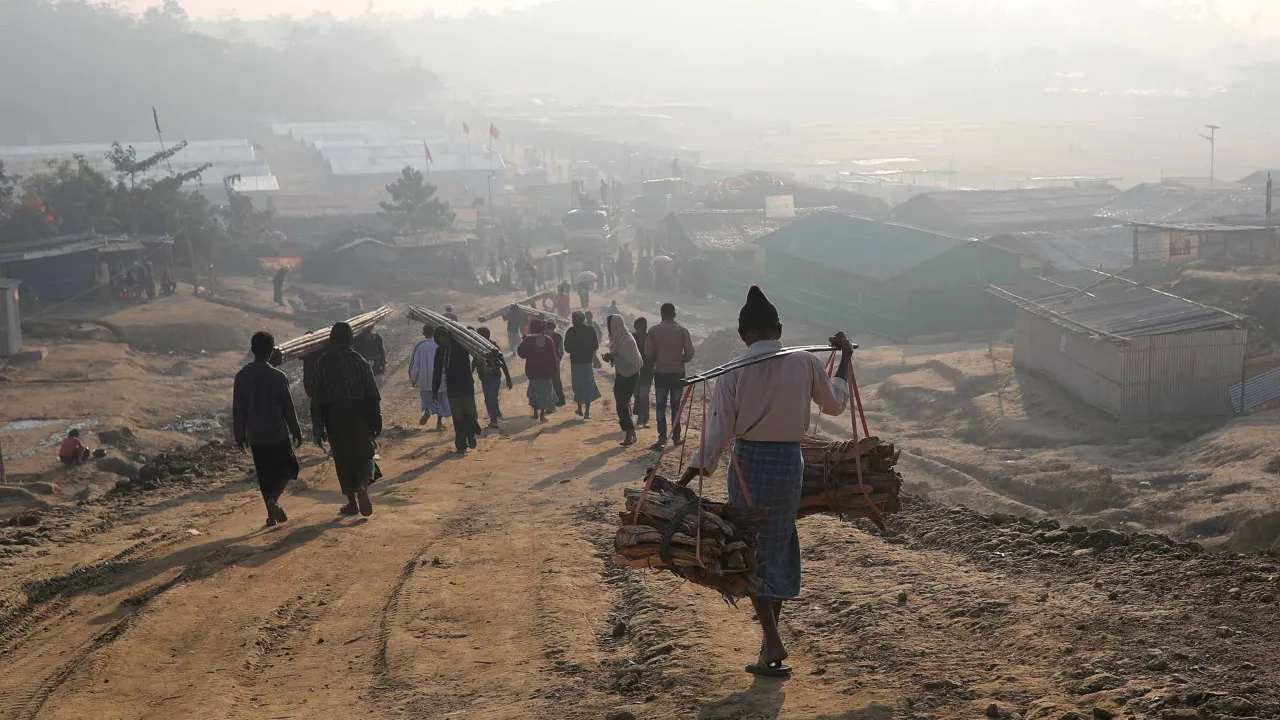
France will request a UN Security Council meeting to comply with the decision of the International Court of Justice (TIJ), which declared the Myanmar military junta responsible for genocide against the Rohingya Muslim minority.
© Reuters
21/11/2026
by
Lusa
Fthe UN Security Council will request a meeting to comply with the decision of the International Court of Justice (TIJ), which declared the Myanmar military junta responsible for genocide against the Rohingya Muslim minority.
The spokesman for the French Ministry of Foreign Affairs (MNE) justifies the call with the United Nations Charter, which provides that the Security Council may take measures to implement a decision of the ICJ if one of the parties to the dispute fails to fulfil the obligations arising therefrom.
The French MNE alludes to the fact that the Myanmar military government (formerly Burma) rejected the sentence handed down on Thursday, which obliges them to investigate crimes, compensate victims and facilitate the return of displaced persons, for considering it biased, selective and for including “interventional recommendations”.
In view of this reaction, France stressed that the International Court of Justice decisions “are definitive and binding on the parties and must be applied in full compliance with international law”.
In this regard, he reiterated Paris’ commitment to defending international law and recalled that the International Court of Justice is the “main judicial body of the United Nations”.
The MNE spokesperson recalled that France mobilized itself from the beginning of acts of violence against Rohingya in 2017 and worked to keep this issue on the agenda of the Security Council, of which it is one of the permanent members.
In addition to the past, the French MNE pointed out that the Paris Government is “very concerned about the situation in Myanmar” which, he said, suffered “a severe deterioration after the 2021 coup d’état”, with about 100,000 dead and four million displaced.
“ Civil populations, including Rohingya, are the first victims of continuous violence and lack of access to humanitarian aid,” the spokesperson for the French MNE said.
On Friday the Myanmar Government considered the decision of the TIJ “unfair”, which recognizes the genocide committed by the Burmese military against the Rohingya.
The day before, TIJ claimed to have proof that the Myanmar authorities killed some 10,000 people from the Rohingya minority during military operations in 2017.
The conclusion arose at the beginning of a three-hour session to read the decision of the main United Nations court on whether Myanmar committed genocide in a brutal offensive against members of the Rohingya minority almost a decade ago.
Violence forced hundreds of thousands of Rohingya, a minority made up mainly of Muslims, to flee to neighbouring Bangladesh.
“The court considers that Myanmar’s security forces killed thousands of Rohingya civilians, perpetrated widespread acts of sexual violence, as well as acts of extreme violence against children, and attacked Rohingya on the run,” TIJ president Yuji Iwasawa said.
Myanmar “committed genocide against the Rohingya group in northern Rakhine state, in violation of its obligations under the 1948 Genocide Convention,” Iwasawa said, stating that the decision was taken with the agreement of nine of the 15 judges.
The Court ruled that Myanmar “allows and facilitates the return, safely, voluntarily and with dignity, to their places of residence” of those who fled violence.
The judges also ordered Myanmar to investigate and punish any person suspected of having committed genocide, also establishing the provision of compensation, the value of which will be determined later.
On Thursday, the European Union (EU) urged Myanmar to comply with the judgment of the International Court of Justice and to arrange for the return and compensation of Rohingya, stressing that this is not “optional”.
The U.S. State Department said it was “analyzing” the decision of the TIJ that recognized Myanmar’s genocide against the Rohingya, warning that this instance is not “politicized”.
Although the decisions of the TIJ are binding and irrevocable, the Court has no means to enforce its verdicts.