
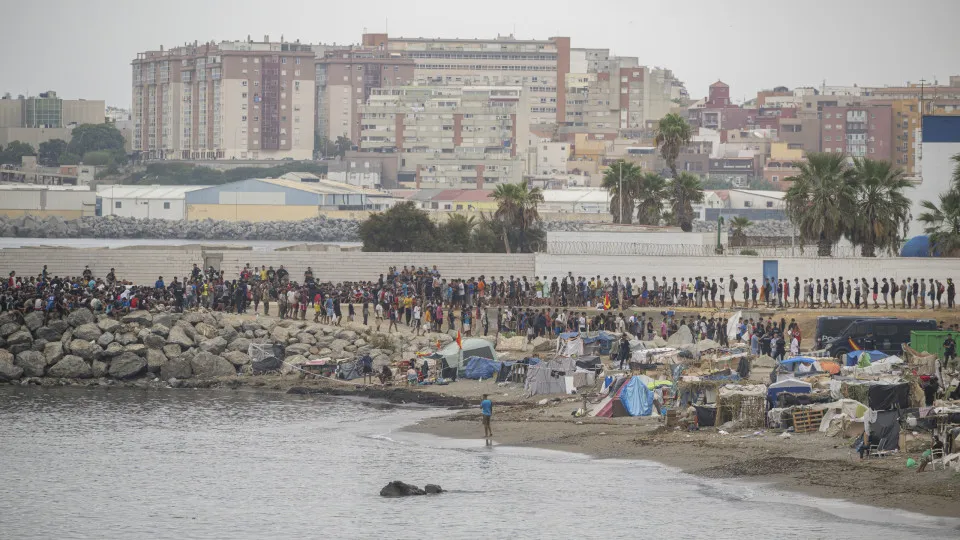
The Spanish national police have identified two senior Moroccan security officials who appear in videos of the great migratory flow at the end of July in Ceuta to instruct migrants near a border crossing.
© Marcos Moreno/Europe Press via Getty Images
05/11/2026
by
Lusa
A spanish national police have identified two senior Moroccan security officials who appear in videos of the great migratory flow occurred in late July in Ceuta to instruct migrants near a border crossing.
The two identified are Mohamed El Oualid, President of the Tetuão Region Police, and Abdel Fattah El Sayed El Radi, general supervisor of the region of M’diq-Fnideq (Rincón-Castillejos), which was the epicenter of the crisis, according to a report sent to the National Court of Spain and quoted by the Spanish news agency EFE.
The intelligence and counterterrorism service of the Spanish national police, the General Information Commissioner, has located 73 videos of the days of mass entry of irregular migrants from Morocco, and the report in question analyses five of these videos.
According to the document, the president of the Tetuão police appears, in one of the videos, “to instruct several migrants, to gestulate with the right arm and to point in the direction in which they should go”.
Police classify the two suspects as being “at the highest level of the operational chain of command of the security apparatus” of Moroccan authorities and ensure that they will continue to analyze the material to “determine the role played by those identified in the events, and to identify the other collaborators who appear in the videos and their command structure”.
The case occurred between 30 and 31 July in Ceuta, the Spanish enclave located in North Africa, when more than 70,000 irregular migrants from Morocco entered the territory.
The crisis, which caused more than 140 deaths and was seen as an instrumentalisation of migrants by Morocco, also triggered a diplomatic crisis in Europe.
Several European countries reacted by calling for Spain to be suspended from the Schengen area, where there is free movement of people in Europe, to prevent Moroccan migrants from entering the continent.
The Spanish Government maintained whenever there was no evidence to point to the involvement of the Moroccan authorities.
On Tuesday, the president of Ceuta accused Morocco of having “planned, prepared and executed” the entry into the city of about 100,000 people at the end of July, lamenting the “barred submission” of Madrid to the neighboring country in this situation.
Juan Jesús Vivas (PP), who spoke at a press conference to take stock of the three months since the events of 30 and 31 July, concluded that Morocco “was behind” the operation and regretted that the Spanish Government did not mobilise “all the means necessary” to stop the “invasion”.