
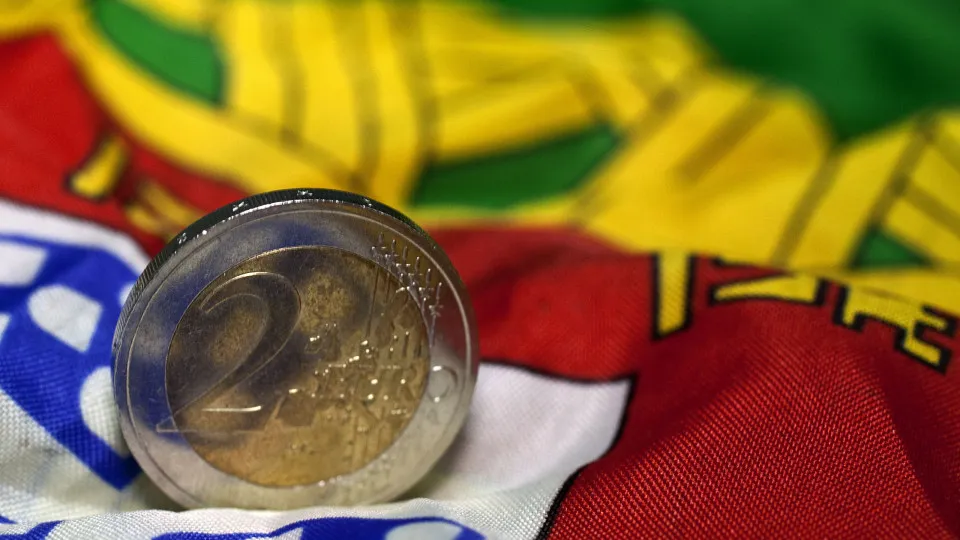
Portugal has secured a national allocation of EUR 35.1 billion in the proposal from the Irish Presidency of the European Union (EU), but it requires an additional EUR 900 million for the outermost regions, Azores and Madeira.
© Lusa
10/10/2026
by
Lusa
Pin the proposal by the Irish Presidency of the European Union (EU), it has secured a national allocation of EUR 35.1 billion, but it requires an additional EUR 900 million for the outermost regions, the Azores and Madeira.
On the day the current rotating presidency of the Council of the EU, held by Ireland, presented a proposal for a multiannual budget for 2028-2034, a Portuguese diplomatic source, indicated to Lusa that the proposal “saves one of the central aspirations that Portugal has in this negotiation, which is to take into account cohesion, ensuring that the national envelope remains balanced vis-à-vis the other Member States, which was not the case at the beginning of the negotiation”.
In this Irish proposal, Portugal has managed to secure a national envelope of EUR 35.1 billion at current prices, an increase of about EUR 1.6 billion compared to the European Commission's proposal by strengthening cohesion.
The total amount is similar to that contained in the document of the EU Cypriot Presidency published last June.
With regard to the current Community framework, there is an 8.6% improvement, when the average for the EU as a whole is 8%.
Still, the country wants to “update the values of now or at least keep the specific money” for the outermost regions (RUP), which is EUR 900 million in the existing Community framework, according to the same Portuguese diplomatic source.
“ The SPS are a geopolitical asset of the EU,” he said.
Last September, Portugal, Spain and France requested in a joint letter that the next EU budget for 2028-2034 maintain the level of support for the SPR, stressing the specificities of these regions, marked by geographical remoteness, insularity and structural limitations.
Today, the Irish presidency of the EU Council has proposed 8% cuts in the European Commission's proposal for a multiannual budget for 2028 to 2034, for a total of €1.62 billion, without substantially moving cohesion and agriculture.
This is a proposal equivalent to 1.16% of the Gross National Income (GNI) of the European Union, a total of €1.62 billion compared to the proposal of the EU executive of €1.76 billion, at constant prices of €2025 (and €1.83 billion compared to €1.98 billion, already in current prices).
The biggest cuts in relation to the Brussels proposal relate to the heading Global Europe and competitiveness, prosperity and security, followed by administration.
Economic, social and territorial cohesion, agriculture, fisheries and rural communities suffer the slightest cut.
“ We deeply regret that the level of ambition is falling”, criticized the Portuguese diplomatic source, stressing that, apart from the reimbursements of the fund for recovery and resilience, the overall budget corresponds to national contributions of 1.02%.
The revised proposal from Ireland, which includes new sources of own revenue to finance the Community budget, comes before next week's European Council meeting, devoted, among other topics, to the next MFF, which will set the EU's priorities and expenditure limits between 2028 and 2034.
As far as new own resources are concerned, the Irish presidency has proposed a package capable of generating EUR 55 billion a year, based on the proposal of the Community executive, based on carbon market revenue, the border carbon adjustment mechanism, uncollected electronic waste, excise duties on tobacco and a contribution from large companies.
Portugal has done well to discuss these new recipes, asking them to be “truely European”.