
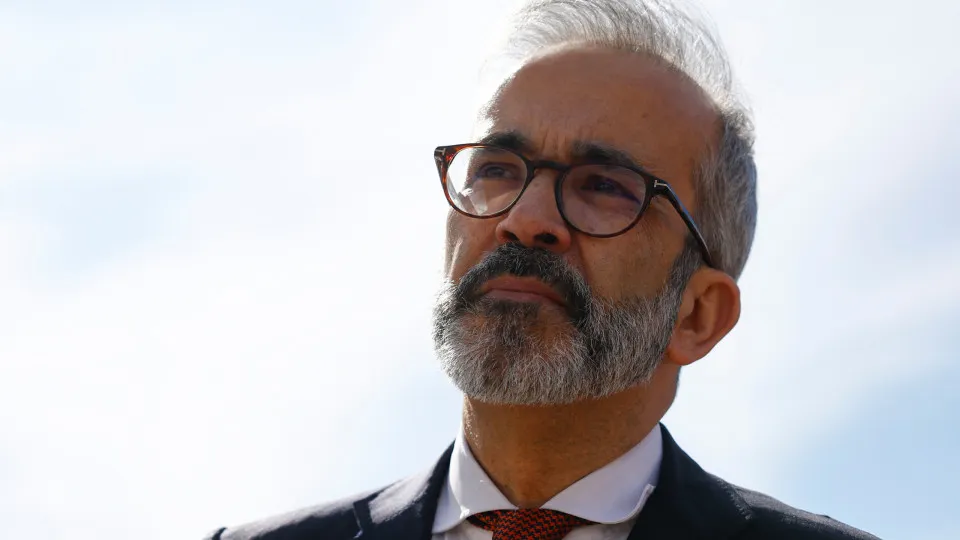
The Portuguese Foreign Minister, Paulo Rangel, has today been in favour of lowering the rate of customs duties from 25% to 10%, when the European Union (EU) discusses the resources to finance the next Community budget.
© REUTERS
29/10/2026
by
Lusa
O portuguese foreign minister, Paulo Rangel, has today been in favour of lowering the rate of customs duties from the current 25% to 10% when the European Union (EU) discusses the resources to finance the next Community budget.
“ On the issue of traditional resources, I think something could be done: today, the rate that states hold is 25% and we would be in favour of it falling from 25% to 10%,” he said, during a parliamentary hearing to discuss in the specialty of the 2027 State Budget proposal (OE2027).
Rangel acknowledged that such a measure could have “a huge impact” for some countries, particularly those with ports.
“ We believe that a reduction of this rate from 25% to 10% would be a way of finding own resources that would reasonably compensate for the work that states have on customs revenue and restore an important Union revenue,” he said.
Negotiation on the next multiannual financial framework (MFF, 2028-2034) – on which the President of the European Council, António Costa, wants agreement later this year – prompted several questions from Members during the hearing of parliamentary committees on Budget, Finance and Public Administration, Foreign Affairs and Portuguese Communities and European Affairs, which lasted almost six hours.
On the own resources under discussion in the negotiations, Rangel indicated that the principle position of the Portuguese Government is to “not be closed” to any proposals, while remaining “totally available” to discuss the global package, analyzing the impact of each measure.
The Minister of State and Foreign Affairs has admitted reservations as to some of the proposed resources, namely on taxation of online games, which “must be measured carefully because it may have an impact on the Portuguese case”, and the application of a tax on electrical and electronic equipment not collected.
As for tobacco tax, the government is in favour, “as long as there is an agreement on the tobacco directive and the current version of the directive has the support” of Lisbon, he commented.
Portugal also supports other proposals, namely the tax on large companies; the carbon adjustment at the border – “and even advocates that there may be a 100% allocation of revenue, because it has a positive impact on Portugal” – and the percentage of revenue generated by the carbon license auctions (TSS).
Rangel insisted on the proposal to postpone the payment of the debt of the Next Generation EU programme and recalled that Portugal supports “the contraction of the common debt for defence, provided it is committed”, which would be “attractive for European capital to settle in Europe”.
During the hearing, the minister was asked by Mr Madeirense Carlos Pereira (PS) about whether the government would admit to using the veto if the EU’s long-term budget proposal – which requires unanimity – “does not meet the needs of the autonomous regions”.
“There are 500,000 Portuguese in the autonomous regions who want to know if Portugal is willing to go further,” the socialist challenged.
Paulo Rangel confirmed that in the negotiations the issue of the outermost regions “is non-negotiable”.
“ In Portuguese tradition, we do not have the habit of using the veto, but I sent our ambassador to Reper [permanent representation of Portugal with the EU] to use it just now on the list of sanctions to Ukraine because of the issue of cod and cod quotas, to save a key sector of Portuguese industry,” the minister said.
Rangel insisted: “This government will not hesitate to use the veto, always with weight and measure.”.
As for the common agricultural policy, Rangel stressed that negotiations are still ongoing, but anticipated “good news” for the primary sector in Portugal, stating that the proposal gives Portugal an envelope “clearly above” from the current budget.