
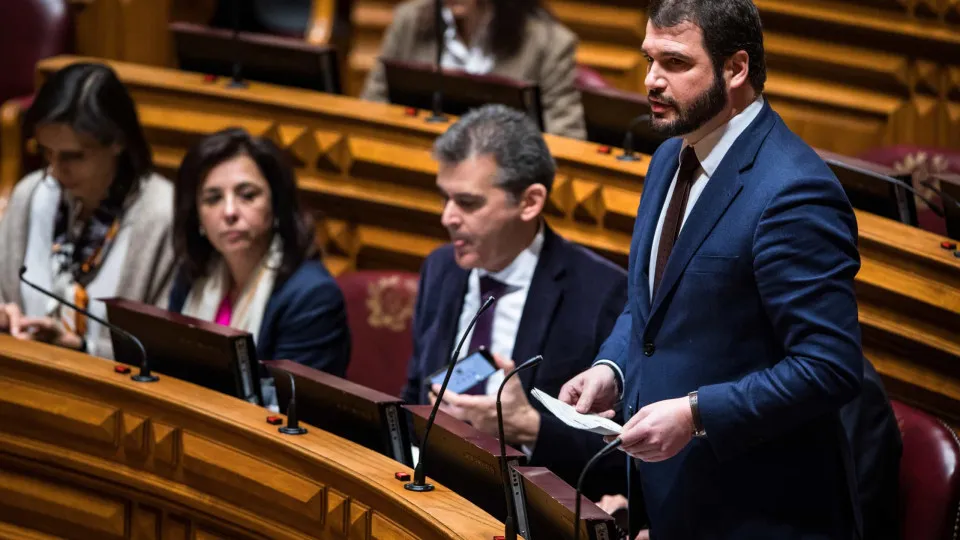
The councilman of PS João Paulo Correia expressed concern that 86% of the revenue from the Gaia cable car is based on tourists, as well as the impact on the STCP lines.
© Getty Images
17/11/2026
by
Lusa
O alderman of PS João Paulo Correia expressed concern today that 86% of the expected revenue from Gaia's future cable car is based on tourists, as well as the impact on the current lines of STCP.
“ The cable car business is only feasible if there is a deviation from the users of the STCP [Oporto Collective Transport Society] of these four careers [900, 901, 905 and 906] of the STCP, for the cable car business ", said today at the public meeting of Vila Nova de Gaia City Hall (Porto district) João Paulo Correia.
The question is a document presented at the Metropolitan Council of Porto, which on Monday approved the accession of Gaia’s cable car – whose inauguration is scheduled for 2030 – to the system of bilingual Andante of the Metropolitan Area of Porto (AMP), in which it can be read that today there are “12,048 daily validations on the bus lines that the cable car intends to capture”.
According to the document, to which Lusa had access, in question are 9,872 validations on lines 900, 901, 905 and 906 of the STCP and 2,176 of lines 9012 and 9021 of the Unir network, between September 2025 and August 2026, with 14,000 daily passengers on the lift in the average scenario “in a cruise year”, scheduled for 2034.
What “most concerns” the PS councilors is that “the cable car business (...) opens the door to the extinction of these four careers, moreover, comes to compete with four STCP careers because – it says explicitly – the goal is to capture the users of these four STCP careers,” said João Paulo Correia.
In addition to criticizing the fact that the document did not come to the Chamber meeting before the accession to the Andante was voted on in the AMP, another of the concerns listed was the prediction that it will be “a business in which 86% of the revenue is tourism revenue”.
“We have not yet had access to the economic-financial feasibility study, nor any search study for the construction of an infrastructure presented as a transport infrastructure and that is not, since 86% of the revenue comes from cash ticket, counting 15 euros per ticket”, he listed.
Referring that Gaia “had a daily average of 2,900 tourists” in 2024, João Paulo Correia pointed out that “the study says that all these tourists, close to 3,000, will use the cable car daily”, which for you “is an extremely ambitious vision and to move on to unrealisticism”.
In the answer, Vice President Firmino Pereira, who presided over the meeting in the absence of President Luís Filipe Menezes (elected by the PSD/CDS-PP/IL coalition), stressed that the objective of the House is that the cable car “does not serve exclusively for tourism”, but is “a transport of public use” and “that is a true public service”.
“ I am not concerned about the question, for example, that this cable car exists and serves as public transport will end with four careers of the STCPs and a career of Unir. If we were to think so, then we would never build the subway lines, because the subway line on [Republic] Avenue ended up with a series of public bus transports” and the Rubi Line of the subway is “exactly the same thing that will happen,” he argued.
Also the mobility councilor Fernando Machado intervened, saying that the cable car line “is being thought for the Gaienses” and already predicts “that in two or three years, taking into account the construction index that is taking place in Madalena and Canidelo, it will be about 40,000 people who will live there”.
In the answer, João Paulo Correia told Firmino Pereira that the metro “was not thought for tourists”.
The new cable car in Gaia, connecting the beach of Pedras Amarelas to Arrábida, will be a private investment that will be around 90 million euros and will not cost the municipality, said the mayor on July 7.
Seasons are planned on the beach of Pedras Amarelas, Lavadors beach, Douro Marina, Segundo Cais da Afurada, Jardins da Arrábida and Arrábida.