
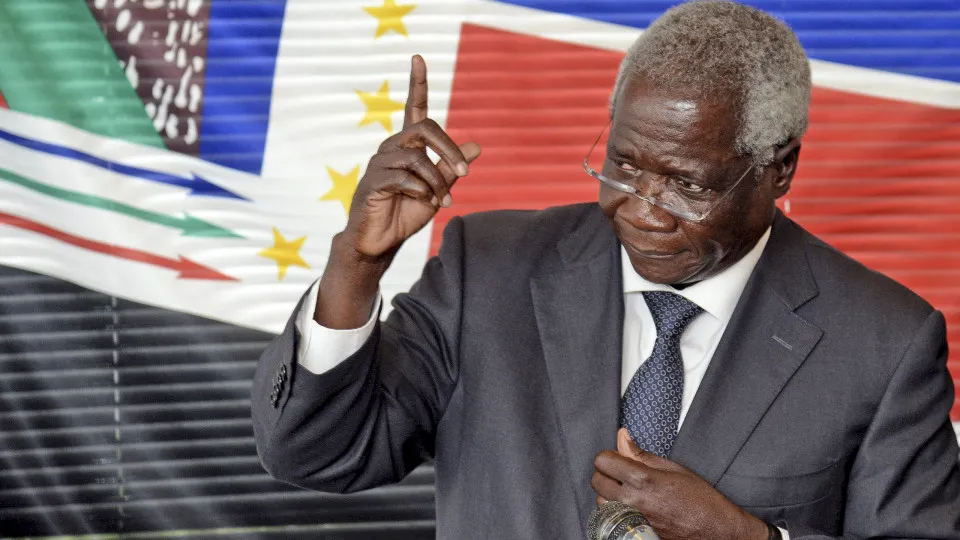
The Mozambican National Resistance (Renamo) today defended the formal recognition of the role played by the historic leader of the party, Afonso Dhlakama, for the end of the civil war and the introduction of multi-party democracy in the country.
© Lusa
04/10/2026
by
Lusa
“Rand we affirm today that it is a national imperative to officially and dignifiedly recognize the figure of President Afonso Dhlakama, for his indispensable role in the democratization and pacification of Mozambique ", said the current leader of Renamo, Ossufo Momade, in a press conference in Maputo.
Speaking on the occasion of the 34th anniversary of the signing of the General Peace Agreement between then President Joaquim Chissano of the Mozambique Liberation Front (Frelimo), in power since the independence of the country in 1975, and Afonso Dhlakama, the historic leader of the Mozambican National Resistance (Renamo), who died in 2018, who ended the 16 years of civil war in Mozambique, Momade said that the agreement concluded in Rome, the Italian capital, on October 4, 1992, constituted a fundamental milestone in national political history and cannot be dissociated from the role played by Dhlakama.
“ Without this historical recognition, without embracing all those who gave their lives for democracy, our reconciliation will remain incomplete,” he said.
The leader of Renamo also recalled that the party was one of the signatories to the General Peace Agreement, which, among others, paved the way for the introduction of multi-partyism, competitive elections and political freedoms in the country. For Renamo, the day represents more than a national ephemeral, and is also a founding moment of the so-called Second Republic.
“October 4 represents the breaking of the handcuffs imposed by the communist regime implanted in the then newly independent nation,” he said.
The party also sought to frame the anniversary of the agreement in the current political context of the country, maintaining that peace cannot be reduced to the absence of armed conflict.
“ True peace requires justice, dignity, inclusion, respect for fundamental rights, opportunities for youth, equal opportunities for women, community development and trust between citizens and institutions,” Ossufo Momade said.
The party considered that several of the goals associated with the democratisation process remain to be achieved, pointing out problems such as poverty, corruption, economic fragility and political exclusion.
The party leader also criticised the conduct of electoral processes in the country since the introduction of multi-partyism, alleging the existence of practices that, in his view, undermine democratic credibility.
“ Mozambique remains one of the poorest countries in the world, even with the vast amount of natural resources coveted by the world,” he concluded.
Also today, in separate messages on the occasion of the Day of Peace, the president of the Mozambican Democratic Movement (MDM), Luther Simango, defended that the consolidation of peace remains dependent on the fight against injustice, poverty and discrimination, saying that “there will be no lasting peace while a Mozambican feels second-rate citizen by thinking differently, because he is from a different region, or because he does not have a political party card”.
In turn, the president of the Optimist People for the Development of Mozambique (We Can), Albino Forquilha, argued that peace in Mozambique should not be reduced to the absence of armed conflict, pointing to structural problems as factors of instability.
“True peace is not the mere absence of gunfire. The silence of the rifles does not mean that the country is in harmony”, he said, defending political and institutional reforms to combat what he classified as exclusion, party capture of the state and lack of electoral integrity.