
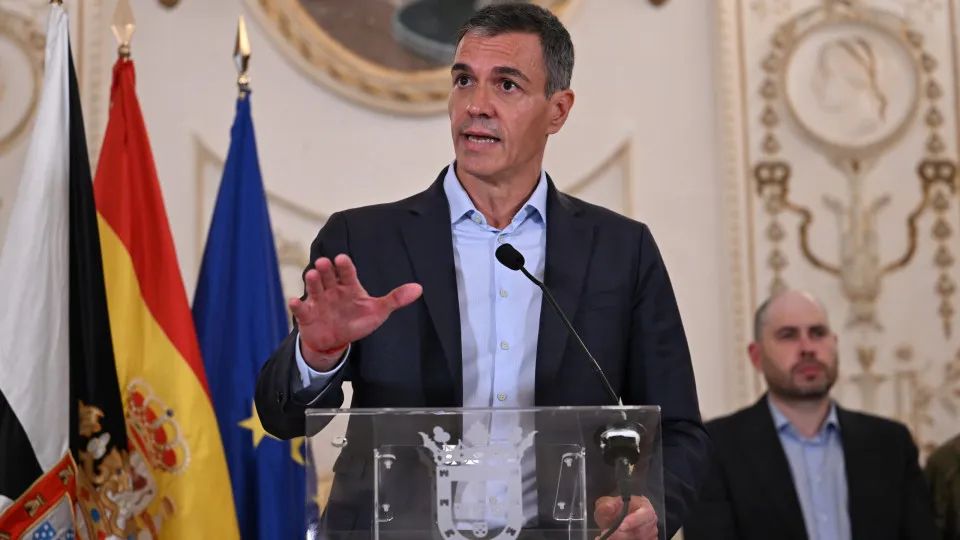
The Prime Minister of Spain, Pedro Sánchez, today considered that the resignation of the Minister of Transport helps to regain confidence in Spanish high speed after two railway accidents in nine months when 115 people died.
© Handout/Anadolu via Getty Images
04/11/2026
by
Lusa
O prime Minister of Spain, Pedro Sánchez, today considered that the resignation of the Minister of Transport helps to regain confidence in the Spanish high speed after two railway accidents in nine months when 115 people died.
“ With his resignation, Oscar Puente helps Spain to regain not only confidence in our railway system, but also in political dignity”, said Sánchez today, in a statement from the Moncloa Palace in Madrid, the seat of the Spanish Government.
The People's Party (PP, right), which leads the opposition, considered that Oscar Puente's resignation is "a theater" less than a month from the Spanish legislative elections of November 29 and was motivated by polls, which anticipate the victory of the right and the end of socialist governments after eight years.
Sánchez announced today that the first Deputy Prime Minister and Minister for Economic Affairs, Carlos Cuerpo, will temporarily take over the Transport portfolio until the elections following the resignation of Oscar Puente.
The Transport Minister resigned on Tuesday evening at the end of a hearing in parliament to explain about the railway accident in Urda, Toledo, on October 28th, where 69 people died, and the state and security of the Spanish high-speed network, the largest in Europe and the second largest in the world, after China.
The Urda accident was the second with fatalities this year with high-speed trains in Spain, after 46 people died on January 18 in Adamuz, Córdoba.
Sânchez praised Oscar Puente today for last week, after the Urda accident, having “behaved, explained and also presented solutions that society demanded and deserved” before resigning and leaving office.
The Minister's resignation was requested last week by almost all political forces represented in parliament, left and right, including allies of socialists in the Government and Congress of Deputies.
After four hours of hearing in parliament on Tuesday, Oscar Puente announced his resignation to the deputies and invoked the example of the former Portuguese minister and leader of the PS Jorge Coelho, in 2001, with the accident of the bridge of Entre-os-Rios, in which 59 people died.
“ He then used a sentence that I want to make: the guilt cannot die single”, said Oscar Puente, who in the previous six days had refused to resign and stated that his duty and responsibility was to remain in office, clarify what happened and present solutions.
On Tuesday he assured that, however, he made the decision to resign immediately after the accident in Urda.
A Transport Minister “from a country such as Spain cannot continue in office with two accidents of this severity in less than a year, however different they are and whether or not they have direct responsibility for them,” he said.
“It is a matter of political dignity, coherence and empathy with the victims,” he added.
Oscar Puente justified his resignation on Tuesday because he had already “completed the most urgent work” after the accident, namely to make the first investigations to try to find out what happened, to advance support for victims and families and to adopt short-term and immediate measures to “improve railway safety”.
These measures were announced on Tuesday, after the seminal meeting of the Council of Ministers, the parliamentary hearing followed for explanations.
The accidents of Urda and Adamuz made jump into critical public space and complaints from trade unions and experts regarding high speed management in Spain.
Opened in 1992, Spain has a 3,993 km high-speed rail network, which liberalised and opened up competition at the end of 2020.
Three companies operate high-speed trains in the country and the opening to competition caused the number of passengers to go up to about 44.5 million in 2025 (double 2019), causing an intensity of use that resulted in the accelerated wear of rolling stock and infrastructure, according to experts.
Trade unions and experts also denounce that this growth was not accompanied by a corresponding and sufficient strengthening of human resources and investment in maintenance.
Before resigning, Oscar Puente defended on Tuesday for four hours the management of high speed in Spain and rejected these criticisms and complaints.