
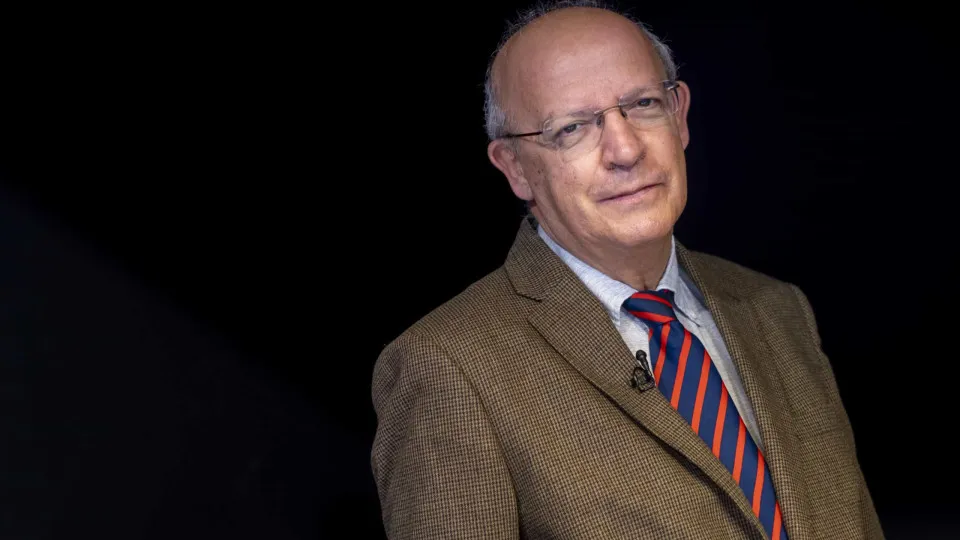
The former President of the Assembly of the Republic Augusto Santos Silva (PS) criticized the Government for being “strunk” in the management of demonstrations for housing and rejected the idea of annual elections.
© Global Images
02/11/2026
by
Lusa
O former president of the Assembly of the Republic Augusto Santos Silva (PS) today considered that the government is “strunk” following the demonstrations for housing, but rejects a scenario in which the country has “elections every year”.
“ Today, we have a completely strung-out Government with regard to this management, a Minister of Internal Administration who has completely lost the north and a Prime Minister who does not lead the Government or respond,” he said today to journalists at the Faculty of Economics and Management of Porto (FEP), after giving his last lesson, entitled “Economy as Social Science (Report of an Learning)”.
Asked whether it is with this government that the PS has to dialogue, he replied that “the PS has to dialogue with the government that is in office”.
“ We have a government in office. I think it's very important that this government continues. Not because he appreciates it too much, but because the country cannot be holding elections every year,” the former Foreign Minister said.
For Augusto Santos Silva, it is necessary that “the government” and “the opposition opposes”, but states that it does not see “the government governing” and that Luís Montenegro is “absent partly uncertain” and “it is difficult to ask him questions”.
Asked about a central block scenario, he said that “it is not on the table”, admitting only that it does not remove it “in the last case, from the philosophical point of view”.
On the police charges that have occurred in recent weeks, the socialist considered that they come from a “clear political orientation”, but if they are “to win votes to the Arrivo”, sees that the parties of the coalition of the Government (AD – PSD and CDS/PP) “will lose”.
The academic also recalled that, as President of the Assembly of the Republic and member of the Government, he saw, “for two years, a tent set up in front of the Assembly itself” without ever “a policeman undoing that tent”.
“I saw, by the way, police and firemen camped in tents for a few days. I saw a young JSD student setting up camp in front of the Ministry of Higher Education. And I saw, to my liking, with the authorities of the country then, the authorities respond with all intelligence, with all wisdom, letting people express themselves, not going there to provoke them, leading to the last of the latter their capacity of tolerance, even of patience, to wait for them to tire”, he recalled.
Asked about the lack of intelligence in the management of the demonstrations, he spoke of “political intelligence”, “wiseness” and “moderation”.
“ It is especially this use of police, because we should not play with certain things. And one of the things that we should not play with is with our security forces ", vincou.
Augusto Santos Silva also considered “absolutely unworthy” that in his city, Porto, “which is the city of freedom, police have infiltrated undercover police armed in the midst of protesters”.
“ I find this unacceptable, unworthy and I don’t even understand why the Minister of the Interior manages to be in his post after having tolerated it,” he stressed, questioning “to what extent” is that “police intervene in the silence of the night,” “wait for television to leave, as they did the first night of the intervention in Porto, to carry on people,” “act as provocatives infiltrate the demonstrations” and “what title the government uses so brutally the police as it is doing.”.
For the sociologist too, what can lead a political decision-maker to make such decisions are “fear” and “uncertainty”.
“ When people react like that, it's a sign that people don't trust them. It's a sign that people are insecure. It's a sign that people feel they have straw tails. It's a sign people want to provoke instead of solve. This is contrary to what a political leader should do, namely in all the portfolios, but in the Internal Administration portfolio, this is particularly necessary”, he said.