
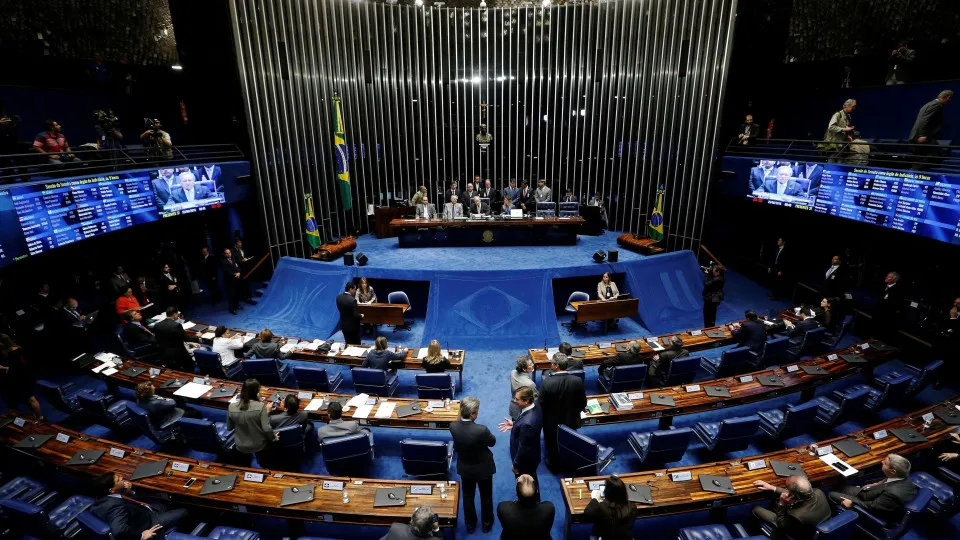
The Brazilian Senate approved today the Proposal for Amendment to the Constitution (PEC) of Public Security, one of the political flags of the Brazilian President, Lula da Silva, which opens the way for the creation of the Ministry of Public Security.
© Reuters
03/11/2026
by
Lusa
O Brazilian federal Senate today approved the Proposal for Amendment to the Constitution (PEC) of Public Security, one of the political flags of Brazilian President Lula da Silva, which paves the way for the creation of the Ministry of Public Security.
The Public Security PEC restructures security in the country with a focus on the integration of police forces and reorganizes the actions of federal entities in the fight against crime, as well as hardening penalties.
The text, which now follows for promulgation, was adopted by 73 votes in favour in the first round and by 75 votes and none against both votes.
The session was hybrid, which allowed Senator Flávio Bolsonaro (PL), who fled to the United States last week, register presence remotely and vote in favor of the PEC.
The approval of the PEC represents a victory for Lula da Silva, who promised that once the text was approved, he would create the Ministry of Public Security, dismembering in two the current Ministry of Justice and Public Security.
The Brazilian Constitution establishes the Unified Public Security System (SUSP), in addition to creating tougher rules for members of criminal factions and militias.
The change also extends the attributions of the Federal Police (PF) and the Federal Highway Police (PRF), in addition to creating mechanisms to increase the financing of public security in the country.
Flag of re-election campaign of Lula da Silva, the PEC came to vote in the last week of the second round of the general elections, but was removed from the agenda by the president of the Senate, David Alcolumbre, after disagreements between the governing base and opposition on the reduction of the majority of criminal responsibility.
During today's vote, the demands of the governing and opposition base dealing with the reduction of the age of criminal liability were withdrawn from the agenda, which allowed the diploma to be approved in two shifts in the same session.
On the eve of the elections, Lula da Silva made signs to the conservative camp and changed his own position by defending the reduction of criminal responsibility to 16 years, but only to the heinous crimes.
The opposition, in turn, advocates the reduction to 14 years for heinous crimes, and to 16 years for minor crimes.
The theme did not come to compose the guidelines of the Public Safety PEC and was used by the opposition at various times to try to obstruct the discussion and voting of the matter.
After agreement between opposition and government, the reduction of criminal responsibility will be discussed at another time by the Brazilian Congress.