
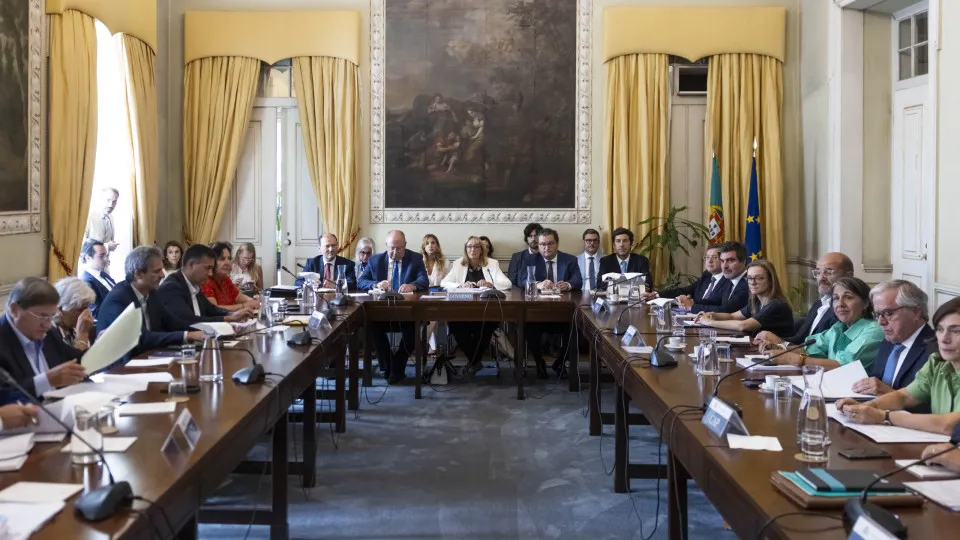
The Government meets with social partners in social consultation, with minimum wage and compensation fund on the agenda.
© Lusa
21/10/2026
by
Lusa
O Government meets today with the social partners in Social Concertation, at a time when the plants advocate a high review of the target for the national minimum wage, while the ‘bosses’ do not see “plausible” reasons for reinforcement.
The official agenda of the meeting indicates that on the agenda is the monitoring of the tripartite wage valuation and economic growth agreement 2025-2028, the Labour Compensation Fund (FCT) and the Labour Compensation Guarantee Fund (FGCT), among other matters.
The meeting will take place at the headquarters of the Economic and Social Council (ESC), in the Palazzo das Laranjeiras, Lisbon, and is scheduled to start at 3:00 p.m.
As usual, it will be chaired by the Minister for Labour, Solidarity and Social Security.
This will be the first social consultation meeting, after the Government has delivered to the Assembly of the Republic the proposed State Budget for 2027 (OE2027).
In the report accompanying the proposal, the executive assumes that “it will raise the minimum wage (RMMG) for the 970 euros”, as provided for in the agreement signed with the UGT and the four business confederations in October 2024, in the headquarters of Social Concertation.
The national minimum wage, which is currently set at EUR 920, is defined by the Government's ordinance after listening to the social partners.
The trade unions have been advocating an increase above the agreed target, arguing in particular that inflation is above expectations.
CGTP argued that the guaranteed minimum remuneration rises to 1,100 euros next year, while the UGT claims to stay above 1,000 euros.
The business confederations, in turn, stated that they do not see “plausible” reasons for moving forward with a strengthening of the existing wage valuation and economic growth agreement, particularly at national minimum wage level, arguing that there are measures that have not yet been complied with.
On the part of the Government, the Minister of Labour has been reiterating that the Government “complys with what it signs in the agreements”, so the 970 euros in 2027 “is what is on the table”, and argued that any change “will have to come from a new agreement” with the approval of three parties: executive, business confederations and union centrals.
The tripartite agreement reviewed the trajectory of the national minimum wage, providing for increases of EUR 50 per year and reaching EUR 1,020 by 2028.
Nevertheless, following the legislative elections of 18 May 2025, in the government program, the executive set a new target to cover the entire legislature, pointing out as an objective that the minimum guaranteed remuneration would reach 1,100 gross per month in 2029.
Another of the topics that can be addressed at today's meeting is the Work Compensation Fund (FCT), whose redemption deadline ends at the end of the year.
The fund was created in 2013, in the time of the ‘troika’ and was financed by companies, through monthly contributions of about 1% of the salary of each worker concerned, with a view to the future payment of part of any compensation for dismissal.
Since May 2023, with the entry into force of the Worthy Work Agenda, companies have ceased to contribute to the FCT and have been able to use the money accumulated in recent years to finance training, support for workers' housing and social equipment, such as day care centers or cafeterias.
Lusa has asked the Ministry of Labour, Solidarity and Social Security to take stock of this fund and is awaiting an answer. According to the ECO in early July, 74% of the funds remain to be raised, so the confederations admit to asking for an extension of the deadline.